Экономическме науки / 8. Математические методы в экономике
H. Yu. Yatsenko,
Ph.D. in Economics
Institute for Economics
and Forecasting, NAS of Ukraine, Kyiv
THE FOURTH INDUSTRIAL
REVOLUTION: POTENTIAL
IMPLICATIONS FOR DEVELOPED ECONOMIES, EMERGING ECONOMIES AND FRONTIER
MARKETS
Nowadays we stand on the verge of another huge technology breakthrough
associated with the Fourth Industrial Revolution which is well-known as
“Industry
It’s worth noting that each industrial revolution can be characterized
by new inventions. Thus, the First Industrial Revolution brought mechanization
of industries. The Second Industrial Revolution is associated with mass
production. The Third Industrial Revolution is related to the transformation of
automation industry. When compared with previous industrial
revolutions, the Fourth is creating a new type of industrial production.
In new type of production, intelligent objects (that are connecting to
the Internet) communicate and interact with each other in favor of the people.
This is related with the concept of “Internet of things” that combines with the
“Internet of Services”. To bring the virtual and physical worlds together
cyber-physical systems are needed. That’s why “Industrie
The urgent of the Fourth Industrial Revolution is obvious. It will
create the basis for economic growth in modern conditions when world economy
appears to be experiencing economic slowdown. At the same time it’s no doubt
that great changes will be seen as the result of the Fourth Industrial
Revolution. And it’s rather interesting to analyze its role in achieving
Sustainable Development Goal 9 and the 2030 Agenda.
First of all, let’s mention the Sustainable Development Goal 9. It’s
known that among these goals are: infrastructure, industrialization and innovation.
As for the 2030 Agenda, it’s mainly connected with creating a world without
poverty, violence, abuse; a world in harmony between different people, between
man and nature.
To analyze the role of the Fourth Industrial Revolution, it’s important
to take into account that it can vary between countries because there are
differences by: geographic location, historical evolution, area, provision of
resources, degree of integration in the global trade, level of economic
development, economic structure, etc. It’s important to analyze the
role of coming Industrial Revolution in detail for developing countries as
these countries are more vulnerable because: their
economies are less diversified, have lower savings rate, and less developed
national financial systems. Besides, those markets are largely open, and the
existing mechanisms that should mitigate the impact of the factors of economic
instability and block their distribution channels, are not enough efficient and
need further development.
So, the importance of classification of countries is obvious. Nowadays,
according to the fast-paced corporate and financial agencies – Financial Times
Stock Exchange (FTSE), Morgan Stanley Capital International (MSCI), Srandard & Poor’s (S&P) – countries may be
classified as Developed, Emerging (Advanced Emerging, Secondary Emerging) and
Frontier. We decided to choose this country classification, because here is a
range of criteria that reflect a country perspective.
To classify 57 countries into homogeneous groups by the characteristics
of determination of an emerging economy, cluster analysis was used. Three versions of clusterization were
considered.
In the first
variant, we proposed the following classification criteria: index of
political instability, GDP per capita, index of ease of doing business,
investment risk, economic growth, global innovation index, and the country’s
area. As a result, we obtained a dendogram, where, by
the above mentioned categories, a group of countries was selected, which are
similar to Ukraine in terms of emerging-market features.
In the second variant, the country’s area was
excluded from the list of criteria. And, after the cluster analysis, we
obtained a dendogram, where, in Ukraine’s group, were
Estonia, Latvia, and Armenia.
In the third variant, the country’s area
was replaced by a synthetic indicator of “effective” area (GDP per 1
sq. km). In this case, the cluster analysis produces a dendogram,
where in Ukraine’s group again are Estonia, Latvia, and Armenia.
From both the theoretical and experimental
study it follows that results are in accordance with the one that obtained by
other scientists. Thus, mainly EU countries, USA, Canada, Japan and etc. form
the first cluster (Developed economies). The second cluster – Emerging
Economies – contains a lot of countries. But what is interesting is that an
association of five major emerging national economies: Brazil, Russia, India,
China and South Africa (BRICS) are among them.
Ukraine may be placed in the group of
countries (Ukraine, Armenia, Estonia, Latvia), where Estonia and Latvia, by
FTSE classification, have characteristics of developed emerging markets
(advanced emerging markets). Overall, based on the results of our cluster
analysis, Ukraine has a potential for formal admission to the relevant group of
countries with emerging economies (e.g., the group of marginal markets (frontier markets)), although the
identified potential in Ukraine will probably fail to realize in the next
future due to the extremely complex conditions primarily caused by the economic
situation of political tension and social unrest in the country and, according
to FTSE, a noticeable lag in the development of the national stock market.
So, let’s start analyzing the potential results of Industry 4.0 for
those groups of countries – Developed, Emerging and Frontier. In a changing
market environment knowledge is the basis for country’s level of development.
Working with knowledge: the improvements or changes to products, technologies
and processes can be made. That’s why, effects of Industry 4.0 on the process
of innovation creation can be viewed in conjunction with the main knowledge
management processes. From Fig. 1 it follows that knowledge management
processes include the creation, utilising,
modification and the elimination of knowledge.
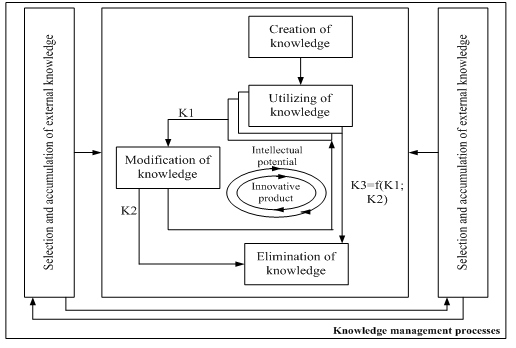
Fig. 1. The main knowledge
management processes
Source: developed by author
The creation of knowledge is a continuous
process of dynamic interaction between explicit and implicit
(tacit) knowledge. Besides, explicit knowledge can be
expressed verbally or can be reflected differently on the document. Resources
of implicit knowledge include intuition,
experience, secrets of skills (talents), wisdom and etc.
The utilizing of knowledge can be determined, firstly, as the access to
the relevant knowledge; secondly, as a process to use this knowledge in
practice.
From Fig. 1 it follows that the modification of knowledge is the
result of
analyzing some subset of knowledge using selected criteria ( ) as changes in the accumulation
of experience and environmental conditions. Among these conditions are: the
emergence of new problem situations;
the industry development tendency; changes in market position in relation to
competitors and etc.
) as changes in the accumulation
of experience and environmental conditions. Among these conditions are: the
emergence of new problem situations;
the industry development tendency; changes in market position in relation to
competitors and etc.
The elimination of knowledge can be described as replacement of existing
knowledge with new knowledge, that ensure the obtaining of more effective,
reliable results that are used in the enterprise. Besides, the necessity to
eliminate the knowledge is defined by the selected criteria ( ,
,  ). Among these criteria are: the discrepancy between the
theoretical, methodological framework of enterprise and the modern conditions
of social and economic development; the obsolescence of professional knowledge,
skills and abilities of employees; conversion or restructuring of the company,
changes to the regulatory framework and etc.
). Among these criteria are: the discrepancy between the
theoretical, methodological framework of enterprise and the modern conditions
of social and economic development; the obsolescence of professional knowledge,
skills and abilities of employees; conversion or restructuring of the company,
changes to the regulatory framework and etc.
Thus, the knowledge can be modified by adding new knowledge to the
amount of accumulated knowledge, changing existing ideas and knowledge,
elimination of obsolete knowledge.
It’s known that existing knowledge is the basis for design the
innovation (good example of transforming knowledge into innovation is the EU
Horizon2020 programme, Creative Europe programme and etc.). In order to maintain competitive
advantage, knowledge management processes should promote innovation strategy
that is a system of actions, aimed at achieving long-term objectives through
coordination, distribution and redistribution of resources between innovative
development paths.
So, on the basis of the following scheme (Fig. 1) it’s possible to
understand the effect of existing knowledge on creation of different types of
innovations. In other words, on the basis of the accumulated knowledge the Fourth
Industrial Revolution with all key innovations and inventions will happen soon
or later.
Penetration of innovations into all areas of industry improves their
performance and creates the conditions for further industrialization. Already
now the main technology (such as: the modern industrial robots, 3D-press,
"smart" products and etc.) are included in the industrial space. They
improve the efficiency level of production by more than a third. At the same
time growth in productivity and incomes require investment in infrastructure
(roads, information and communication technologies etc.). Such investments will
help developing countries to sort out the
problems of: facing difficulties in accessing electricity, lack of access to
water, access to reliable phone services, lack of access to markets, jobs etc.
(United Nations 2016).
It worth mentioning that world competition promotes the emergence of
alternative infrastructure projects. These projects are different in terms of
scale and ambitious. Among them are: Trans-Pacific partnership (TPP), “Economic
zone of the New Silk Road” (OBOR) and Transatlantic Trade and Investment
Partnership. Successful projects determine the countries that will receive a
number of benefits in terms of raising infrastructure finance.
An inevitable consequence of the Fourth Industrial Revolution is
the movement of manufacturing industry towards local markets. As the result,
production is getting closer to the markets, is becoming cleaner, more
environmentally friendly. Flexible smart factory infrastructure would mean a
substantial reduction in energy use. Since then “social and
technological progress occurs in harmony with nature” (United Nations 2015). That is one of the most important goals of
the Sustainable Development Goals of the 2030 Agenda.
However, there's no unanimity
among scientists about the effects of the Fourth Industrial Revolution on the labour market opportunities. As
intelligent systems can perform many of the repetitive, routine production
tasks much more efficiently than humans, so, these tasks can be automated and
millions of people will become unemployed worldwide. These concerns mostly
relate to Secondary Emerging Economies
and Frontier Markets that are characterized by a higher percentage of
low-skilled workers. So, nowadays there is the urgent need in developing
countries to accumulate knowledge and increase the demand for highly qualified
specialists who create new knowledge and new technologies.
As for the 2030 Agenda, the rise in unemployment will contradict with
such Sustainable Development Goals as strengthening
“universal peace in larger freedom”, poverty
reduction and etc. (United Nations 2015).
And now, last but not least, I’d like to say about obstacles which may
prevent the Fourth Industrial Revolution from
making positive changes in people’s lives. Today’s global economy could face
the financial crisis that may lead to declining economic dynamics, volatility
of financial markets, lowering of the standards of living. So, to succeed in
achieving Sustainable Development Goals there is an increasing need for
development and practical implementation of new concepts and methodological
approaches to identify and evaluate dangerous negative trends of economic
development for timely warning of crises. Macroeconomic
Imbalance Procedure of EU
countries and Indicative Guidelines
of G20 countries are the examples of such early warning mechanisms and
guidelines. The same solution can be used by countries that are not part of the G20 and EU.
So, as it follows from the above considerations, the Fourth Industrial
Revolution presents new challenges and opportunities for world industry and
society. But, great efforts should be made by Emerging economies and Frontier
markets in order not to stay on the sidelines of the world and to be
successfully integrated into global value chains.
Literature:
Germany Trade & Invest. (2016). Industrie 4.0. Smart Manufacturing for the Future.
Retrieved from: https://www.gtai.de/GTAI/Content/EN/Invest/_SharedDocs/Downloads/GTAI/Brochures/Industries/industrie4.0-smart-manufacturing-for-the-future-en.pdf
United Nations. (2016). Sustainable Development Goals. 17 Goals to
Transform Our World. Retrieved from: http://www.un.org/sustainabledevelopment/infrastructure-industrialization/
United Nations. (2015). Transforming our World: The 2030 Agenda for Sustainable
Development. Retrieved from https://sustainabledevelopment.un.org/post2015/transformingourworld/publication