Safin R.T. – a senior
lecturer, Almaty University of Power engineering and Telecommunication (Almaty
city, Kazakhstan)
Turzhanova K.M. – candidate
for a master's degree, Almaty University of Power engineering and
Telecommunication (Almaty city, Kazakhstan)
Artyukhin V.V. – a
c.t.s., docent, Almaty University of Power engineering and Telecommunication
(Almaty city, Kazakhstan)
Satimova E.G. – a
c.t.s., docent, Almaty University of Power engineering and Telecommunication
(Almaty city, Kazakhstan)
The
review of methods for determination of Signal/Noise ratio in the video systems
Receiving television (TV) image in
accordance with the requirements of the customer in compliance with the
requirements of SS P 51558-2000 Video security systems. General technical
requirements and test methods "[2] is the ultimate goal in building video
surveillance systems, video surveillance and protection. To this end, it is
important to correctly determine the composition of the equipment throughout
the video. Surveillance System image quality is completely determined by the
characteristics of units, assemblies and elements included in it.
Subjective
method. Subjective method by visual assessment of the quality of television
images according to SS 26320-84, adopted in the television systems with the use
of modern computer technology. As observed object using the standard test
pattern with the main parameters according to SS 14872-82, specially modified
for carrying out the test lenses. Subjective video quality is measured by the
following procedure:
- A video
sequence are selected for use in the test;
- Selected
parameters of the measuring system;
- Select a video
display method and calculation of measurement results;
- Invited the
required number of experts (usually not less than 15);
- Carried out
the test itself;
- Calculated
average based on an expert assessment [1].
Subjective
measurements of varying degrees of difficulty - from statements such as "I
think, well," before formal assessment with the participation of many
observers and under controlled experimental conditions - has long been used to
assess the quality of the video in the development of products, their
assessment of customers, as well as in post-production. A formal subjective
tests involving large numbers of viewers ensures the correct accounting of
features of the human visual system.
Subjective
assessment does not provide that the metric, which is obtained by a purely
objective assessment, but it can give a useful and repeatable results. In other
words, it is possible to develop such image quality ratings that accurately
reflect the perception of the typical viewer.
The
International Telecommunication Union (ITU) developed a standard in the formal
subjective tests of image quality - Recommendation ITU-R BT.500 "Method of
the subjective assessment of the quality of the television picture." This
Recommendation, first published in 1974 (then repeatedly updated), describes a
series of procedures to evaluate the image quality of a person. Each treatment
begins with the selection of participants who do not have to be experts and
check their vision. Under controlled conditions, the participants are browsing
up to 30 minutes of test scenes and evaluation of image quality put up for each
scene.
Recommendation
describes several methods for measuring subjective video quality. Consider some
of them. The method of measurement called the Double Stimulus Impairment Scale
("Scale degradation with two stimuli") is as follows. Reference
members browsing stage (often in the form of 601 video standard), and then -
the same scene after its processing in the system under test. Each participant
evaluates the degradation of the image of the scene after processing a single
number on a scale from 1 - very annoying; 2 - annoying; 3 - slightly annoying;
4 - notably, but not annoying; and 5 - unnoticed. Balls are set to a number of
different scenes.
Another variant
of this method: party evaluates the quality of both scenes in a pair of
"standard-after treatment", without knowing which one is the
reference. Then analyzed the difference estimates for each pair of scenes. In
another group of techniques from Recommendation BT.500 audience is invited to
evaluate the treated test scene, but they did not indicate the reference. In
these techniques, "one stimulus", the same test scene party may be
presented one or more times. It uses a five-point scale, "the degree of
irritation," described above, or 11-point digital scale.
Method Single Stimulus Continuous
Quality Evaluation ("Continuous quality assessment with one
stimulus") provides that the viewer continuously assesses a program
lasting 10-20 minutes, rather than a series of test scenes. Audience ratings
are recorded several times per minute. However, the ratings are based on
viewing the real program, may depend on the evaluation of the content of the
participant of the program, not just the image quality.
Subjective
testing methods can be used to assess a wide variety of types of video
equipment and systems, including video recorders, video capture cards, video
codecs for Web- cameras, as well as industrial complexes. Subjective methods
are suitable for both analog and digital compressed video.
However, the
subjective tests necessary to control many different parameters, including the
selection and testing of participants, as well as ensuring equal conditions for
all viewing audiences. Carrying out tests and analysis of results require time
and costs. And, more importantly, for different studios different results [5]
may happen when evaluating the same equipment.
Instrumental
(oscilloscope) method. For the concept of minimum illumination is used
so-called IRE scale (an abbreviation of the name of Institute of Radio
Engineers). At this scale, the maximum useful video 0.7 is taken as 100 IRE
units. Composite video signal with the standard amplitude 0.3 1B comprises a
clock signal and an image signal 0.7. Different manufacturers specify the
sensitivity for different cameras on a scale IRE values from 20
to 50. With this decrease in the amplitude of the video image quality is
reduced to an acceptable (usable picture).
According to the
ambiguity of the choice of threshold manufacturer photo detectors as a
parameter indicative of the sensitivity, often use other indicators. For
broadcast-standard expansion of this parameter can be output voltage for a
given level of illumination, the type of source, lens speed and noise level.
Another commonly used parameter is the steepness of the lighting
characteristics - output voltage, normalized to the exposure. The dimension of
this characteristic reflects the effect illumination reciprocity law and the
accumulation of time. The output signal is determined by the total number of
photons collected in CCD elements, while the illumination (the number of
photons per second) and the accumulation time may be different.
To determine the
main parameters of the TV system must be sensitive knowledge of video cameras
in the form of minimum acceptable illumination of the CCD, as it is possible to
take into account the luminosity of the lens used in this case, the distance to
the object, its contrast and so on. D. Illumination on E0 object and matrix EM
are related:
 , (1)
, (1)
where k0 - the
reflection coefficient of the object; T - light transmittance lens; m - lens
focal length ratio of the distance to the object; F - the ratio of the focal
length f of the lens to the diameter D of its entrance pupil.
The total
attenuation of the light lens associated with the square of its relative
aperture (aperture F) and transmission coefficient τ. In a number of
guidelines in applied television using a special name for the relationship -
the transmission ratio or transmission ratio. In practice, the lighting on the
object and on the matrix differ by an order of magnitude.
The fundamental
factor limiting the sensitivity is noise having at least two sources: the
quantum noise of light structure and the inherent noise of the camera. In an
ideal television camera its sensitivity depends on the photon noise -
fluctuations in the number of photons with respect to the mean. In view of the
independence of photons in a stream of photons in the light amount of the
expansion element in a particular frame is subject to Poisson statistics. As a
result, the achievable signal to noise photon is proportional to the square
root of the number of photons received from a TV camera observing the object
(here a first approximation the dependence is eliminated from consideration
radiation energy and reflection coefficients for the quantum efficiency of the
wavelength, which are discussed below). The plot in the field of the TV camera
is characterized by reflection coefficients k0 object and background Kf;
ability to accumulate photo detector is determined by the area of
the expansion element, the quantum yield n, averaged over the
length of the wave, and the time savings Tn. For the cameras used in the
composition of PPS, it is also important to set a threshold signal / noise
ratio threshold to provide the desired accuracy of the adoption of decisions by
the observer.
Taking into
account these parameters and formulas (1) allows you to find an expression for
the ultimate sensitivity, i.e. the threshold of illumination of the scene to
the actual situation of detection and identification of low-contrast objects:
 , (2)
, (2)
Where  - potentially
available CCD number of photons per 1 см2 of 1 second with uniform illumination
spectrum and in the visible range of 1 lux.
- potentially
available CCD number of photons per 1 см2 of 1 second with uniform illumination
spectrum and in the visible range of 1 lux.
When a large
difference in the coefficients of reflection of the object and the background
in the numerator of the formula (2) instead of the background of the reflection
coefficient Kf is necessary to substitute half the sum of the coefficients of
reflection of the object and the background.
Managing the
numerical values of the majority of members in the formula (2)
options are either unavailable or can be carried out within a small range.
Thus, the aperture ratio of the best modern spherical lens (F = 0.8 ... 0.75)
is unlikely to be significantly increased in the near future. The quantum yield
of most serial CCD closer to 0.5 in the visible wavelength range and near IK.
The area of element expansion in CCD tends to decrease, and the parameters of
the micro lenses are close to the theoretical limit. Substitution of typical
values of the characteristics of the observed scenes and the CCD
matrix provides an estimate of the maximum sensitivity of the camera in the
real world: Ethr = 0.2 lx worse nameplate data given in the specifications. The
sensitivity of the cameras is not only limited by photon noise, but also a
number of additional factors.
Firstly, there is the scattering of
light in the lens (Figure 1). Part of the light photons incident on the
entrance pupil of the objective, and creates additional diffused background.
This pattern reduces the contrast of the useful object, and introduces an
additional photon noise. Second, the CCD is always inherent noise present.
Reading dark signal, etc. Further, the sensitivity of CCDs is reduced due to
the emission output transistor device. This phenomenon was first observed in
astronomical cooled CCD camera, and was regarded as unique. Since the
sensitivity of CCDs has increased 100-fold, and this effect contributes to the
decrease in sensitivity CCD cameras similar to the scattered light in the lens.
Continuous
growth of the sensitivity of cameras focused the attention of manufacturers and
users in this parameter, relegating to second place is another important
parameter - the signal / noise ratio. However, its role is paramount in
practice, since it is the ratio of signal / noise ratio is determined by the
probability of correct identification of images, the potential resolution and
the number of brightness gradations reproduced in television system. The
meaning of "signal / noise ratio" is based on the measurement of the
ratio of signal amplitude to the rms noise.
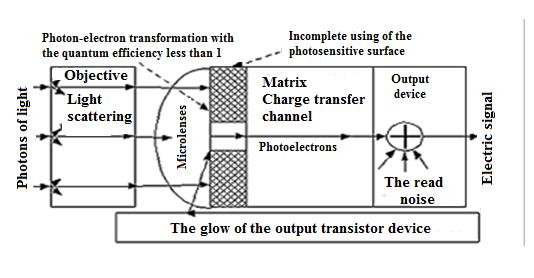
Picture 1. The reasons for limiting the
sensitivity of the camcorder on the CCD
Differences in
the shape of the recording signal / noise ratio associated with the use of
linear or logarithmic scale. Two ways to specify this parameter are related.
 (3)
(3)
Hereby, the mean
amplitude of the signal Us and noise - UN.
That signal to noise at rated video amplitude (0.7 V or 100 IRE) and is
contained in the specifications to the camera. In practice, the measurement of
television oscillographic method peak noise value is determined on the scale
"coring" at the level of black. Typically a Gaussian noise is
considered and to go to the rms value using peak factor equal to 6.
The noise level
of the CCD is accepted to estimate the number of rms noise electrons σ,
which is a standard deviation of each carrier bag charge. Noise CCD have
several independent causes, so that the number of rms noise of the electrons is
determined by the geometrical sum of the CCD components:. 
Photon noise. As
stated previously, this noise is a consequence of the discrete nature of light.
The standard deviation (SD) number of photons from the average value is equal
to the square root of the mean value. For maximum signal RMS photon noise in
the CCD element reaches hundreds electrons. Investigated noise components are
the first cause of restrictions potentially achievable signal / noise ratio. On
the other hand, it is limited to a capacity element CCD matrices which model
interline transfer of approximately 50,000 electrons. Therefore, the TV
cameras, serially produced for the PPS, the maximum S / N ratio at a high
luminance does not exceed 50 dB. S / N ratio is an objective characteristic of
the image related to the subjective assessment of its quality. Expert
evaluation of subjective quality degradation with increasing noise level on a
scale recommended by the International Advisory Committee for the radio (CCIR),
is shown in Table 1.
Table 1. Expert evaluation of
subjective quality degradation with increasing noise level on a scale
recommended by the International Advisory Committee for the radio (CCIR)
|
Un,
мVпри US = 100 IRE |
, dB |
, times |
Quality |
Deterioration |
|
14,0 |
50 |
316 |
Excellent |
Unnoticeable |
|
17,5 |
40 |
100 |
Good |
Noticeable,
but does not interfere |
|
23,0 |
30 |
32 |
Satisfactory |
Slightly
interfere |
|
35,0 |
20 |
10 |
Unsatisfactory |
Interfere |
|
70,0 |
10 |
3 |
Unfit |
Strongly
interfere |
Conclusion:
The main
parameters for camcorder studies are resolution, signal / noise ratio and the
light sensitivity of the camcorder, with a relative aperture F. For competent
installation of video cameras should be considered the focal length, the
format, the value of the dead zone and some others. For the objective control
and various studies video is the most appropriate instrumental method based on
subjective perceptions.
1. Артюхин В. В.. Инструментальное определение
качественных характеристик видеокамер в системах охранного телевидения //
Материалы 6-ой научно-практической конференции. «Актуальные возможности науки –
2010». – Praha. – «Education and Science». – 2010. – с.43÷46.
2. ГОСТ Р 51558-2000. «Системы охранные телевизионные.
Общие технические требования и методы испытаний». – 2001.
Владо Дамьяновски. CCTV. Библия видеонаблюдения. Цифровые и сетевые технологии.
Перевод с англ. – М.: ООО «Ай-Эс-Эс Пресс», 2006, - 480 с: