Agriculture 4.
Technologies of storage and processing of agricultural products
Assoc. Prof. V.Yu. Ovsyannikov, graduate student Yu.S. Kraminova,
student T.S. Kirichenko, student A.S. Moskalenko
Voronezh State
University of Engineering Technologies, Russia
Methods of comparison and evaluation of refrigeration plants
concentration by freezing moisture
At present the
trends of development of the food industry of Russia and developed European
countries are directed toward the creation of food products of new generation,
is most which effectively satisfy the food ration of the wide sector of the
users of the production of food industry [1].
In this case
special accent is removed precisely to the methods of the refrigerators working
of the food raw material of the plant and animal origin, which to the maximum
degree ensure the safety of the initial biological composition of product,
simultaneously braking undesirable biochemical processes and reactions of the
disintegration of substances.
Today one of the
most promising methods of the concentration of liquid food media, that ensures
the maximum biological safety of the parent substances of raw material, is the
method of refrigerators concentration the freezing out method of moisture,
based on the transformation into ice of the part of the liquid component of the
solution with the concentration of the dissolved substances in the liquid
phase.
Technical and
economic comparison of the separate installations of refrigerators
concentration must be accomplished on the basis reduced annual costs. The
comparison of the reduced annual costs for different installations should be
carried out with the identical value of thermal load on the crystallizer –
concentrator and the equal parameters of the concentrated medium (expenditure,
inlet temperature and output).
Besides technical
and economic comparison in a number of cases is of practical interest the
comparison of the separate crystallizer of different types according to the
design indices, such as weight, volume on the overall dimensions, the cost, and
also on thermal efficiency [2, 3].
For the estimation
of thermal efficiency of the crystallizer – of concentrates by the freezing out
method of moisture is used the energy coefficient, which is the ratio of a
quantity of selected heat to the power, spent on the pumping over of the
concentrated medium
 , (1)
, (1)
where Q – a quantity of otvodimoy
heat; τ – the duration of
concentration;  - summary expenditures of energy
for the pumping over of the concentrated medium.
- summary expenditures of energy
for the pumping over of the concentrated medium.
The conditions for
comparison according to the design indices will be following:
а) a quantity of transferred heat for all crystallizer
– of concentrates by the freezing out method of moisture is equal: Q=idem;
б) summary expenditures of energy for overcoming of
resistance with the displacement of the concentrated medium  =idem;
в) thermal efficiency of the crystallizer – of
concentrator by the method of the refrigeratory concentration E=idem;
г) a quantity of concentrated medium and a quantity of
refrigerant are equal Gс=idem; Gх= idem;
д) the identical temperature working conditions: the
mean temperature of the concentrated medium tс= idem; the refrigerant tх= idem; an average
difference in temperatures Δt= idem.
After writing down
the known equation of heat transfer and after carrying heat and the expendable
power to the unit of surface from the equation (1), we will obtain
 , (2)
, (2)
where NF - expenditure of energy for the pumping over of the
concentrated medium, in reference to one square meter of the calculated surface
of the apparatus.
Taking into account
resistance lengthwise, local resistances at the entrance and the output from
flow area of the internal space of crystallizer the energy consumption can be
calculated by the formula:
 , (3)
, (3)
where V – the internal volume of crystallizer;  - summary hydraulic resistance
in the apparatus; F – the surface
area of the heat exchange of crystallizer; η – Efficiency of
apparatus; ω – the rate of flow of the
concentrated medium in the crystallizer; d
– the inside diameter of crystallizer; l
– the length of the working zone of crystallizer.
- summary hydraulic resistance
in the apparatus; F – the surface
area of the heat exchange of crystallizer; η – Efficiency of
apparatus; ω – the rate of flow of the
concentrated medium in the crystallizer; d
– the inside diameter of crystallizer; l
– the length of the working zone of crystallizer.
Taking into account, that
 , (4)
, (4)
we obtain
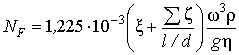 , (5)
, (5)
here ξ – the coefficient of the hydraulic resistance of
medium lengthwise of crystallizer;  - the summary coefficient of local resistances; g – the acceleration of
gravity.
- the summary coefficient of local resistances; g – the acceleration of
gravity.
The comparison of
the dimensional, weight and cost indices of different types of crystallizer for
the refrigerators concentration of the liquid media of food and biological
origin, is as noted earlier, it is necessary to achieve with the identical
values of energy coefficients. Examining the first and second conditions for
comparison for two apparatuses, designated by indices 0 and 1, we obtain with Q0=Q1, NF0=NF1
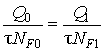 (6)
(6)
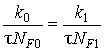 ; E0=E1. (7)
The obtained
expression makes it possible to find the combined values of the power of all
compared crystallizer.
The ratio between
areas of top and bottom wings of the compared crystallizer with the conditions
accepted they will be written down as follows
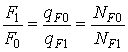 . (8)
. (8)
Relationship of the working
volumes of the crystallizer
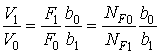 , (9)
, (9)
here b – the coefficient of compactness, which characterizes the
calculated transfer surface, concluded in the unit of the cubic meter of the
space.
Relationship of the weights of
the crystallizer
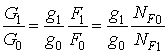 , (10)
here g – the mass of the unit
of useful heat exchange surface.
Relationship of the
costs of the heat exchange surfaces of the crystallizer
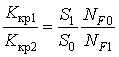 , (11)
где S – the cost of the unit
of the mass of the heat exchange surface.
Literature
1.
Ovsyannikov V.Yu. Study of the process of freezing moisture from the extracts
of the endocrine and special raw material. Diss. cand. tech. the sciences.
Voronezh. State. tech. Acad., 2003. 184 p.
2.
Antipov S.T., Ovsyannikov V.Yu., Kondratyev Ya.I. Kinetics of the process of
concentration by freezing the cherry juice. Herald of the Voronezh state
university of the engineering technologies. 2014, № 4 pp. 44-48.
3. Antipov S.T.,
Dobromirov V.E., Ovsyannikov V.Yu. Heat- and mass exchange with the
concentration of liquid media by freezing. Voronezh. State. tech. Acad.
Voronezh, 2004. 208 p.