Математика/1.Дифференциальные
и интегральные уравнения
Abdrakhmanova G.M.
Karaganda economic
university of Kazpotrebsouz, Kazakhstan
On Jackson- Nikolskii inequalities
in spaces with asymmetric weights Lebesgue
A.A.Markov
In 1889, the famous chemist Mendeleev module works at the request of algebraic
polynomial algebraic polynomial module assessment proved inequality. In 1951 he
inequality for trigonometric polynomial and space (pand q) proved different when S.M. Nikolskii.
Theorema1 (JACKSON- NIKOLSKII INEQUALITIES) Let  and
and  is
trigonometric polynomials of degree n.
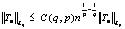
Then we have
is
trigonometric polynomials of degree n.
Then we have
Definition
1 Let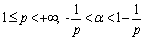 , and for
 periodically metric function
  the following integral
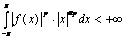 ,
,
now it lies on the spaceand
  is Weights Lebesgue space/
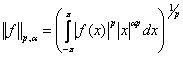
Let () be the
space of p power Lebesgueintegrable functions f on  equipped with the norm
Definition
2 Let 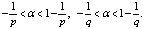 and let
  be
arbitrary numbers
be
arbitrary numbers  . The
following
. The
following
 (1)
(1)
the set of
allffunctions is called asymmetric
weights Lebesgue space. Denote by  . In this
paper the following lemms considered.
. In this
paper the following lemms considered.
Lemma 1 Let
and let be arbitrary numbers . Theasymmetric
weights Lebesgue norm satisfies the conditions:
1.
 almost everywhere in;
2.

3.

For any
positive integer n, let denote the collection of all trigonometric
polynomials of degree n, i.e.,  means that

where is factor trigonometric polynomial.
Set the
following lemma is valid.
the
following lemma is valid.
Lemma 4 Let and
and .The
following estimates hold:
.The
following estimates hold:
a) If , then
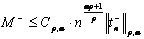 (2)
(2)
b)
If, then
 (3)
(3)
Proof Let the maximum will be at point  .
.  ,
,  valid for
any
valid for
any 
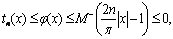

Therefore

Enough to
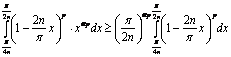
bring it on inequality.To do this, we use the integral properties

If so, then the perfomed
(3) inequality. If
so, then the perfomed
(3) inequality. If  , then
  .
.
 ,
, 
Here will the following inequality 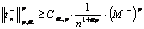 .
.
If  , then
  ,
, 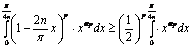 .
.
If , then, 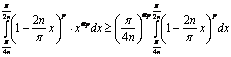 .
.
Here will the following inequality
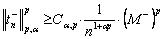 ,
,  .
.
Therefore 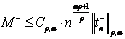 .
.
Set . Then  has zerosand
  . Let be
 the smallest positive zero of the
function . We have
the smallest positive zero of the
function . We have 
Lemma 1 shows that

Therefore

It is enough to convert, to inequality.To do this, we use the properties
of the integral.
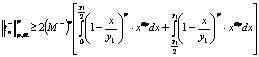
If  , then we
have inequality (4).If
, then we
have inequality (4).If  , then
 .
.
 ,
,  .
.
Consequently 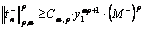 .
.
If , then  . Therefore

If , then

Therefore
The proof is complete.
Affirmation 1 Let  be
arbitrary numbers from . Then we
have
be
arbitrary numbers from . Then we
have
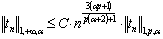 (4)
(4)
Proof It suffices to prove the following inequality.
 (5)
(5)
If , then
  .
.
If,  then
then

The assertion is proved.
Theorem 2 Let
n be a natural number,  and let
  be arbitrary numbers from (1,∞]. Then we
have
be arbitrary numbers from (1,∞]. Then we
have

Here 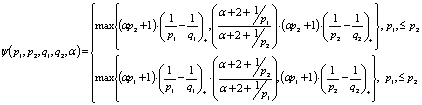 .
.
Proof We considered separately two cases.
(a)
If , then it
follows from lemma 2 that
 (6)
(6)
Under the terms  . Therefore
 (7)
(7)
If  , then
 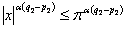 . Therefore
 (8)
(8)
(6)-(8)of
inequalities
 (9)
(9)
If , , then
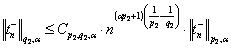 (10)
(10)
(b)
If , then it
follows from lemma 4 that
 (11)
(11)
Under the terms . Therefore
 .
.
Of these inequalities  .
.
According to the formula
 .
(12)
.
(12)
Under the terms  of the
theorem
of the
theorem
 (13)
(13)
If , then . Therefore
 (14)
(14)
(12)-(13)of
inequalities
 (15)
(15)
(6)-(15)of
inequalities, for  , we have
 .
.
References
1.
Бари Н.К. «Обобщение неравенств С.Н.Бернштейна и
А.А.Маркова»//
Изв. АН СССР. Сер. матем., 1954, том 18, выпуск 2, 159–176
2. Никольский С.М. «Приближение функций многих переменнных и
теоремы вложения». М., Наука, 1969. с. 133
3. Стечкин С.Б. «Обобщение некоторых неравенств
С.Н.Бернштейна» //
Докл. АН СССР. 1948. Т.60. №9 с. 1511-1514.
4.
Козко
А.И. «Аналоги неравенств Джексона-Никольского для тригонометрических полиномов
в пространствах с несимметричной нормой» //Матем. заметки, 1997, том 61, №5, С.687 – 689.