Filatov V.O., Dr.Sci., Prof., Chala O. S.
Kharkiv National University of Radio
Electronics
APPROACH TO THE KNOWLEDGE
REPRESENTATION OF DISCRETE-EVENT PROCESSES
Discrete-event
processes include sequences of actions that change at discrete instants of time
when certain events occur. Each event occurs as result of influence of external
factors or process actions. Knowledge workers change the process when events
occur. They use their experience to choose a rational sequence of actions to
complete the task.
Existing
approaches to the description of the processes include a set of action
sequences. They have a number of drawbacks/
1) Depending
on the events that occurred, the sequence of actions may change. However, only
the basic workflows are usually included in the process model.
2) Actions
consist of elementary operations that can affect its result. This means that
the process model consists of several levels. However, usually only one level
is considered.
3) The
influence of the executors of the process on the sequence of its implementation
is not considered. However, performers can change the process based on their
experience and their goals [1].
The
problem of changing the sequence of actions is as follows. With the existing
approaches to constructing the process model, the actions that must be
performed to achieve the process goal are usually specified at the stage of the
description building. As a result, the change in the description of the process
after the introduction of the model is fraught with considerable difficulties.
In other words, the traditional model defines the actions to be taken during
the implementation of the process, but does not provide an opportunity to
determine the actions that can be performed to achieve the process goal.
The
problem of insufficient detailing of actions in the model is due to the fact
that in practice the actions of performers are generalized in the model. Each
action is treated as a separate complex procedure. The performance of the
process is affected by the result of the action, and not the details of its
implementation. At the same time, each performer performs work at a much more
detailed level of individual operations. And these operations can influence the
result of the action as a whole.
The
problem of incompleteness of information in the process model is due to the
fact that part of the context data in the process model construction is simply
implied and not considered. However, these contextual data are often used by
executors to modify the process [2,3].
If uncontrollable
external disturbances occur during the execution of a discrete-event process,
then the state of the data necessary for performing operations and actions
changes. This requires the adaptation of the structure of the process. Such an
adaptation is performed on the basis of knowledge of the interrelations between
the context and the actions of the process. Thus, the development of a
knowledge representation for the actions of the process is topical.
The
proposed approach is based on the integration of the model of such processes
with the knowledge graph. The knowledge graph is based on the same ideas as
semantic networks. It connects entities and their properties through a set of
relationships. The knowledge graph is used for
knowledge representation, storage and reasoning [4]. But usually the knowledge
graph contains static knowledge that does not reflect the dynamic processes in
which the actions are performed in time.
It is
suggested to consider the actions of the process as the entities. These actions
have temporal and spatial properties, as shown in Figure.
The proposed approach allows us to
adapt the process model using the knowledge graph.
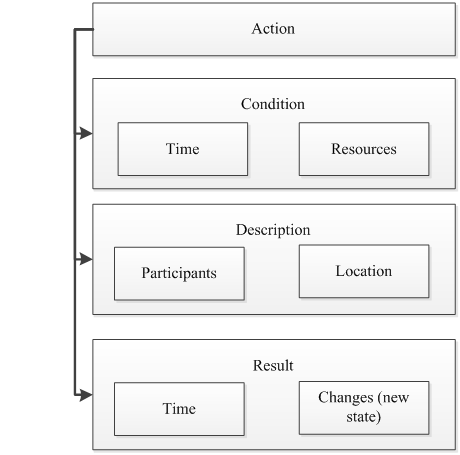
Figure –
Action structure
References:
1. Gronau, N. (2012). Modeling and Analyzing knowledge
intensive business processes with KMDL: Comprehensive insights into theory and
practice (English). Gito, 522.
2. Brockmann E. N., Anthony W. P., (1998): The Influence of Tacit
Knowledge and Collective Mind on Strategic Planning, Journal of Managerial
Issues, X, 2, 204-222.
3. Polanyi, M. (1958) Personal Knowledge: Towards a
Post-Critical Philosophy. University of Chicago Press, 493.
4. Pan, J.Z. Exploiting Linked Data and Knowledge Graphs
in Large Organisations / J.Z. Pan, G. Vetere, J.M. Gomez-Perez, H. Wu, . – Springer, 2017. – 266
p.