ФИЗИКА/ 5. Геофизика
D.Sc. Khristoforov B.D.1, D.Sc. Khristoforov O.B.2, Ph.D. Chertovskikh O.O.3
Institute
of Geosphere Dynamics of RAS 1, Russian Federation;
Troitsk Institute for Innovation and Fusion Research 2, Russian
Federation;
Moscow State Institute of International Relations 3, Russian
Federation
Investigation of pulse action, simulated by laser
irradiation on operation of aircraft engines
INTRODUCTION.
At present time powerful pulsed lasers have found application in a number of
state-of-the-art industrial technologies, methods of modeling and research of
the processes of interaction of radiation with matter. The development of the
most powerful pulsed laser systems is aimed at studying extreme states of
matter, as well as their application in military sphere and solving the
problems of Inertial confinement fusion.
High volume
chip manufacturing based on the use of UV excimer lasers pumped
by electric discharge is one of the most widely applied
nanotechnologies nowadays. The most powerful and high-energy lasers of this
type are pumped by a volume discharge in combination with an auxiliary surface
discharge [1-8]. The next generation lithography technology supporting extreme
ultraviolet (EUV) volume chip production at the 7 and 5 nm nodes uses 13.5 nm EUV
light generated by tin-plasma produced by a high-power high- repetition rate CO2-
laser system. At the same time, for the inspection of nanostructures there can
be used high-brightness EUV- light sources based on both laser-produced and
discharge-produced plasma [9-15].
Laser eye-microsurgery,
laser lithotripsy and laser treatment of benign prostatic hyperplasia are
regarded as the most socially significant application of pulsed lasers.
The
important applications of high-power high- repetition rate lasers are laser
annealing [16], including the low-temperature annealing of polycrystalline
silicon for the volume production of flat panel color displays, fabrication of
high-quality thin films of high-temperature superconductors by pulsed laser
deposition, the laser chemistry’ synthesis and laser marking [17-19], laser
drilling which is used in the aerospace industry, remote sensing of the
atmosphere, terrestrial surfaces and water bodies [20-22].
With the advent of short and ultrashort
laser pulses, there has been a growing interest in the applications of
femtosecond and picosecond lasers for laser surgery as well as for such
applications as laser ablation of metals in liquids, laser surface
modification, including photovoltaic and laser impact hardening of the surface.
The
results of the research [23] have proved the possibility of using high-power
laser radiation to simulate a lightning strike. In this paper presented are the
results of the study of the effect of thunderstorm and other impulse actions of
a natural and technogenic nature on the operation of turbojet engines of
aircraft. The study was carried out on the basis of the results obtained by one
of the authors of the present research, B.D. Khristoforov, while simulating the
above mentioned effects by pulsed laser irradiation of air intakes of aircraft
[24-26]. To calculate the parameters of impulse actions in the given research
there have partially been used the methods of mathematical modeling developed
to describe a wide range of explosive processes of natural and technogenic
character in various environments: in water, soil, at the surface of the earth,
in the atmosphere, at high altitudes, at the surface of stars, in pulsed
nuclear reactors, etc. [27-39]. The English version of this work assumes its use by the author of the
works [40-42] as a textbook.
MATERIALS AND METHODS. For modeling, were
used lasers at a wavelength of 1.315 μm with explosive
pumping. In addition, a comparison was made between the action of pulsed lasers
on aircraft engines with the action of electrical discharges and the action of
explosives in the air. As aircrafts, used in experiments to simulate lightning and
other actions on the air intake of an airplane, there were used aground MIG-23
and MIG-21 aircrafts with their turbo-jet engines being on, Fig. 1. In the
experiments a laser beam or a discharge-produced plasma affected the surface of
the cone at the entrance to the air intake.
The output energy of laser and electrical discharge
ranged from 10 to 49 kJ. To generate a discharge-produced plasma at the
entrance to the air intake, there was applied an electric explosion of a flat
conductor made from a metal foil or a surface discharge, the physics and
technique of which are presented in Refs [43-47]. There was used a battery of
capacitors with a capacity of up to 13,000 μF, with a voltage
of up to 5 kV, with an energy reserve of up to 160 kJ. For the explosions there
were used charges of explosives initiated at the center with explosive heat Q =
4.8 MJ/kg, density of about 1600 kg/m3 with a mass up to 0.02 kg.
During the laser irradiation or electric discharge or explosion the high-speed
cameras recorded from different directions and at different frequencies an
explosion cloud or an emerging plasma plume. The shadow method allowed to
record the front of the shock wave.

Fig.
1. The scheme of the experiment: 1, 2 - the first and second aircrafts, 3- the
location of the impulse action, 4- the external blowing with the help of the
jet engine stream of the second aircraft.
Simulation
of lightning and other actions on the operation of a turbojet engine of an
aircraft flying at low altitudes and subsonic speeds were also carried out with
its counterflow at speeds of up to 500 km/h from the jet of another aircraft.
THE
RESULTS OF THE STUDY. In Table 1 there presented the typical results of
measurements at electrical discharge and irradiation on the cone of the aircraft
10 cm from the inlet to the air intake after the energy release, where E is the
total energy of plasma, Ed
is the energy in the discharge taking into account the combustion of the
initiator of the discharge, m1 is
the mass of the electrically exploding conductor made from the metal foil, h
and V1 - is the lift height and the
flare volume at the barrier to the end of the energy release, T - is the
brightness temperature of the plasma in IR spectral region.
Table 1. Parameters
of discharge-and laser-produced plasma on the engine air inlet of aircraft.
|
|
Discharge-produced plasma |
Laser-produced plasma |
||||||
|
E, kJ |
35 |
27 |
19 |
14 |
23 |
19,5 |
18 |
30 |
|
Ed, kJ |
31 |
22,7 |
15 |
10,4 |
- |
- |
- |
- |
|
m1 , г |
0,14 |
0,14 |
0,14 |
0,14 |
- |
- |
- |
- |
|
h, cm |
21 |
18 |
14 |
11,5 |
- |
- |
11,5 |
21 |
|
V1, l |
52 |
42 |
26 |
20 |
31 |
29 |
- |
- |
|
T, kK |
27,5 |
21 |
22 |
21 |
- |
23 |
- |
32 |
Methods of simulating the action of
lightning on aircraft engines allowed calibrate antisurge system and estimate
the minimum required plasma energy to defeat the aircraft of the MiG- 21, 23
type.
The carried out aground research showed
that the drift of laser-produced plasma or discharged- produced plasma and
explosive plasma into the air intake of an aircraft can lead to the loss of
gas-dynamical stability of the operation of the turbojet engine, the transition
to surging and the termination of work, Fig. 2.
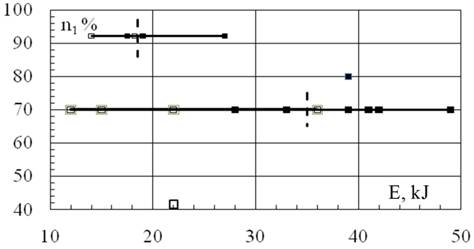
Fig.
2. The diagram characterizing the energy boundaries (vertical dashed lines) for
the disruption of operation of a turbojet engine at different engine operating
frequencies n%. Dark and light squares correspondently indicate the violation
of the gas-dynamic stability of the engine and its absence.
In
the conditions of the experiments anti-surge systems usually did not have time
to restore the work of engine. As it could be seen from the dependences of Fig.
2, with an increase in n% - the engine operating frequency which determines the
engine blowdown speed, the energy of the heated gas which is necessary to
disrupt its gas-dynamic stability reduces. Thus, for n = 93%, the energy
consumption for plasma formation, the tightening of which in the air intake
leads to a violation of the gas-dynamical stability of the engine, was less
than 19 kJ. Disruption in the operation of the turbojet engine, which occurred
after passing through it a shock wave and a region of heated gas, was of a
probabilistic nature and depended on the energy or volume of the plasma and on the
engine speed. The engine failure was accompanied by the ejection of heated gas
from the air intake, which was recorded by heat sensors after passing the heated
gas area through compressor, and from the jet, which was recorded by the
cameras.
CONCLUSION. There were studied the parameters of shock waves with the
affect on the surface of the laser radiation and electric discharges with
energies characteristic for lightning and below this level, and there were
determined their trotyl equivalents. There was studied the influence of external
blowing on the parameters of shock waves with the velocities of up to 500 km /
h, simulating a storm or an airplane flight at low altitudes.
There were also defined energy levels
necessary to violate the gas dynamical stability of aircraft engines under
different operating conditions at low altitudes and subsonic speeds. The
obtained results, in particular, suggest that the crash of IL-76 during aerial firefighting
in the Irkutsk region in 2016 [48] can be associated with the violation of the
gas-dynamical stability of engines and the loss of maneuverability of the
aircraft in hilly terrain with the ingress of combustion products into the air
intakes after the discharge of water into the mountains from the height of less
than 100 m.
Referencies:
1.
Baranov
V.Yu., Borisov V.M., Davidovskii A.M., Khristoforov O.B. Use of a discharge
over a dielectric surface for preionization in excimer lasers. Quantum
Electronics. 1981. V. 11. № 1. P. 42.
2.
Baranov
V. Yu., Borisov V. M., Molchanov D. N, Novikov V. P., Khristoforov O. B.
Wide-aperture electric-discharge XeCl laser with ultraviolet preionization and
20-J output energy. Quantum Electronics. 1987. V. 17. P. 978.
3.
Baranov
V.Yu., Borisov V.M., Molchanov D.N., Novikov V.P., Khristoforov O.B. A
wide-aperture UV-preionized XeCl laser with the emission energy of 20 J.
Quantum Electronics. 1987. V. 14. P. 1542.
4.
Borisov
V.M., Khristoforov O.B., Kirukhin Yu.B., et al. The kilowatt range high
repetition rate excimer lasers // Progress in Biomedical Optics and Imaging.
1991. V. 1503. P. 40.
5.
Borisov
V., Khristoforov O., Kirykhin Yu., et al. Prospects for high power, high
repetition rate industrial excimer lasers. Proceedings of SPIE - The
International Society for Optical Engineering XIII International Symposium on
Gas Flow and Chemical Lasers. Editors: A. Lapucci, M. Ciofini. Florence, 2001.
P. 348-352.
6.
Borisov
V. M., El'tsov A. V., Khristoforov O. B. High-power, highly stable KrF laser
with a 4-kHz pulse repetition rate. Quantum Electronics. 2015. V. 45. № 8. P.
691-696.
7.
Borisov
V. M., Demin A. I., Khristoforov O. B. Prototype of a high-power, high-energy
industrial XeCl laser. Quantum Electronics. 2015. V. 45. № 3. P. 200-203.
8.
Borisov
V.M., Demin A.I., Khristoforov O.B. et al. High-average-power excimer lasers.
Proceedings of SPIE - The International Society for Optical Engineering Сер.
"XII International Symposium on Gas Flow and Chemical Lasers and
High-Power Laser Conference" 1998. P. 56-66.
9.
Schriever
G., Stamm U., Gäbel K., Darscht M., Borisov V., Khristoforov O.,
Vinokhodov A. High power EUV sources based on gas discharge plasmas and laser
produced plasmas. Microelectronic Engineering. 2002. V. 61-62. P. 83-88.
10. Borisov V.M., Vinokhodov A.Yu., Ivanov A.S., Kiryukhin
Yu.B., Mironov S.V., Mishchenko V.A., Prokof'ev A.V., Khristoforov O.B. Р
High-power gas-discharge EUV source. Plasma Physics Reports. 2002. V. 28. № 10.
P. 877-881.
11. Borisov V.M., Demin A.I., Eltsov A.V., Ivanov A.S.,
Khristoforov O.B., et. Al. Xenon and tin pinch discharge sources. In book: EUV
Sources for Lithography. 2006. P. 477-504.
12. Borisov V.M., Vinokhodov A.Yu., Ivanov A.S., Kiryukhin
Y.B., Mishchenko V.A., ProkofEv A.V., Khristoforov O.B. Laser-induced extreme
UV radiation sources for manufacturing next-generation integrated circuits.
Quantum Electronics. 2009. V. 39. № 10. P. 967-972.
13. Борисов
В.М., Борисова Г.Н., Виноходов А.Ю., Захаров С.В., Иванов А.С., Кирюхин Ю.Б.,
Мищенко В.А., Прокофьев А.В., Христофоров О.Б. Мощный источник света в
экстремальном УФ диапазоне (13.5 нм) // Квантовая электроника. 2010. Т. 40. №
8. С. 720-726.
14. Borisov V.M., Koshelev K.N., Prokofiev A.V., Khadzhiyskiy F.Yu.,
Khristoforov O.B. EUV light source with high brightness at 13.5 nm. Quantum
Electronics. 2014. V. 44. № 11. P. 1077-1082.
15. Борисов
В.М., Кузьменко В.А., Христофоров О.Б. Импульсно-периодический источник
высокотемпературной плазмы и коротковолнового излучения для технологических
применений // Инженерная физика. 2014. № 4. С. 34-43.
16. Limanov A.B., Chubarenko V.A., Borisov V.M.,
Vinokhodov A.Yu., Demin A.I., Khristoforov O.B., El'tsov A.V., Kiryukhin Yu.B.
The study of silicon films obtained by sequential lateral solidification by
means of a 3-kHz excimer laser with a sheet like beam. Russian
Microelectronics. 1999. V. 28. No 1. P. 25-33.
17. Borisov V M,
Gordon E.B., Khristoforov O.B., Matyushenko V.I. Chemical HF laser initiated by
an excimer XeCl laser. Quantum Electronics. 1982. V. 12. №2. P. 256-258
18. Маклаков В., Христофоров О., Мошников А.
Селективная модификация материалов неразрушающим потоком высокоэнергетичных
фотонов // Наноиндустрия. 2011. № 5 (29). С. 66-70.
19. Ershov
Y.A., Maklakov V.V., Khristoforov O.B. Photochemical technology of the
formation of polymer materials’ nanomarkers. Theoretical Foundations of
Chemical Engineering. 2016. V. 50. No 1. P. 76-82.
20. Barenboim G., Saveka A., Avandeeva O., Borisov V.,
Khristoforov O., Stepanovskaya I. Development of a system for the early detection
and monitoring of oil spills on water bodies with a glance to its use in the
Arctic zone. Proceedings of the 36th AMOP Technical Seminar on Environmental
Contamination and Response 2013. P. 565-590.
21. Avandeeva O.P., Barenboim G.M., Borisov V.M., Saveka
A.Y., Khristoforov O.B., Stepanovskaya I.A. A toxicity estimation system for
individual hydrocarbons in the monitoring loop of emergency oil spills on water
bodies. Automation and Remote Control. V. 75. № 11. P. 2023-2033.
22. Авандеева О.П., Баренбойм Г.М., Борисов В.М.,
Савека А.Ю., Степановская И.А., Христофоров О.Б. Система раннего обнаружения и
мониторинга аварийных разливов нефти на водных объектах арктической зоны // Инженерная экология.
2013. № 6. С. 30-47.
23. Khristoforov B.D. Modeling gas-dynamic processes in
thunderstorms by powerful electric discharges. Combustion, Explosion, and Shock
Waves. 2010. V. 46. № 1. P. 11-15.
24. Khristoforov
B.D., Khristoforov O.B. Chertovskikh O.O. Study of pulsed impacts on the
operation of aircraft engines. News of science and education. 2017. V. 8. № 2.
P. 022-026.
25. Христофоров
Б.Д., Христофоров О.Б., Чертовских О.О. Исследование импульсных воздействий на
работу авиационных двигателей // Академический журнал Западной Сибири. 2017. Т.
13. № 1. С. 55-56.
26. Христофоров
Б.Д., Христофоров О.Б., Чертовских О.О. Исследование импульсных воздействий,
моделируемых лазерным облучением, на работу авиационных двигателей //
Авиакосмическое приборостроение. 2017. № 9. С. 28-38.
27. Христофоров
Б.Д. Моделирование параметров молнии и грома мощным электрическим разрядом и
излучением // Академический журнал Западной Сибири. 2013. Т. 9. № 5 (48). С. 118-122.
28. Христофоров
Б.Д. Исследование удара разогнанных взрывом порошков и игл // Инженерная
физика. 2014. № 7. С. 47-57.
29. Belinsky I.V., Khristoforov B.D. Viscosity of NaCl
under shock compression. Journal of Applied Mechanics and Technical Physics.
1968. V. 9. № 1. P. 150.
30. Христофоров
Б.Д., Широкова Э.А. Параметры ударной волны при подводном взрыве шнурового
заряда // Прикладная механика и техническая физика. 1962. № 5. С. 147.
31. Adushkin V.V., Khristoforov B.D. Craters of
large-scale surface explosions. Combustion, Explosion, and Shock Waves. 2004.
V. 40. № 6. P. 674-678.
32. Khristoforov B.D. Parameters of radiative and
gas-dynamic processes in air, near-ground, and ground explosions of charges
with a mass up to 1000 tons. Combustion, Explosion, and Shock Waves. 2014. V. 50. № 1. P. 97-104.
33. Khristoforov B. Investigation of shock wave parameters
at explosives blasts in the tubes with air. Universal Journal of Engineering
Science. 2013. № 1 P. 28-33.
34. Христофоров
Б.Д. Исследование ргд характеристик приземных и высотных взрывов ВВ //
Инженерная физика. 2017. № 7.
С. 35-42.
35. Христофоров
Б.Д. Моделирование взрывных процессов при вспышках у поверхности солнца //
Инженерная физика. 2015. № 10.
С. 57-62.
36. Solovev V.O., Khristoforov B.D. Simulation of the
effect of x-rays on the cellular structure of the chamber walls of a nuclear
power facility. Atomic Energy. 2008. V. 105. № 1. P. 42-49.
37. Соловьёв
В.О., Христофоров Б.Д. Разработка методов моделирования действия мощного
излучения на стенки камеры реактора импульсных ядерных энергетических установок
// Проблемы машиностроения и автоматизации. 2008. № 3. С. 56-61.
38. Соловьёв
В.О., Христофоров Б.Д. Моделирование механического воздействия импульсного
рентгеновского излучения на стенки камер ядерных реакторов // Проблемы
машиностроения и автоматизации. 2007.
№ 4. С. 72-76.
39. Solovev V.O., Khristoforov B.D. Modeling the action of
x-ray radiation on the walls of explosion chambers of pulsed nuclear power
plants. Combustion, Explosion, and Shock Waves. 2008. V. 44. № 5. P. 601-606.
40. Чертовских
О.О.Британский университет: методы, формы и содержание учебного процесса //
Человеческий капитал. 2015. № 8 (80). С. 15-20.
41. Пичкова
Л.С., Чертовских О.О. Гендерный фактор в обучении межкультурной коммуникации //
Человеческий капитал. 2016.
№ 12 (96). С. 59-62.
42. Чертовских
О.О. Значение исследования историко-культурных особенностей университетов
Великобритании в условиях академической мобильности студентов и преподавателей.
В сборнике: Актуальные вопросы подготовки специалистов международного профиля:
смена парадигм. 2014. С.
163-171.
43. Баранов
В.Ю., Борисов В.М., Высикайло Ф.И., Христофоров О.Б. Исследование условий
формирования однородного сильноточного скользящего разряда // Теплофизика
высоких температур. 1984. Т. 22. № 4. С. 661-665.
44. Borisov V.M.,
Davidovskii A.M., Khristoforov O.B. Experimental investigation of the
characteristics of a planar surface discharge. Quantum Electronics. 1982. V.12.
No 11. P. 1403-1407.
45. Борисов
В.М., Высикайло Ф.И., Кирюхин Ю.Б., Христофоров О.Б. // Квантовая электроника.
1983. Т. 10. № 10. С. 2110 -2112
46. Борисов
В.М., Высикайло Ф.И., Христофоров О.Б. Исследование однородного сильноточного
скользящего разряда // ТВТ. 1983. Т. 27. № 9. С. 844-851.
47. Borisov V.M., Vysika'ilo F.I., Kiryukhin Y.B.,
Khristoforov O.B. Pulse-periodic surface discharge. Quantum Electronics. 1983.
V. 13. P. 1408.
48. "Russian IL-76 plane with 10 on board disappears while
putting out forest fire in Siberia". RT com. Retrieved 25 July 2016. URL: https://www.rt.com/news/349088-firefighter-plane-lost-siberia/