Технические
науки/4. Транспорт
UDC
656.022
Cuzmina
T. V., Graduate Student,
Odessa
National Maritime University, Ukraine
Malaksiano N. A., PhD, Associate
Professor,
Odessa
National Maritime University, Ukraine
SELECTION
OF EFFICIENTCY BASED SPEED OF SHIP'S OPERATION
The crisis of
recent years had a big impact on the economic situation in the world. To a
large extent it affected the marine industry as well. The fluctuation of energy
prices, the decrease of the production volume and the instability of the demand
for maritime transport services caused the increasing of competition in the
maritime market. Shipping companies had to adapt to the conditions of the
market, which was changing rapidly. Considering the circumstances, the
regulation of costs and control over them became particularly important for the
shipping companies. To remain competitive in the market, most shipping
companies grew more active in introducing measures to reduce fuel costs. As
fuel costs directly dependent on the speed of the vessel, the practice of
operating ships at reduced speeds has recently been extended. Therefore,
nowadays, the study of the problem of choosing the economically justified ship
speed has become especially relevant.
It is necessary
to distinguish between the optimal speed and the economically justified speed,
since the concept of the optimal ship speed assumes a set of requirements for
preventing collisions, hydro meteorological factors and economic
considerations. In this paper, we will examine only the last factor.
Each shipping company used to carry out the separate
partial researches in this direction and, as a rule, the received results were
not widely disclosed and also were not systematized enough. But taking into account,
practical importance of this problem, more and more studies devoted to this
issue have appeared in scientific publications recently. The ecological aspect
of the decrease in the vessel speed can’t be denied as well. According to a new
investigation of the International Maritime Organization (IMO) [1], gas
emissions from containerships, bulk carriers and tankers could be essentially
minimized by reducing the speed. In June/July of 2017, about 3.5% of the
container fleet, about 1%, of the dry bulk fleet and about 2.5% of the oil
(crude & product) tanker fleet had been laid-up or idle [2]. Requiring
ships to slow down to such an extent that the idle and laid-up ships would be drawn back into ?????? the
fleet would reduce emissions immediately by 4%. Further speed reductions of
20-30% would put shipping emissions on a declining pathway, thus contributing
to reaching the goals of the Paris Agreement.
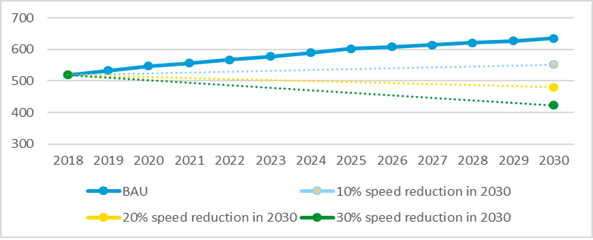
Figure 1 - Impact of speed reductions on
maritime emissions in 2030 [2].
The results of the study show that the amount of average
annual savings for the period of 2018-2030 constitutes about 75 million tons,
140 million tons and 190 million tons depending on the reduction in speed
(Table 1), which is 4.7 %, 8.8 % and 12.0 %t respectively of total fuel
consumption.
Table
1. Average annual CO2
emission savings in the period 2018-2030 [1].
|
10%
speed reduction |
20%
speed reduction |
30%
speed reduction |
|
|
Container fleet |
34 |
62 |
85 |
|
Dry bulk fleet |
32 |
59 |
83 |
|
Crude & product tanker
fleet |
10 |
19 |
25 |
|
Total |
76 |
140 |
193 |
IMO representatives are going to demonstrate the results of the
experiment at the next conference on developing a strategy for reducing gas
emissions in 2018 in London [3].
It is clear that
a decrease in the ship speed allows to save fuel and, consequently, to reduce
the cost of cargo transportation. But, on the other hand, substantial slowdown may
be unacceptable for the cargo owner. To investigate this problem, we introduced
methodology, based on the multicriteria estimates. This
approach allowed us to choose economically justified level of vessels speed, making
allowance for the time of cargo transportation.
References:
1.
Speed regulations for carbon crackdown, News [http://www.motorship.com];
2.
Jasper
Faber Regulating speed: a short-term measure to reduce maritime GHG emissions /
Jasper Faber Thomas Huigen Dagmar Nelissen
: CE Delft, 2017. – 34 p.;
3.
Imo
proposes to reduce the speed of vessels to reduce emissions, News [http://mtelegraph.com/].