Elina Khobotova
ELEMENTAL COMPOSITION OF
ASH-SLAG WASTES OF SLOVIANSKA
THERMAL POWER PLANT
The low-waste technologies stimulate the use of industrial wastes in
various branches of industry. Blast-furnace slag has the properties
of effective broken slag, іt can be used for manufacturing various types of cement.
Wastes of the power engineering industry are fuel ash
and slag. Ashes from TPP carry-over are widely used for manufacturing cement
and various types of concrete, for manufacturing bricks and light porous fillers, as well as in road building. However, at the
majority of TPP ashes and slag are removed hydraulically. Thus, the ash-slag
being inhomogeneous by its structure and properties gets into dumps and that
complicates its further use.
The conclusion about the use of ash and slag for some
definite purposes can be made only after preliminary determination of their
elemental, chemical, mineral composition and granularity.
Identification of the class of ash-slag wastes
radiation safety is also of great importance. Ashes and slag are the components
of the technogenically changed radiation background.
Their uncontrollable application in the manufacturing of building materials can
increase the gamma radiation intensity, external irradiation doses due to electromagnetic
radiation, and the internal irradiation doses while inhaling radon isotopes.
The aim of research was to make a conclusion that ash and slag wastes of Slovianska TTP could be used in construction based on
determination of their elemental and chemical composition.
Research of the ash-slag wastes composition. Distribution
of ash-slag samples by granulometric fractions was
carried out by means of sieve sets. The granularity of ashes varies widely.
More often ashes of hydro dumps have a polydisperse
composition with predomination of small fractions. The maximum size of ash
particles is
The results
of the gamma-spectrometric research of ash-slag wastes.
Gamma-spectrometric analysis was performed on the scintillation gamma
spectrometer SEG-001 "AKP-S" which measures the range of energy of
gamma radiation from 50 to 3000 keV. The time of
measuring activity of natural radionuclides makes up
4 hours on average. To process the results of measurement program Akwin is used. The results of gamma-spectrometric analysis
of ash-slag wastes have shown that their fractions include 40К and
two representatives of radioactive families 226Ra and 232Th
(Table 1). The isotope 40К share is the biggest in the total
activity (more than 80 %). Efficient specific activity (Cef) of slag fractions does not
practically change as well as the content
of
particular radionuclides in it. Hence, there can not
be a restriction in the use of particular granulometric
fractions in construction. According to Cef values of ash-slag and its particular
fractions, they refer to the first class of radiation safety at the value of Cеf 370 Bq/kg. Such materials can be used in construction without
restriction.
370 Bq/kg. Such materials can be used in construction without
restriction.
Table 1 − The results of gamma-spectrometric
analysis of fractions of ash-slag wastes from the Slovianska
TTP
|
Fraction, mm |
Сеf., Bq/kg |
Сsum., Bq/kg |
Сі, Bq/kg (% content) |
||
|
40К |
226Ra |
232Th |
|||
|
<5 |
237 |
897 |
745 (83 %) |
83.4 (9.3 %) |
68.6 (7.6 %) |
|
5-10 |
269 |
984 |
807 (82 %) |
104
(10.6 %) |
72.9 (7.4 %) |
|
>10 |
264 |
966 |
792 (82 %) |
100
(10.4 %) |
73.5 (7.6 %) |
The results
of electron probe microanalysis of ash-slag fractions. Electron microprobe analysis (EMPA) is carried out by
the scanning electron microscope JSM-6390 LV INCA with the system of INCA
x-ray microanalysis. The x-ray microanalysis gives an idea
about the elemental composition of fractions. The fraction <
Table 2 − The results of the
electron microprobe analysis of fractions of the Slovianska
TTP ash-slag wastes (mass part)
|
Element |
Fraction, mm |
||
|
<5 |
5-10 |
10-20 |
|
|
C |
28.92 |
0.00 |
0.00 |
|
O |
48.86 |
63.87 |
56.75 |
|
Na |
0.43 |
0.96 |
0.79 |
|
Mg |
0.45 |
1.27 |
0.94 |
|
Al |
4.72 |
8.80 |
12.19 |
|
Si |
9.46 |
17.70 |
19.96 |
|
S |
0.27 |
0.10 |
0.35 |
|
Cl |
0.10 |
0.00 |
0.00 |
|
K |
1.18 |
1.37 |
2.26 |
|
Ca |
1.40 |
2.10 |
1.34 |
|
Ti |
0.28 |
0.23 |
0.48 |
|
Fe |
3.92 |
3.59 |
4.94 |
The method makes it possible to study the
morphological features of the sample surface. Conglomerates of aggregates
sintered with each other in contact are the prevailing spatial form (Fig. 1). The
availability of organomineral aggregates in fractions
worsens the quality of ash from a perspective of its use in concrete. The
fraction of 5–
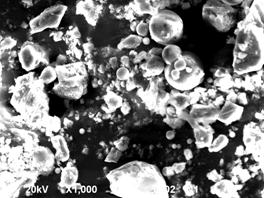

a b
Fig. 1 – The surface of the <
The microelemental analysis
showed the full absence of organic components. The mass fraction of silicon
(17.7 %) follows oxygen (63.87 %), then come aluminium
(8.8 %) and iron (3.59 %). The silicon content has increased 1.87 times, aluminium – 1.86 times, the iron content practically has
not changed in comparison with the fraction <
The results of the
electron microprobe analysis of the fraction of 10–
Conclusions. The elemental
composition of fractions is different; fractions include glass as a material
without the crystal structure; there are also differences in granulоmetrical
properties of slag fractions; materials can be used in construction without any
restriction.