I.M. Ryabukha
Professional Competence Development of a Seafarer
Kherson
State Maritime Academy
Training of seafarers is closely influenced by the
requirements and needs of the industry itself; it is reflected in the documents
of International Maritime Organisation (IMO), International Convention on
Standards of Training, Certification and Watchkeeping for Seafarers (STCW). In
order to assist with uniform interpretation of the STCW Convention, IMO has
agreed a number of clarifications of the Convention’s provisions and has also
developed further guidance to assist parties to meet their Convention
obligations. For maritime training institutes worldwide, IMO has also developed
a series of model courses which provide suggested syllabi, course timetables
and learning objectives to assist instructors developing training programmes.
In 2006 the European Commission for Education and Training set up a list
of eight recommended key competences which should be incorporated in all new
curricula:
·
communication in
the mother tongue, which is
the ability to express and interpret concepts, thoughts, feelings, facts and
opinions in both oral and written form (listening, speaking, reading and
writing) and to interact linguistically in an appropriate and creative way in a
full range of societal and cultural contexts;
·
communication in
foreign languages, which
involves, in addition to the main skill dimensions of communication in the
mother tongue, mediation and intercultural understanding. The level of
proficiency depends on several factors and the capacity for listening,
speaking, reading and writing;
·
mathematical
competence and basic competences in science and technology. Mathematical competence is the ability to develop and apply mathematical
thinking in order to solve a range of problems in everyday situations, with the
emphasis being placed on process, activity and knowledge. Basic competences in
science and technology refer to the mastery, use and application of knowledge
and methodologies that explain the natural world. These involve an
understanding of the changes caused by human activity and the responsibility of
each individual as a citizen;
·
digital competence involves the confident and critical use of information society technology
(IST) and thus basic skills in information and communication technology (ICT);
·
learning to learn is related to learning, the ability to pursue and organise one's own
learning, either individually or in groups, in accordance with one's own needs,
and awareness of methods and opportunities;
·
social and civic
competences. Social competence refers to
personal, interpersonal and intercultural competence and all forms of behaviour
that equip individuals to participate in an effective and constructive way in
social and working life. It is linked to personal and social well-being. An
understanding of codes of conduct and customs in the different environments in
which individuals operate is essential. Civic competence, and particularly
knowledge of social and political concepts and structures (democracy, justice,
equality, citizenship and civil rights), equips individuals to engage in active
and democratic participation;
·
sense of
initiative and entrepreneurship is the
ability to turn ideas into action. It involves creativity, innovation and
risk-taking, as well as the ability to plan and manage projects in order to
achieve objectives. The individual is aware of the context of his/her work and
is able to seize opportunities that arise. It is the foundation for acquiring
more specific skills and knowledge needed by those establishing or contributing
to social or commercial activity. This should include awareness of ethical
values and promote good governance;
·
cultural awareness
and expression, which involves appreciation
of the importance of the creative expression of ideas, experiences and emotions
in a range of media (music, performing arts, literature and the visual arts) [6].
These key competences are all interdependent,
and the emphasis in each case is on critical thinking, creativity, initiative,
problem solving, risk assessment, decision taking and constructive management
of feelings.
Even more at the professional level, there is attention to the issue of
competence and therefore the request to schools and universities to become
engaged in competence-based learning. Competence-based learning incorporated
into education at all levels indicates two major changes:
·
a
shift from content of teaching and training paths to the “learning outcomes”
which are likely to be achieved and which can be used either in the further
education path or in the world of work and in any other social context;
·
enables
transferability of competences from one subject area to another.
Education is aimed at creating teaching and learning experiences and
environments that would bring about desired changes in learners, whether to be
more knowledgeable, better skilled or to influence their attitudes and values
positively [4].
We can represent Professional Competence of a seafarer in a form of a
scheme (see Fig.). The basis of Professional competence is personal
characteristics of a person. His self-esteem and ability to analyse situation
critically; general level of emotional intelligence and motivation for
development; basic values and attitudes.
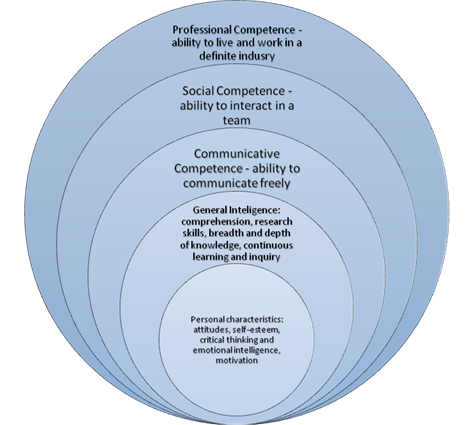
Fig. Composition of Professional Competence of a
Seafarer
Next goes
general inteligence of a person. This indicates definite level of research
skills, general knowledge attained during secondary education, personal
readiness for continuous learning and seeking for new information.
The following
constituent of professional competence is communicative competence. It includes
not only speaking and writing skills, but also skills of free communication
with representatives of different cultures and/or levels of hierarchy in
different professional situations.
Three previous constituents lead to development of a very important
competence of a person – Social competence. Social competence of a person we
shall understand as integral property of personality, represented by the system
of personal traits and features, capabilities and socially meaningful faculties
providing accordance of individual to his social group and determines the achievement
of successful realization of own and publicly meaningful aims in heterogeneous
society.
As maritime educational institution, we understand our ultimate
objective as development of Professional competence of a seafarer. To our mind,
it is based on the above-mentioned constituents and can be defined as ability
of a seafarer to live and work successfully in definite industrial environment
complying with the requirements and demands of this environment.
Thus, we should
clearly see that changing attitude to learning is essential for professional
competence development of seafarer.
References
1.
Компетентностный подход в педагогическом
образовании : коллект. моногр. / под ред. В. А. Козырева,
Н. Ф. Родионовой, А. П. Тряпициной. – СПб. : Изд-во РГПУ
им. А. И. Герцена, 2005. – 392 с.
2.
CEN,
E-CF, European e-Competence Framework version 3.0, www.ecompetences.eu/e-cf-3-0-download/
3.
European
Qualifications Network
http://www.eucen.eu/EQFpro/GeneralDocs/FilesFeb09/STATEofPLAY.pdf
4.
Malan,
SPT. (2000). The “new paradigm” of outcomes-based education in perspective. Journal
of Family Ecology and Consumer Sciences / Tydskrif vir Gesinsekologie en
Verbruikerswetenskappe 28, 22-28.
5.
Pajer
F. La formazione degli insegnanti, Convegno internazionale di studi – Le
Università “di tendenza” per l Europa, 2004.
http://www.olir.it/areetematiche/78/documents/Pajer.pdf
6.
Key competences for lifelong
learning http://eur-lex.europa.eu/legal-content/EN/TXT/?uri=uriserv:c11090