Bulhakov
M.O.
SHEI “National Mining
University”, Ukraine
Mathematical model of DDoS-attack
A distributed
denial-of-service (DDoS) attack is a malicious attempt to disrupt normal
traffic of a targeted server, service or network by overwhelming the target or
its surrounding infrastructure with a flood of Internet traffic. DDoS-attacks
achieve effectiveness by utilizing multiple compromised computer systems as
sources of attack traffic. Exploited machines can include computers and other
networked resources such as IoT devices.
A DDoS-attack
requires an attacker to gain control of a network of online machines in order
to carry out an attack. Computers and other machines (such as IoT devices) are
infected with malware, turning each one into a bot (or zombie). The attacker
then has remote control over the group of bots, which is called a botnet.
Once a botnet has
been established, the attacker is able to direct the machines by sending
updated instructions to each bot via a method of remote control. When the IP
address of a victim is targeted by the botnet, each bot will respond by sending
requests to the target, potentially causing the targeted server or network to
overflow capacity, resulting in a denial-of-service to normal traffic. Because
each bot is a legitimate Internet device, separating the attack traffic from
normal traffic can be difficult.
Let us suppose that
the attacked node has an inbound channel with a bandwidth of C bit/s, and an
edge router has an input buffer of B bits. The attack situation can be simulated
using a model of statistical multiplexing of traffic from N attacking nodes,
which can be in two states: sending packets (ON-state) and inactivity
(OFF-state).
We denote the time
periods (in seconds) of functioning and inactivity as  and
and  respectively. If
the source is active (ON-state), then it generates r packets per second. The
size of the sent packet in bits will be denoted by L, and the volume of
received packets at time t as Q (t).
respectively. If
the source is active (ON-state), then it generates r packets per second. The
size of the sent packet in bits will be denoted by L, and the volume of
received packets at time t as Q (t).
Then the buffer
overload probability can be approximated by the formula:
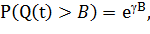
where
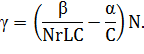
To cause an
overload on the transmission channel, the attacker must select attack parameters
such that the value of γ is close to zero or negative. Therefore, the
number of nodes for the attack must satisfy the inequality
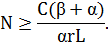
Let us call the
ratio of the duration of sending packets to the whole period of operation and
inactivity as the coefficient of employment of the traffic source τ:

Then the inequality
limiting the number of attacking nodes can be expressed as

In typical
ICMP-flood attacks, the attacking nodes are constantly in the ON-state, sending
parasitic traffic to the victim. In this case, the coefficient τ = 1 and the inequality for the number of attacking nodes is
simplified to

To make it difficult
to recognize the attack the attacker masks it under the usual overload in the
network. To do this he needs to choose rather small values for the parameters τ
and r.
So if an attacker
chooses values of τ = 0,05 and r = 20 pack/s and the attack target is a
server with a channel throughput of C = 10 Mbit/s, then 1,7 * 104 attack nodes are required to attack.
In addition, an
attacker can execute several processes on each of the attack nodes, and those
using fictitious addresses of senders, can act for the attacker as various
sources of traffic. Thus, it is quite realistic to implement a distributed
DoS-attack masking it under the natural overload of the channel.
The conclusions
drawn can be generalized to different types of attack sources. Let the attacker
have M different types of attacking nodes. Then the attacker must choose the
attack parameters so that the following relation is true:
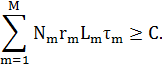
An attacker can
generate traffic that does not cause suspicion and is similar to traffic from a
normal user, having at his disposal a sufficient number of N controlled nodes.
Basing on some collected statistics on network state dynamics (for example,
packet loss level) it is possible to estimate the future states of the system
under study.