Kuzbass State Technical University
Technologies of extraction and production of
sHale oil in the USA
Since
the early 1980s, oil shale has not been on the U.S. energy policy agenda, and very
little attention has been directed at technology or energy market developments
that might change the commercial prospects for oil shale. This report presents
an updated assessment of the viability of developing oil shale resources in the
United States and related policy issues. The report describes the oil shale
resources in the western United States; the suitability, cost, and performance
of available technologies for developing the richest of those resources; and
the key energy, environmental, land-use, and socioeconomic policy issues that
need to be addressed by government decision makers in the near future [1].
The
term oil shale generally refers to any sedimentary rock that contains solid
bituminous materials that are released as petroleum-like liquids when the rock
is heated. To obtain oil from oil shale, the shale must be heated and resultant
liquid must be captured. This process is called retorting, and the vessel in
which retorting takes place is known as a retort.
The
largest known oil shale deposits in the world are in the Green River Formation,
which covers portions of Colorado, Utah, and Wyoming. Estimates of the oil
resource in place within the Green River Formation range from 1.5 to 1.8
trillion barrels. Not all resources in place are recoverable. For potentially
recoverable oil shale resources, we roughly derive an upper bound of 1.1
trillion barrels of oil and a lower bound of about 500 billion barrels. For
policy planning purposes, it is enough to know that any amount in this range is
very high. For example, the midpoint in our
estimate range, 800 billion barrels,
is more than triple the proven oil reserves of Saudi Arabia. Present U.S.
demand for petroleum products is about 20 million barrels per day. If oil shale
could be used to meet a quarter of that demand, 800 billion barrels
 of recoverable resources would last for more than 400 years [2].
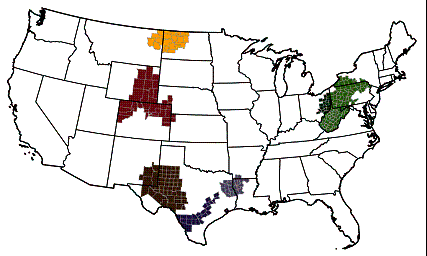
Fig. 1. The seven regions analyzed in this report accounted for 95% of
domestic oil production growth and all domestic natural gas production growth
during 2011-13
The Strategic
Significance of Oil Shale
If the
development of oil shale resources results in a domestic industry capable of
profitably producing a crude oil substitute, the United States would benefit
from the economic profits and jobs created by that industry. Additionally, oil
shale production will likely benefit consumers by reducing world oil prices,
and that price reduction will likely have some national security benefits for
the United States. A hypothetical shale oil production rate of 3 million
barrels per day was assumed for the purpose of calculating consumer benefits.
Economic Profits. If low-cost shale oil
production methods can be achieved, direct economic profits in the $20 billion
per year range are possible for an oil shale industry producing 3 million
barrels per day. Through lease bonus payments, royalties on production, and
corporate income taxes, roughly half of these profits will
likely go to federal, state, and
local governments and, thereby, broadly benefit the public.
Employment Benefits. A manifestation of the
economic benefits of shale oil production is an increase in employment in
regions where shale oil production occurs or in regions that contain industries
that provide inputs to the production process. A few hundred thousand jobs will
likely be associated, directly and indirectly, with a 3 million barrel per day
industry. The net effect on nationwide employment is uncertain, however,
because increases in employment arising from shale oil production could be
partially offset by reductions in employment in other parts of the country.
Reduced World Oil Prices. Production of 3
million barrels of oil per day from oil shale in the United States would likely
cause oil prices to fall by 3 to 5 percent, but considerable uncertainty
surrounds any calculation on how large the effect might be,
especially when trying to model the
behavior of the Organization of the Petroleum Exporting Countries (OPEC) and
other major suppliers far into the future. Assuming a 3 to 5 percent fall in
world oil prices, the resulting benefits to consumers and business users in the
United States would be roughly $15 billion to $20 billion per year.
National Security. A drop in world oil
prices would reduce revenue to oil exporting countries. A 3 to 5 percent
reduction in revenue would not change the political dynamic in those countries
a great deal. With regard to enhancing national security, the principal value of
oil shale production would be its contribution to a portfolio of measures
intended to increase oil supplies and reduce oil demand.
Other claims of the benefits of
increased domestic oil production, such as a reduced trade deficits and more
reliable fuel supplies for national defense purposes, are not well justified
[3].
Extraction and
processing
Most exploitation
of oil shale involves mining followed by shipping elsewhere, after which one
can burn the shale directly to generate electricity, or undertake further
processing. The most common methods of surface mining involve open pit mining
and strip mining. These procedures remove most of the overlying material to
expose the deposits of oil shale, and become practical when the deposits occur
near the surface. Underground mining of oil shale, which removes less of the
overlying material, employs the room-and-pillar method.
The extraction of
the useful components of oil shale usually takes place above ground (ex-situ
processing), although several newer technologies perform this underground
(on-site or in-situ processing). In either case, the chemical process of
pyrolysis converts the kerogen in the oil shale to shale oil (synthetic crude
oil) and oil shale gas. Most conversion technologies involve heating shale in
the absence of oxygen to a temperature at which kerogen decomposes (pyrolyses)
into gas, condensable oil, and a solid residue. This usually takes place
between 450 °C and 500 °C. The process
of decomposition begins at relatively low temperatures, but proceeds more
rapidly and more completely at higher temperatures.
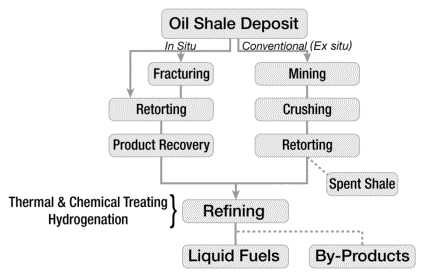
Fig. 2. Overview of shale oil extraction
Bibliography:
1.
Fletcher, Sam, “Efforts to Tap Oil
Shale’s Potential Yield Mixed Results,” Oil and Gas Journal, April 25, 2005, p.
26.
2.
Bivens, Josh, Updated Employment
Multipliers for the U.S. Economy, Working Paper No. 268, Washington, D.C.:
Economic Policy Institute, 2003.
3.
Corbet, Bruce T., The Stuart Oil
Shale Project, briefing presented to the DOE Oil Shale Peer Review Meeting,
February 19, 2004.