Medicine / 7.Clinical medicine
Danilevska N.V., Marchenko E.P.
Zaporizhzhya state medical University Ministry of Public health of Ukraine, Zaporizhzhya, Ukraine
A new
therapeutic technique of "subliminal verbal suggestion" for soldiers
treatment with PTSD
The
main fact of our research is that the subliminal by its power of sound verbal
information, not unavailable to the audition person, perceived on a
subconscious level, processed and affects his feelings, thoughts and behavior
[1–7].
This
knowledge has helped us in the development of technique of soldier’s
psychotherapy with PTSD.
It is
known that, firstly, the soldiers in the adaptive force for military action of
behavior, are not inclined to trust others, and therefore not predisposed to
full compliance in psychotherapy.
And so
worry that block any psychotherapeutic formulas is conviction.
We can take a long while to convince a soldier that «the fighting is over and you can relax», but he will not accept
this information and will remain tense, in anticipation of danger.
Secondly,
any psychotherapeutic conversation with PTSD patients, may remind him of the
traumatic situation and provoke a flashback. For example, such known methods as
"Eye Movement Desensitization and Reprocessing"
on the first stages can be painful for patients because of the fact that causes
patients to remember painful experiences. Because of this, patients often
refuse any form of treatment.
But if
convey this information through the "subliminal verbal suggestion",
the soldier will accept it subconsciously, without critical reflection from the
side of consciousness and admit it.
"Subliminal
verbal suggestion" allows to heal psychological trauma without painful
patient’s memories, because the patient is not consciously hear the therapeutic
formula, but subconsciously perceives them.
In our
research, we have defined the most common causes of PTSD in soldiers and
recorded on audio the possible information. For example, more often the
soldiers feel tension, because subconsciously they expected danger from every
where their lives are threatened. In this case sanogenic formula sounded:
"it's safe, you can relax." Then a record become more, it was not
heard on the background of other sounds. And impose on it a neutral tone.
We formed two groups of patients: soldiers from the first group (30 mans; 32±0,86 years old) listened to the soundtrack with hidden subliminal suggestion within half an hour during the week. The second group of soldiers (32 mans; 34±0,72 years old) listened to the same melody, but without no hidden formulas.
Even after the third session in the first group we
noted a decrease in anxiety and nightmares, improvement of dream sleep,
reduction of the somatic form and conversing manifestations, associated with
trauma, and a reduction of flashback (p≤0.01) (illustration 1, 2).
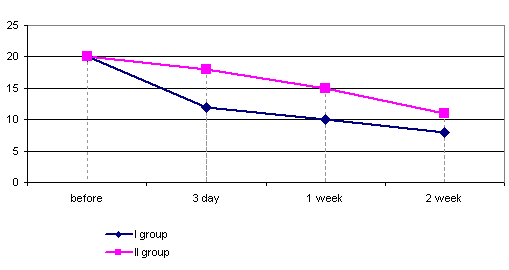
Illustration 1. The results of the study using the Hospital Anxiety Scale
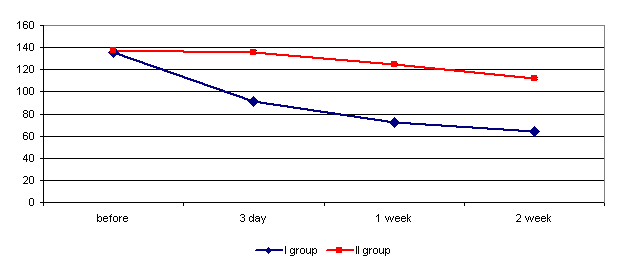
Illustration 2. The results of the study using the Mississippi Post-Traumatic Stress Disorder Scale
These
indicators were significantly better than the control group of patients, who
listened to the same melody, but without hidden verbal formulas.
Thus,
our developed method has proven its efficiency and allows to:
–
successfully conduct the psychotherapy of patients with impaired
compliance, which consciously block the therapeutic setting;
–
get a more rapid therapeutic effect, which is very important in the
environment of soldiers, who are continuosly to situate in war conditions;
–
to achieve a therapeutic effect without retraumatization of patients
because of reminders in the process of psychotherapy of traumatic event. To
avoid episodes of flashbacks.
References:
1.
Август
Форель. Гипнотизм или внушение и психотерапия. Их психологическое, психофизиологическое и
медицинское значение со включением психоанализа / Перевод с 12-го немецкого
издания Г.А. Котляра. – Ленинград: Образование, 1928. – 304 с.
2. Borgeat F.
Psychophysiological changes following auditory subliminal
suggestions for activation and deactivation / F.Borgeat, J.Goulet // Percept
Mot Skills. – 1983. – №56(3). – Р.759–766.
3.
Chaloult L. Use of subconscious and conscious suggestions combined with
music as a relaxation technic [Article in French] / L.Chaloult, F.Borgeat,
R.Elie // Can. J. Psychiatry. – 1988. – №33(8). – Р.734–740.
4. Borgeat F.
Psychophysiological responses to subliminal
auditory suggestions for activation / F.Borgeat, J.Boissonneault, L.Chaloult,
R.Elie // Percept Mot Skills. – 1989. – №69(3 Pt 1). – Р.947–953.
5. Danilevskaya
N. Subthreshold verbal suggestion for treatment PTSD patient / N.Danilevskaya
// Odessa, Ukraine, Regional Seminar in
Neuropsychopharmacology. – 2015. – P.45.
6. Landry M.
Elucidating unconscious processing with instrumental hypnosis / M.Landry,
K.Appourchaux, A.Raz // Front Psychol. – 2014. – №5. – Р.785.
7. Mitchell
C.W. Effects of subliminally presented auditory suggestions of itching on
scratching behavior / C.W. Mitchell // Percept Mot Skills. – 1995. – №80(1). – Р.87–96.