Педагогика /
Методические основы воспитательного процесса
Закревская Т.В.
КГУ «Средняя школа №12»
(Кокшетау, Казахстан)
Manifestations’ features of
emotional responsiveness in adolescence
A deep
interest in studying the problem of emotional responsiveness, and in
particular, the teenagers emotional responsiveness dictated by the huge
importance of this mechanism in the development of personality and moral
sentiments of human, communication. Development of emotional responsiveness is
especially important in the period of adolescence, when develops intensively
moral values, life perspectives, a new life outlook and relationships between
people.
Study
of emotional responsiveness of the individual to the experience of others
devoted a significant amount of research works (G.M. Andreeva, A.A. Bodalev,
V.V. Boiko, A.K. Bochart, A.A. Valantinas, V. Veber, T.P. Gavrilova, T. Kashtanova,
V.V. Kovalev, P.V. Kozina, A.N. Leontiev, Vladimir Mikaelian, M.M. Mukanov,
N.N. Obozov, A.B. Orlov, A .Yu. Panasyuk, K. Rogers, S. Rubinstein and others).
The
significant number of experts defines emotional responsiveness as a conscious
empathy to current emotional state of another person, without losing sense of
external origin of this experience, as well as empathy manifests itself in an
effort to understand the other person, feel into his sufferings, to help and to
support. [6]
From
the psychological point of view, the ability to display emotional
responsiveness is the norm. There are different techniques (diagnosis of
emotional responsiveness by A. Mehrabian and N. Epstein, the technique
"Diagnosis of the level of emotional responsiveness" by I.M. Yusupov,
the technique for diagnosing the level of empathic abilities by B.B. Boyko and
others) to identify people the level of emotional responsiveness and even its
individual aspects. The range of symptoms varies widely: from mild emotional
response to a full immersion in the world of the partner’s senses during
communication. It is believed that empathy is due to emotional response to
perceived external, often almost imperceptible, manifestations of emotional
state of another person, for example actions, speech, facial reactions,
gestures and so on. [5]
A
number of researchers (V.V. Boiko, A.K. Bochart, A.A. Valantinas, V.Veber, P.V.
Kozina, V.A. Mikaelian and others) emphasize in the manifestation of emotional
responsiveness that aspect that empathy person realizes that the feelings he
experiences are the feelings of reflection of the communication partner. It is
considered that if this does not occur, from their point of view, such process
is not empathy, but rather identification with interlocutor. It is the ability to understand that the
current feelings reflect the state of the other person allows empathy person to
use this ability for deeper understanding of the partner, and discern their
individual emotions from those that have arisen in response to the partner’s
emotions.
The
ability to exercise emotional responsiveness is the foundation for friendly
relations, which occupy an important place in interpersonal communication
teenager. In turn emotional responsiveness is based on the social withdrawal,
according to G. Craig [3] "because if you do not know what the other
person feels, you cannot sympathize with him".
In this
research work, we set the next goal, to explore the level of emotional
responsiveness in adolescence. The study was conducted among pupils of
secondary school № 12, in Kokshetau, at the age of 13-15. We used the
methodology of the study empathetic trends or manifestation of emotional
responsiveness among peers proposed by I.M. Yusupov.
Analysis
of the given results allowed to find out that 100% of those surveyed, 25%
children turned out to have a low level of emotional responsiveness. 65% have
the average level. But the highest level has only 10% of respondents who are
the most sensitive to the needs and others concerns, generous. Visually, it is
possible to see the results in Figure 1.
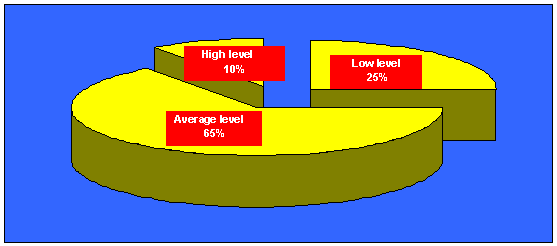

Figure
1. Analysis of emotional responsiveness adolescents based on I.M. Yusupov’s
technique
In
adolescence is especially great need for friendly relations, which suggest the
desire for full understanding and acceptance of the other one, defining
intimate and personal character of communication with peers and, later, with
significant adults. Accordingly, the awakening of emotional responsiveness at
the younger age will contribute to favorable development of interpersonal
relationships in the future.
Summing
up, it must be noted that in this article we disclosed the definition of
emotional responsiveness as a conscious empathy to current emotional state of
another person, without losing the sense of external origin of this experience
and found that the majority (80%) of surveyed teens have an average level of
manifestation of emotional responsiveness.
In this
connection there was a question of finding new ways of developing emotional
responsiveness in adolescents.
In
general, conducted dissertation research leads to the following conclusions:
1.
Emotional responsiveness of the teenager is understood as the ability of an
individual and the basis of formation of growing person’s humane feelings. It
is the attributes of its competency development in the multicultural aspect of
optimization of interpersonal interaction and corporate cooperation, the
quality of basic humanistic outlook and perception of the world, the leading
characteristic of an intelligent person.
Emotional
responsiveness is a manifestation of human indifference to the world and people
based on moral norms and principles, which develops on the basis of the
harmonious development of emotional, intellectual and moral components of the
teenager in a specially organized educational environment.
The
process of development of emotional responsiveness in adolescents is associated
with the changes that occur in the physical and especially emotional,
intellectual and moral development. Namely, there is a transition from
theoretical thinking to abstract, figurative and logical; there is a rethinking
of human values. It should be noted that during the period of identity formation
and "self-concept", which largely contribute to the manifestation of
teenagers’ emotional responsiveness.
2. Also
were selected the next criteria such as the cognitive, emotive, and behavioral
proficiency indicators of teenagers’ emotional responsiveness.
3. The
need for pedagogical and educational integration of the arts and the history of
the domain was substantiated in the development of teenagers’ emotional
responsiveness as a determinant of the individual’s developing humane feelings.
4. The
stages of emotional responsiveness of adolescents in meaningful and semantic
space of historical and cultural actualization: situational (object) detection,
emotional identity (subjective transport), personal (humane) relationship.
5. The
possibility of educational system of the school in the development of emotional
responsiveness of adolescents related to the implementation of humanitarian
potential integration of educational components was revealed. The ideas of
student-centered education, optimization of interpersonal interaction to
achieve the corporate educational purposes were approved.
6. The
model of teenagers’ emotional responsiveness in the formation of personality,
combining personal-developing potential of its components on the basis of the
teaching principle of intonation-shaped actualization of cultural and
historical events and phenomena was developed.
7.
Pedagogical conditions for development teenagers’ emotional responsiveness in
the formation of identity are:
-
Implementation of the productive integration of the content of humanitarian
subjects in complementary unity with personality-developing capability in the
sphere of arts;
-
Targeted use in the educational process of emotional and developmental
potential various forms of ethics education, emotional immersion and
practice-oriented psycho;
- The
organization of theoretical and practical training of teachers to work on the
development of humane feelings of the individual adolescent.
Further
research on this issue we see in the development of training of manifestation
of emotional responsiveness in adolescence or earlier ages.
Literature
1.
В. Бойко. Диагностика эмпатических способностей
2.
Крайг
Г. Психология развития: Пер. с англ. СПб.: Питер, 2000.
3.
Рождерс К. Емпатія .-
М.,1984. - с. 235-237.
4.
http://www.scorcher.ru/neuro/neuro_sys/empaty/empaty1.php