Филологические науки/7. Язык, речь, речевая коммуникация
Koilekbayev M.,
Ganyukova A. A.
The Karaganda state
university named after E.A. Buketov
Non-verbal communication as a way of self-expression
In human society, communication can be carried out by
both verbal and non-verbal means. Verbal communication is a basic human and
universal means of communication. Any other way of interaction can be expressed
by means of language. However, as already mentioned, by means of language not
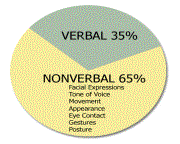
everything can be expressed, the percentage of verbal communication is 35%.
Non-verbal communication is communication, exchange of
information without words, it covers 65%. They are gestures, facial
expressions, tone of voice and sign systems. All of these methods of
communication by analogy sometimes also called languages that are
primary and secondary, or natural and artificial.
The primary language signals directly to represent
meanings. For example, facial expressions is the primary language, facial
signals of our face immediately indicate some state message. In fact, verbal
language, i.e., human speech is also the primary language. To the secondary
non-verbal languages we can refer: the Morse code, the system of
musical notation, language, alarm system flags in the Navy, smoke alarm system,
warning system of civil defense, etc. As you can see, natural languages are
primary, artificial languages - are secondary ones. Body language
can tell a lot about the feelings and intentions of the communicants. Of
course, body language goes back to the communicative behavior of animals, which
is studied by special science - ethology (the study of the social behavior of
animals). Animals are distinguished from each other poses and gestures of
intimidation, reconciliation, love and intentions etc. Even we, communicating
closely with some animals can correctly interpret their posture, actions that
do exactly signaling role. Similarly, body language informs us about bodies and
persons. For example, a woman walking towards the wrist is removed, and the men
- the elbows. The whole body language includes four information transmission methods.
1. Gestures that is a way of using hand sign. You can,
for example, waving his hand invitingly from the other end of the hall, drawing
attention. You can twist the hand at a temple or make fended irritable gesture.
Applause also a gesture meaning greeting or gratitude. One or two clapping - a
way to attract attention. In many pagan religions clapping attracted the
attention of the gods before prayer.
It is noticeable that all these gestures are used in
situations where people, for some reason, can not send a message in everyday
language. That is the secondary language gestures are replaced with ordinary
language. While the primary language of gestures, do not replace, but directly
express emotion or some value.
Similar to the signs of body language, head movement serves.
The most common - nodding, nod, swinging that express consent, understanding,
denial. Similar in its semantics with motion gestures shoulders. For example, a
person can shrug - express confusion or to report: I do not know.
2. Facial expressions - a way
to use facial expressions. Man is able to distinguish and interpret the subtle
movements of facial muscles. The position or movement of parts, the person
performs the symbolic function: eyebrows may be raised in surprise, anger, fear
or a salutation. Face reading - physiognomy - engaged in Aristotle.
Mimicry as a way of communicating is present in higher
animals - apes. However, although their faces sometimes similar to human, but
often express a different meaning. For example, teeth that we could find a
smile in monkeys express threat. Monkey simply raises the gums and teeth shows.
Many mammals do in this way, e.g. dogs,
tigers, wolves and so on. By the way, the same sign of the threat was apparently
peculiar once and a human in some primitive society grin and is not only a
smile, but also a sign of threat or bitterness. It should include facial
expressions and signaling eyes. It is known as the women flirt, shooting eyes.
Batting eyelashes, we can say yes. Direct, open look in the eye is considered a
sign of a strong and free man. In animal world, there were cases when a male
gorilla attacked the cameraman, seeing gleaming lens camera as a direct eye
contact as a challenge.
3. The position of the body. It
is believed that a relaxed posture shows confidence in the interlocutor. Signs
transmitted body is very important at the first meeting, when any aspect of the
personality, the character have not yet manifested. We can also distinguish
between the aggressive position of the body when a person is tense and ready to
move, his body forward slightly filed, as if preparing to throw. This situation
is like a body signals us about possible aggression.
Body position in space can also be informative. For
example, personal space known phenomenon that in the European culture is from
80 cm to 1 m. There are other differences in the cultures associated with the
position of the body. For example, the Americans consider normal stand sideways
to each other while talking, but here it can be perceived as a sign of
disrespect.
4. Tactile communication:
touching, patting, etc. Using the tactile elements of communication also speaks
of the mutual relations, status, and degree of friendship between the
communicants. The close people express their relationship by hugging, stroking,
kissing. Friendly relations can be expressed by shaking hands, clapping on the
shoulder. Teens, exactly like young animals, are to mimic fights - they
playfully fighting for the lead. These relationships are expressed in their
butting, kicking and captured. Of course, every kind of touching is appropriate
in certain situations, and only in certain situations can transmit some sense,
that is perceived as a manifestation of the communicative intent.
Thus, non-verbal communication is an extremely complex
integral part of overall communication skills yet. However, people are often
totally unaware of their non-verbal behavior.
The basic awareness of non-verbal communication
strategies, regarded above, can help to
improve interaction with others. Knowledge of these signs can be used to
encourage people to talk about their concerns and can lead to a greater shared understanding,
which is, after all, the purpose of communication.