Dokukova N.A., Kaftaikina E.N.
The Belarusian State University
Natural oscillations
synchronization of multi-element-dynamical system of autonomous oscillators
The dynamical system of n autonomous oscillators is
considered (Figure 1), each of oscillators is secured to the beam having a
resilient termination. Oscillators receive the deviation and possess the speed at
the initial time. It is necessary to determine the values of these kinematic
parameters to provide phase, antiphase and other types of objects synchronizations
which are interacting with each other through a common connection.
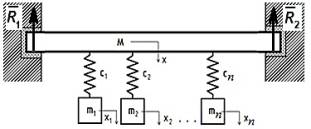
Figure 1 - Oscillation scheme of n oscillators secured to the beam
The system of motion equations of the mechanical system
is provided in matrix form: 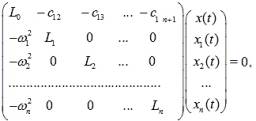 (1)
(1)
with initial conditions  ,
, 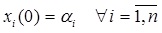 , (2)
, (2)
 ,
,
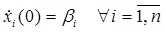 . (3)
. (3)
Here 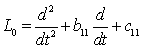 ,
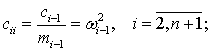
,  − differential operators with parameter of time t; cij – coefficients of elastic elements cj-1, assigned to the corresponded masses mi-1,
  ;
; 
 ,
, 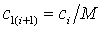 ,
, ;
;  , b
– the coefficient of viscous resistance of the beam oscillations;
, b
– the coefficient of viscous resistance of the beam oscillations;  – vector of unknown mass displacements in Figure 1;
  and
and  – linear force of friction and elastic "Winkler" base in the supports of the beam
  . Common force
  -
conservative, the strength of the
linear friction in the beam,
nonconservative force of viscous resistance
oscillations -
-
conservative, the strength of the
linear friction in the beam,
nonconservative force of viscous resistance
oscillations -
 .
.
The characteristic equation takes the form:
 , (4)
, (4)
if the partial frequencies
of all n-linear oscillators are
identical 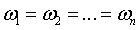 . For simplicity, set b = 0. Then the multi-element solutions of the problem leading to the next vibrational modes
 (5)
(5)

where l1=w1, 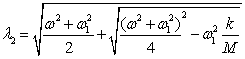 ,
,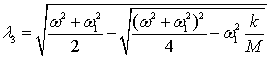 .
.
Uncertain coefficients
of relevant decisions are defined using
the method developed in [1, 2],
which analytical formulas are shown in
Table 1.
If we put n= 2, с12=с13, a1=a2=b1=b2=b=K= 0 and choose the following conditions as initiala1 =g,
a2 =d,
b1=b2 =
0, then obtained analytical formulas of solutions, fully coincide with displacements in [2].
If
n=N
(N ),
),  , bi = 0 (
 ), b= 0, K= 0, then the obtained analytical formulas solutions are fully coincided with displacements in [3, 4] taking into account the absence of a load mode.
As an example, consider the mechanism
with arbitrary physical
parameters: n=5, M=20kg, m1=m2=m3=m4=2kg, c1=c2=c3=c4=485kg/s2, K=125.0 kg/s2, a1=-10сm, a2=6сm, a3=-2сm, a4=4сm, a5=-5сm, b1=60сm/s, b2= -90сm/s, b3=40сm/s, b4= -70cm/s, b5=80cm/s, w=11.292 rad/s, w1=15.572 rad/s, l1=15.572 rad/s, l2=19.127 rad/s, l3=2.035 rad/s.
Table 1
|
№ |
Beam displacements coefficients x(t) |
Coefficients of autonomous oscillators displacements xj(t), |
|
1 |
2 |
3 |
|
1 |
|
|
|
|
|
|
|
2 |
|
|
|
3 |
|
|
|
4 |
|
|
|
|
|

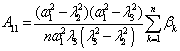
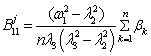
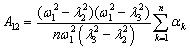
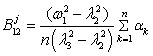

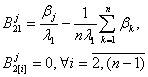

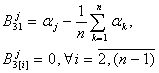
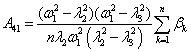
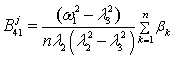
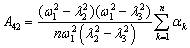
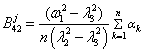
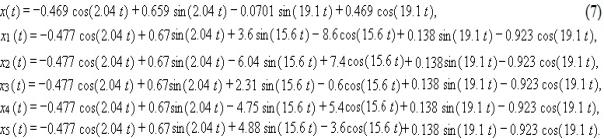
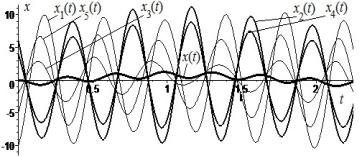
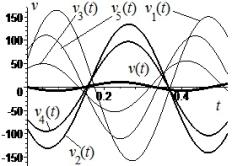
Displacement and velocity of components are plotted in Figure 2 and on the basis of formulas (5) and (6),
Table 1 will take the form:
a) b)
Figure 2 - Displacements x(t) and xj(t) , j =  of dynamical system consisting of 5 identical oscillators on an elastic beam with different initial conditions on a and velocity v(t), vj(t) on b
If the difference between squares of the
frequencies is a great
value in comparison to other
differences, that vibrations with the natural frequency l1 will have the greatest amplitudes. Consider what phase differences jj - ji could be between the
harmonic oscillator with the same
natural frequencies l1. The corresponding
particular solution can be represented
as:
is a great
value in comparison to other
differences, that vibrations with the natural frequency l1 will have the greatest amplitudes. Consider what phase differences jj - ji could be between the
harmonic oscillator with the same
natural frequencies l1. The corresponding
particular solution can be represented
as:
 . (8)
. (8)
It is necessary that one of the phases
jj  , other ji
 to get the difference π between phases of two
oscillatory processes
to get the difference π between phases of two
oscillatory processes  and
and  . It’s possible, for example, when
  and any numbers
  with different signs. Lets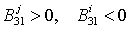
 . (9)
. (9)
If
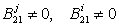 , then antiphase occurs when the
correspondent coefficient are the same module
, then antiphase occurs when the
correspondent coefficient are the same module
 , but always are different sign.
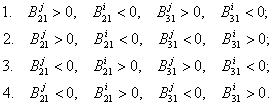 (10)
(10)
Lets change the characteristics of the initial
conditions for the provided
example in order to the displacement of the second
oscillator is in antiphase to the third one using case 2. Lets
define what should
be a2, b2, a3, b3 on the basis of inequalities (10) and the coefficients of the table 1. This
results in the following relationships between the parameters:
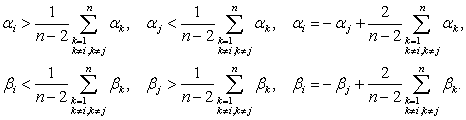 (11)
(11)
Lets a3= -15.0 cm and b3=75.0 cm/s, then a2=7.67 m, b2= -28.33 cm/s, in i=2, j=3,
n=5. Their substitution into
the formula (5), (6) leads to other displacements:
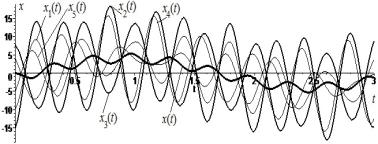
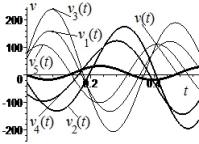
Two solutions x2(t) and x3(t) are in antiphase of harmonic oscillations with the natural
frequency l1 = 15.6 rad/s, which can be clearly
seen in the overall displacements graphs in Figure 3.
In order to the natural
oscillations are in phase with zero difference between
the phases, it is necessary to satisfy
the condition:
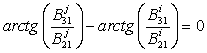 . (13)
It’s
possible if
 . (14)
The algebraic expression (14) is trivial in the
case when the corresponding
initial conditions (2) and (3) at least in two
oscillators under consideration coincide aj = ai and bj = bi.
a b
Figure 3 - Displacements x(t) and xj(t), j =  of the dynamical system on а, x2(t) and x3(t) are in antiphase on frequency l1, velocity v(t), vj(t) on b
Figures 2 and 3 are presented the convergence of the solutions according to the
formulas (5), (6) and Table 1 to the initial conditions (2) and (3).
References:
1. Dokukova N. A. and
Konon P. N. General laws governing in mechanical vibratory systems// Journal of
Engineering Physics and Thermophysics, 2006, Volume 79, Number 4, Pages
824-831, Publisher Springer New York, ISSN: 1062-0125.
2. Dokukova N.A., Kaftaikina E.N. The synchronization of two linear oscillators// Materialy VII
miedzynarodowej naukowi-praktycznej konferencji. Przemysl, Polska. 7-15
listopada 2012 r. Przemysl: Nauka i studia, Vol. 18, pp. 28 – 35, 2012.
3.
Dokukova N.A., Kaftaikina E.N., Konon P. N. About synchronous
oscillations of multi-linear dynamical systems // Materials of the X International scientific and
practical conference, «Conduct of modern science», November 30 - December 7, 2014.- Mathematics. Physics. Modern information
technologies. - V. 21. - Sheffield. Science and education Ltd.
Registered in england & wales. Registered Number: 08878342. Sheffield, S Yorkshire,
England, - 2014. - С. 25-32.
4.
Dokukova N.A., Katakana E.N., Konon P.N. Synchronous
oscillations of n-autonomous oscillator
on a single inelastic fixed-ended beam // X International
scientific practical conference
"Bdescheto Ask a question from
light to Naukat - 2014". Mathematics. Physics. Svremenni
on information technology "Byal GRAD-BG" Ltd., c. Sofia. Republica Bulgaria. - 2014. - T. 18. - S. 19-25.