Student
Nechay V., Ph.D. Kovalenko M.
National Technical University of Ukraine «Kyiv
Polytechnic Institute», Ukraine
The theoretical basis for the development of the field of
mathematical models of electrical machines
Lumped parameters are matrices describing
electromagnetic properties such as resistance, capacitance, and inductance. In
the time-harmonic case the lumped
parameter matrix is either an impedance matrix or an admittance matrix
depending on how the model is excited (current or voltage). In a static
calculation only the resistive, capacitive, or inductive part of the lumped
parameter matrix is obtained.[1] To
calculate the lumped parameters, there must be at least two electrodes in the
system, one of which must be grounded. Either a voltage or a current can be
forced on the electrodes. After the simulation, extract the other property or
the energy and use it when calculating the lumped parameter.
There are several available techniques to extract the lumped parameters. Which
one to use depends on the physics interface, the parameter of interest, and how
the model is solved. The overview of the techniques in this section use a
4-by-4 matrix example for the lumped parameter matrix. This represents a system
of at least five electrodes, where four are used as terminals and the rest are
grounded, as illustrated in Figur 3-2.[1]
251658240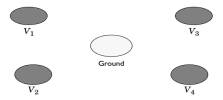
Figure 3-2: A five-electrode system with 4
terminals and one ground electrode.
If a system specifies that all electrodes
are terminals, the results are redundant matrix elements. This is better
understood by considering a two-electrode system. If both electrodes are
declared as terminals, a 2-by-2 matrix is obtained for the system. This is
clearly too many elements because there is only one unique lumped parameter
between the terminals[2]
Forced voltage
If
voltages are applied to the terminals, the extracted currents represent
elements in the admittance matrix, Y. This matrix determines the
relation between the applied voltages and the corresponding currents with the
formula[3]
251658240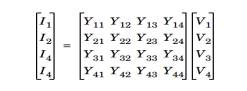
so
when  is nonzero and
all other voltages are zero, the vector I
is proportional to
is nonzero and
all other voltages are zero, the vector I
is proportional to
the first column of Y.
In electrostatics the current is replaced with charge and the admittance matrix
is
replaced with the capacitance matrix
251658240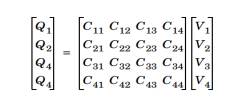
Fixed current
It might be necessary to calculate the Z-matrix in a more direct way. Similar
to the Y calculation, the Z calculation can be done by forcing
the current through one terminal at the time to a nonzero value while the
others are set to zero. Then, the columns of the impedance matrix are
proportional to the voltage values on all terminals[4]:
251658240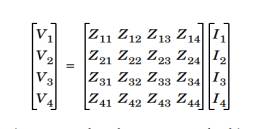
In magnetostatics this option means that
the energy method is used; see Calculating Lumped Parameters Using the Energy
Method below.
Fixed
charge
The Electrostatics interface can use total
charge instead of total current. This gives the inverted capacitance matrix in
a similar manner as the Z and Y matrices.
251658240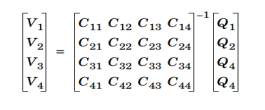
Studing
Lumped Parameters
To study lumped parameters, use the
terminal boundary condition for each electrode.
This boundary condition is available in the following interfaces and the
methods
described in the previous section are used to calculate the lumped parameters[4]:
• Electrostatics. Uses
a stationary study and the energy method.
• Electric Currents.
Uses a stationary or frequency domain study type using the method based on
Ohm’s law.
• Magnetic and Electric
Fields. For the stationary study the energy method is used. For the frequency
domain study type, the method based on Ohm’s law is used.
References:
1. Jianming Jin, The Finite Element Method in
Electromagnetics, 2nd ed.,
Wiley-IEEE Press, May 2002.
2. O. Wilson, Introduction to Theory
and Design of Sonar Transducers, Peninsula Publishing, 1988.
3. R.K. Wangsness, Electromagnetic
Fields, 2nd ed., John Wiley & Sons, 1986.
4. D.K. Cheng, Field and Wave
Electromagnetics, 2nd ed., Addison-Wesley, 1991.