Rogozhina E. V.
All Russia Scientific and
Research Institute of Floriculture and Subtropical Crops, Sochi, Russia, e-mail: RogojinaEW@yandex.ru
The
potential activity of nitrogen fixation and carbon dioxide emission of soil
under peach orchard in humid subtropics of
Seasonal dynamics of
potential nitrogen-fixing activity and CO2 emission in brown
weakly unsaturated forest soils of the natural cenosis (beech-hornbeam forest)
and peach orchard in the subtropical zone of Russia were studied. In general,
the soils of these communities were characterized by high values of nitrogen
fixation activity (NA) (from 1.7 to 77 µg C2H4 / (g h)
during the year); the rate of CO2 emission was changed from 38,8 to
150,8 mg CO2/ kg of soil per day. The potential activity of nitrogen
fixation in soils of different cenoses was comparable and depended largely on
the acidity of the soil solution. Reduction of CO2 emission by 33%
in average was observed in soils of the agrocenosis.
Key words: peach agroecosystem, soil biological
activity, potential nitrogen-fixing activity and carbon dioxide emissions brown
unsaturated forest soils, the humid subtropics of
The environmental conditions of the black sea coast of
There are many indicators used to determine the
biological activity of the soil to determine the level of agrogene load (the
activity of enzymes, the number of different groups of microorganisms, the
species composition and biodiversity, etc.) [3;7]. The study of the intensity
of the process of nitrogen fixation in soils and emission of CO2
allows to characterize the functional activity of microbiocenosis. These
processes depend on many environmental factors: abiotic (humidity and
temperature, physical and chemical properties of the soil), biotic (biochemical
processes, type of vegetation) and agrogenic (agrotechnical and reclamation
measures) [8; 9]. As a result, nitrogen-fixing capacity of the soil and the
intensity of CO2 emissions varies depending on the vegetation period,
the influence of agrotechnical methods of cultivation [4; 11], which makes it
difficult to assess the degree of exposure to a particular factor. Therefore,
to assess the degree of changes in the functional activity of soils at agrogana
the cultivation required in the annual dynamics.
In connection with the foregoing, the goal of this research was the
comparative study of potential nitrogen-fixing activity and emission CO2
of soil agroecosystem peach orchard, annually exposed to complex agrochemicals.
The study
was conducted during 2008 –
Identification
of potential activity of nitrogen fixation was carried out by means of
acetylindole on a gas chromatograph Crystal-2000 with a flame ionization
detector. Determination of the CO2 emissions of the soil was carried
out using absorption [11] and titrimetric end - (weight of soil
As a result of research, it
was determined that in accordance with the established grades [5], soil peach
orchard – brown weakly unsaturated forest, humus-poor, characterized by low
provision hydrolizable nitrogen, medium, and high security movable potassium,
the supply of the mobile forms of phosphorus – the middle. The acidity of
samples changed in the range of 6.14 to 7.4 [Table.1].
Table 1. Agrochemical properties of brown weakly
unsaturated forest soils (in the layer 10 –
|
Indicator |
2008 |
2010 |
||
|
|
Peach |
|
Peach |
|
|
pHsal |
7,6 |
6,1 |
7,4 |
6,3 |
|
Humus, % |
3,8 |
2,7 |
2,9 |
2,2 |
|
Nitrogen
easily hydrolizable, mg/kg |
37,0 |
69,0 |
63,0 |
72,0 |
|
Mobile
phosphorus, mg/kg |
268,0 |
429,0 |
330,0 |
410,0 |
|
Mobile
potassium, mg/kg |
178,0 |
480,0 |
Not det. |
Not det. |
The change in indicators of
biological activity under the influence of the culture of the peach was
evaluated at the background site (beech and hornbeam forest)
soil which was characterized by a more alkaline reaction of the soil solution,
a higher content of humus and less security hydrolizible nitrogen, mobile
phosphorus and potassium [Table.1]. The soil of the beech-hornbeam forest
(background site) in the summer-autumn period was characterized by high values
of potential nitrogen-fixing activity (NA) (August 1,7; in October C2H4
3,3 µg/(g h)), which was comparable with the values obtained for leached medium
loam black earth in the forest steppe zone of Eastern Siberia (рНН2О=6,8) [9]. The intensity of the process of nitrogen
fixation in brown weakly unsaturated forest soils had a large influence neutral
reaction of soil solution (pHКСl=7.3
in August and
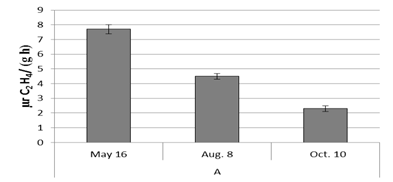
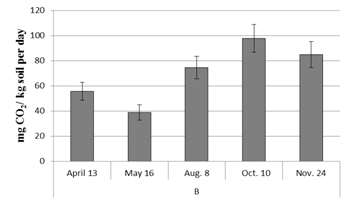
Fig.1 Seasonal dynamics of CO2 emissions
(A) and the potential activity of nitrogen fixation (B) soil peach orchard
(layer 0 –
The differences of NA compared to the forest (2.6
times higher in August and 1.4 times lower in October) was related, perhaps
first with various security nitrogen-fixing microbial complex organo-mineral
nutrition [9]. The decrease in NA in the soil of the peach orchard from may to
October (Fig.1) correlated with soil acidity (pHКСl=7.4
in may; 7,0 – in August, from
The intensity of CO2 emissions of forest
soils is comparable to the values obtained for the loamy red soil (
Thus established at this stage, the differences of nitrogen fixation
capacity of the soil natural cenosis (beech-hornbeam forest) and farming peach,
did not have a clear connection with pesticide load. The decrease in NA in the
soil of the peach orchard from may to October were correlated with the acidity
of the soil solution. Reduction of CO2 emissions compared to the
background site from 10 % in October to 50 - 55 % in April and August,
respectively, showed inhibition in all the periods of vegetation of plants.
REFERENCES
1. Agrokhimicheskie metody issledovaniya pochv (Agrochemical
Methods for Soils Investigation), Moscow: Nauka, 1975.
2. Ananiev, N. D., Spatial and
temporal variation in microbial metabolic coefficient in soils / N. D. Ananiev, E. V.
Blagodatskaya, T. S. Demkina // Soil Science, 2002, №10, pp. 1233-1241.
3. Malyukova, L.S., Influence of
long application of fertilizers on the biological activity of tea plantation
soils [Text] / L. S. Malyukova, E. V. Rogozhina,
D. V. Strukova, // Agrochem. Vestnik, 2012, № 2, pp. 15-17.
4. Malyukova, L.S., Effect of
different types and doses of mineral fertilizers on the respiratory activity of
the soil of tea plantation / L. S.
Malyukova, V. V. Kerimzade, A. V. Velikiy/ Fruit and berry-culture of Russia:
collection of scientific works VSTISP, Moscow, 2015, T. 43, pp. 132-138.
5. Malyukova, L.S., Metodiheskie rekomendatsii
po kompleksnoi pochvenno-rastitelnoi diagnostike
mineralnogo pitanija chaya (Guidelines on integrated soil and plant diagnosis
of mineral nutrition of tea) [Text] / L. S. Malyukova, N. V. Kozlova // Sochi: GNU VNIITS and SK RAAS,
2010. - 37 s.
6. Mineev, V.G., Praktikum po agrokhimii (Practical
Work on Agricultural Chemistry), Moscow: MGU, 2001.
7. Rogozhina,
E.V., Group composition and functional activity of the
complex culture of tea rhizosphere microorganisms in the conditions of subtropical
Russia / E.V. Rogozhina , L. S. Malyukova //
Collection of scientific. tr. VNIITsiSK. Vol. 42. T. 2. "Subtropical crops
and southern gardening." Sochi, 2009. pp. 111-118.
8.
Chemitdorzhieva, E. O., Features of carbon dioxide emissions from muchnistokarbonatnyh
chernozems Tugnui basin Zabaikalye / E. O. Chemitdorzhieva, G. D. Chemitdorzhieva //
Agrochemistry, 2010, №11, pp. 45-49.
9. Schott, P.
R., Biologicheskaya fiksatsiya azota v odnoletnih
agrotsenozah lesostepnoi zoni Zapadnoi Sibiri (Biological nitrogen fixation in annual agrocenoses forest-steppe zone
of Western Siberia): Abstract. Dis. ... With Dr.'s. Science / Peter Schott
Reingoldovich. Barnaul: GNU ANIISKH SB RAAS, 2007. - 39 s.
10. Januszewski, E. B., The role of biologically active substances in
improving environmental sustainability agrobiocenosis planting peach / E. B. Januszewski
// Collected scientific. tr. VNIITsiSK. Vol. 42. T. 2. "Subtropical crops
and southern gardening." Sochi, 2009. pp. 169-174.
Rogozhina, E.V., Estimation of Рotential
Nitrogen-Fixing Activity of Agrophytocenoses Soils of the Subtropical Zone of
Russia / E. V. Rogozhina, N. V. Kostina, L. S. Malyukova // Moscow University
Soil Science Bulletin, 2011. Vol. 66, № 1. pp. 32-35.