Пиль
Э.А.
Академик РАЕ, д.т.н., профессор.
DETERMINATION
OF CORRELATION DEPENDENCE OF ELLIPSOID SURFACE ON ITS VOLUME
It is well known from the literature
on mathematics that during calculation of sphere volume or its surface area it
is sufficient to know only one of the values, due to that another may be easily
calculated. The issue of identification of correlation dependencies between
ellipsoid surface Se and its volume Ve, that is Se = f(Ve) is discussed further
in the article. These formulae make it possible to quickly calculate
ellipsoidal economic shell surface area which may be interpreted as GDP of a country.
The plotted 2D graphs help to visualize the influence of the three variables
onto the GDP. The variables remain constant, they decrease and increase.
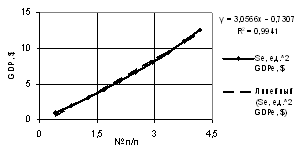
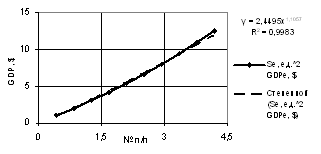
Figures 1 and 2 show two dependencies
of GDP with Х1
= 1, Х2
= Х3
= 0.1…1. It is obvious from the presented figures that these dependencies
permanently increase up to their maximum value. In this case during calculation
of the GDP one may use both linear dependence with the correlation factor of R2 = 0.9941,
power law dependence with R2 = 0.9983.
|
Fig. 1. GDP = f(X1, X2, X3) Х1 = 1, Х2 = Х3 = 0.1…1 |
Fig. 2. GDP = f(X1, X2, X3) Х1 = 1, Х2 = Х3 = 0.1…1 |
|
Fig. 3. GDP = f(X1, X2, X3) Х1 = 1, Х2 = Х3 = 1…0.1 |
Fig. 4. GDP = f(X1, X2, X3) Х1 = 1, Х2 = Х3 = 1…0.1 |
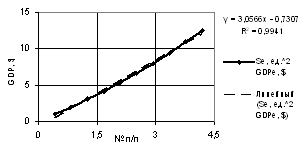
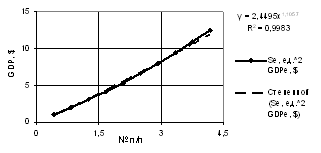
The next two Figures 3 and 4 display
the GDP dependencies when the variables were Х1 = 1, Х2 = Х3 = 1…0.1. Here, the GDP values
decrease, and the correlation factors are equal to R2
= 0.9941 and R2 = 0.9983 accordingly.
|
Fig. 5. GDP = f(X1, X2, X3) Х1 = 1…10, Х2 = Х3 = 1 |
Fig. 6. GDP = f(X1, X2, X3) Х1 = 1…10, Х2 = Х3 = 0.1…1 |
|
Fig. 7. GDP = f(X1, X2, X3) Х1 = 1…10, Х2 = Х3 = 0.1…1 |
Fig. 8. GDP = f(X1, X2, X3) Х1 = Х2 = Х3 = 1…10 |
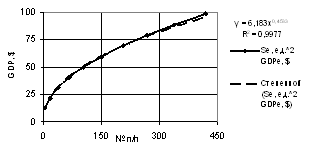
The next Fig. 5 shows that with Х1 = 1…10, Х2 = Х3 = 1 it is
expedient to perform the GDP calculation according to the power-law dependence
due to the fact that in particular case the correlation factor is substantially
huge, and amounts to R2 = 0.9977.
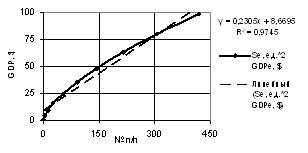
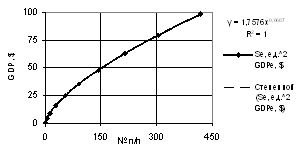
In Figures 6 and 7 the curves of GDP were plotted with Х1 = 1…10, Х2 = Х3 = 0.1…1. It is well seen from
the curves that to calculate the GDP one shall use either linear dependence
with R2 = 0.9745 or the
power-law dependence with R2
= 1.0.
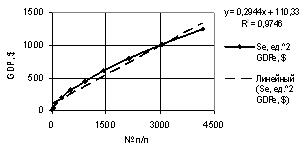
In order to plot the GDP dependencies
the following variables' values were used Х1 = Х2 = Х3 = 1…10 in Figures 8 and 9. In order to
calculate the GDP value it is necessary to utilize the linear function with R2
= 0.9746, or the power-law dependence with R2
= 1.0 in these examples.
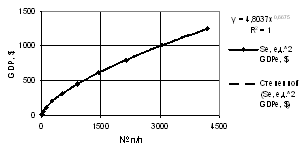
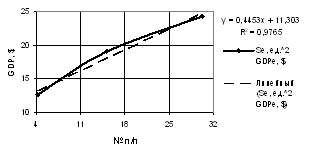
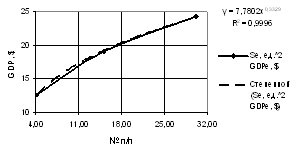
The next two Figures 10 and 11
display the GDP curves plotted with Х1 = 1…3, Х2 = Х3 = 1…0.8. Here, it is quite possible to use
linear dependency with R2 = 0.9765 during the calculation, or the
power-law dependence with R2 = 0.9996.
|
Fig. 9. GDP = f(X1, X2, X3) Х1 = Х2 = Х3 = 1…10 |
Fig. 10. GDP = f(X1, X2, X3) Х1 = 1…3, Х2 = Х3 = 1…0.8 |
|
Fig. 11. GDP = f(X1, X2, X3) Х1 = 1…3, Х2 = Х3 = 1…0.8 |
Fig. 12. GDP = f(X1, X2, X3) Х1 = 1…6, Х2 = Х3 = 1…0.5 |
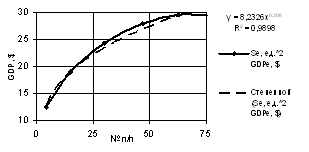
The curve of GDP with Х1 = 1…6, Х2 = Х3 = 1…0.5 was
plotted in Figure 12. In this particular case,
during the GDP calculation it is necessary to use the power-law dependence with
R2
= 0.9898.
|
Fig. 13. GDP =
f(X1, X2, X3) Х1 = 7…10, Х2 = Х3 = 0,4…0.1 |
Fig. 14. GDP = f(X1, X2, X3) Х1 = 1…0.1, Х2 = Х3 = 1 |
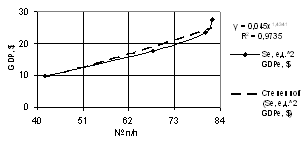
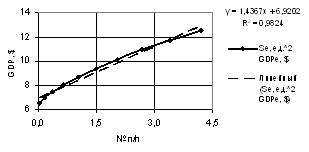
Figure 13
displays the GDP curve plotted with Х1 = 7…10, Х2 = Х3 = 0.4…0.1. Here, it is quite
possible to utilize the power-law dependence with R2 = 0.9735 during the GDP
calculation.
|
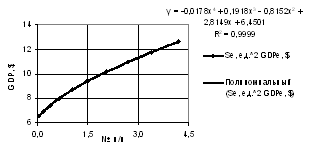
Fig.
15. GDP
= f(X1, X2, X3) Х1 = 1…0.1, Х2 = Х3 =
1 |
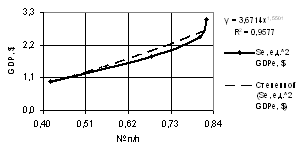
Fig. 16. GDP1 GDP = f(X1, X2, X3) Х1 = 1…0.7,
Х2 = Х3 = 0.1…0.4 |
|
Fig. 17. GDP = f(X1, X2, X3) Х1 = 1…0.7,
Х2 = Х3 = 0.1…0.4 |
Fig. 18. GDP = f(X1, X2, X3) Х1 = 0.6…0.1, Х2 = Х3 = 0.5…1 |
The curves of GDP with Х1 = 1…0.1, Х2 = Х3 = 1 were
plotted in Figures 14 and 15. In this example it is necessary to utilize the
linear function with R2 = 0.9824, or the power-law dependence with
R2
= 0.9999 during the GDP calculation.
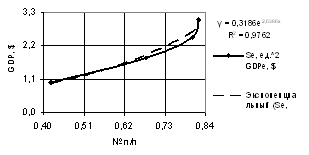
Figures 16 and 17 present the curves
plotted with Х1
= 1…0.5, Х2
= Х3
= 0.1…0.6. In this case it is necessary to utilize two functions: the power-law
function with R2 = 0.9577 or exponential function with R2
= 0.9762during the calculation.
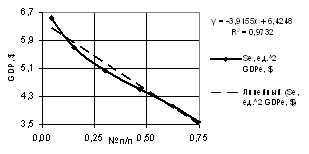
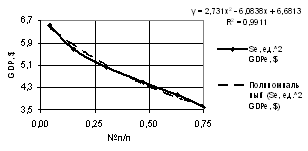
The following two Figures 18 and 19
display the curves plotted with Х1 = 0.6…0.1, Х2 = Х3 = 0.5…1. In this case, it is necessary to utilize
the following two functions: the linear function with R2
= 0.9732 or polynomial function n
= 2 with R2 = 0.9911 during the calculation.
|
Fig. 19. GDP = f(X1, X2, X3) Х1 = 0.6…0.1, Х2 = Х3 = 0.5…1 |
Fig. 20. GDP = f(X1, X2, X3) Х1 = Х2 = Х3 = 1…0.1 |
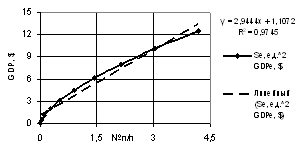
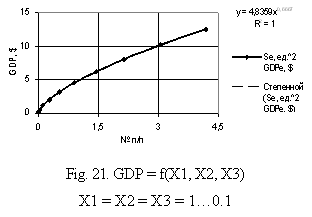
The two Figures 20 and 21 display the
GDP curves plotted with the same values of variables Х1 = Х2 = Х3 = 1…0.1. In
this case, it is necessary to utilize the following two functions: the linear
function with R2 = 0.9745 or the power-law function with
correlation factor of R2 = 1.0 during the GDP calculation.
Basing on the information and presented
graphs, the priorities during the GDP calculations are the following: linear
and power-law functions take the first place, polynomial and exponential functions
follow.