Химия/4
Химпроизводство
Savenkov A.S., Masalitina N.Yu.
National Technical University "Kharkiv
Polytechnic Institute"
Ukraine, Kharkiv, Frunze str., 21, onbliznyuk@ukr.net
MODELING
LOW-TEMPERATURE ammonia oxidation process on the OXIDe CATALYST
The process of low-temperature catalytical oxidation
of NH3 has been investigated for production of N2O for organic
synthesis. In the recent years, nitrous oxide has become used as a mild
oxidizer for partial oxidation of hydrocarbons, for example oxidation of
benzene to phenol. The catalytic oxidation of ammonia to N2O at low
temperatures (200–400ºC) is a promising and more economically efficient
technique. That is why, the process for direct ammonia oxidation is of interest
to numerous researchers [1–4].
A mathematical model of the process of ammonia
oxidation on the oxide catalyst has been developed.
The studies conducted [4–5] justify the assumption
about the mechanism of the ammonia catalytic oxidation on the oxide catalyst
and give a kinetic model of the reaction, allow us to determine the conditions
of maximum N2O-output. As the analysis of the bibliography and our
experimental research has shown, to ensure the maximum N2O-selectivity
and high intensity of the process it is necessary to maintain external
diffusion conditions. At low NH3-concentrations of the catalyst
surface, which is typical for external diffusion conditions, the rate of its
oxidation to NO и N2 decreases
dramatically and its selective oxidation to N2O takes place.
To create a mathematical model of the ammonia
oxidation to N2O with due consideration of N2 – and
NO-synthesis, a complex of physicochemical, kinetic and technological research
has been done. The analysis of the data shows that along with a high maximum N2O
output, a simultaneous oxidation of ammonia to NO and N2 is
observed, though the rate of these processes is low. At the same time the
conversion of NO into N2 was revealed.
Stoichiometric basis of ammonia oxidation reaction
routes, taking into account the formation of nitrogen I oxide for oxide
catalyst has the following form:
4NH3 + 5O2  4NO + 6H2O
4NH3 + 4O2  2N2O + 6H2O
4NH3 + 3O2  2N2 + 6H2O
2N2O  2N2
+ O2
2N2
+ O2
Modeling of the process is reduced to
determining a mathematical description structure in the catalyst bed
considering the assumed reaction mechanism. Oxygen on the catalyst surface at a
high temperature is mainly in the dissociated state. The ammonia adsorption, as
well as its dissociation and formation of intermediates interacting with each
other, which leads to the formation of N2O, NO, N2, Н2О, and being released at 350-360ºC, take
place on the free catalyst surface.
In the process of catalysis ammonia
acts as an electron-donor, and oxygen as an electron- acceptor. Having
adsorbed, О2 molecules
attach electrons from the catalyst surface and turn into oxygen surface atoms
(step 1). On step 2 NH3 molecule donates
electrons from the catalyst surface which is not covered with oxygen, N-H bonds
are thus weakening and the imido-particles are being formed. On the catalyst
surface coated with oxygen, ammonia forms particles of the imide-type (step 3),
which are then recombining to form nitrogen (step 7). Further addition of
oxygen to the imide (steps 4, 5) leads to the formation of N2O.
Steps 6, 8, and 9 are connected with give N2O, N2 and Н2О formation.
The proposed detailed mechanism of the process has
been used for deriving kinetic equations, which describe the reactions on the
catalyst surface and relate to the formation of O, N2O, N2.
Let us form a system of equations representing the rates
of the certain steps and excluding the concentration of intermediates, we will
obtain a kinetic model of the reaction. The rates on the routes I–IV have been
described by the formulae: 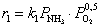 ;
;  ;
;  ;
;  , where
: k1, k2, k3, k4 – kinetic routes constants. The kinetic model of
the reaction connected with the ammonia expenditure and N2O
formation has the following form:
, where
: k1, k2, k3, k4 – kinetic routes constants. The kinetic model of
the reaction connected with the ammonia expenditure and N2O
formation has the following form:


The process in the catalyst bed for external
diffusion condition is characterized by a large temperature gradient. At small
distance - a few centimeters in front of the catalyst – the gas is heated by
the amount of the adiabatic heat-up of the reaction mixture from 200 to
360ºC. This can lead to significant longitudinal heat and mass transfer.
However, the effective coefficients of longitudinal diffusion and thermal
conductivity of the gas phase are small and longitudinal heat transfer is
carried out mainly along the solid skeleton of the catalyst bed. When
describing the process the influence of the flows arising in non-isothermal
boundary layer of multi-component mixture - Stefan flow, thermal diffusion, as
well as diffusion thermal conductivity can be neglected, since the volume of
the reaction mixture does not vary by more than 10%, and it is highly diluted
with inert gas N2, molecular weights of components and, thus, their
diffusion coefficients differ little [6].The
temperature of the catalyst in the bed of the oxide catalyst is assumed to be
constant and is determined by the adiabatic heating of the coming reaction
mixture. On this basis, to describe the process a model of plug-flow for the
gas phase with the use of material balance equations for each component is
accepted.
The degree of NH3-oxidation on oxide catalysts was calculated
according to the developed mathematical model. For calculating this process it
is necessary to know the coefficients of heat and mass transfer from the gas
flow to the catalyst, as well as the physical and chemical properties of the
mixture, depending on the temperature, pressure and composition of the mixture.
On solving the inverse problem of chemical kinetics,
using the experimental data, we determined reactions
rates constants connected with the formation of N2O (k1),
NO (k2), N2 (k3) and N2, resulting
from the nitrogen oxide decomposition (k4), and the
concentrations of the substances on the catalyst surface. Table 3 shows the
calculation data of conversions coefficients for each component.
The comparison of calculating and experimental
conversion coefficients shows good coincidence, the difference is not more than
1–3%.
A mathematical model of the oxidation process of NH3,
considering the physical and chemical properties of the ammonia-air mixture and
nitrous gas has been developed; the rate constants and their temperature
dependence have been determined. This will allow determining the optimal
process conditions of NH3 oxidation on the the oxide catalyst at
different pressures in a wide range of changing process parameters. On the
basis of the developed model, a program for calculating the NH3 oxidation
reactor using the oxide catalyst has been created. During the operation
process, the volume and the surface of the catalyst are changed. That is why a
mathematical model referring the rates of ammonia oxidation steps to a mass
unit of the oxide catalyst has been derived in the research.
References
1. A.S. Ivanova
etc. The role of support in formation of the manganese–bismuth oxide catalyst
for synthesis of nitrous oxide through oxidation of ammonia with oxygen. –
Journal of Catalysis. –
2004. – № 221. – Р. 213–224
2. A.S. Noskov, I.A. Zolotarskii etc. Ammonia oxidation into nitrous oxide over Mn/Bi/Al catalyst. – Chemical Engineering Journal. – 2003 – № 91.–
Р. 235–242.
3. O.N. Bliznjyk, V.V. Prezhdo.
Production of N2O by low-temperatue oxidation of ammonium / Polish
Journal of Applied Chemistry. – 2003. – V. 47, № 2. – P. 65–72.
4. Н.Ю. Масалітіна, А.С. Савенков, О.М. Близнюк, О.М. Огурцов. Нітроґен (І) оксид. Дослідження процесу одержання шляхом низькотемпературного окиснення аміаку // Хімічна промисловість
України. – 2014. – №5(124). – С. 54–58.
5. B.C. Бесков, Ю.Л. Вяткин,
А.С. Савенков. Теоретическая оптимизация реакции окисления
аммиака // Теоретические основы химической технологии. – 1980. – Т. 14, № 3. –
С. 442–445.
6.
Н.Б. Варгафтик. Справочник по теплофизическим свойствам
газов и жидкостей. – М. : Наука, 1972. – 720 с.