Igoshina
S.E., Averin I.A., Vishnevskaya G.V., Pronin I.A., Karmanov A.A.
Penza State University, Penza, Russia
Multicomponent metal oxide nanomaterials with fractal structure for
highly sensitive vacuum sensors
The
attempts to create vacuum sensors based on nanomaterials that exhibit certain
dimensional effects have begun relatively recently, but they show great
prospects for the use of nanotechnology in this field [1]. The purpose of this
research is the development of highly sensitive vacuum sensors, based on multicomponent
metal oxide nanomaterials with fractal structure.
We
used binary systems based on SiO2-SnO2 with various mass
fractions of tin dioxide and ternary ones based on SiO2-SnO2-ZnO,
synthesized by the sol-gel method [2, 3]. Film forming sols, based on
tetraethoxysilane (TEOS) and hydrolyzed in an acidic medium, were applied. Binary
metal oxide nanomaterials of SiO2-SnO2 composition were synthesized
by adding modifying impurities SnCl2×2H2O to TEOS-based
sol. Their hydrolysis products undergo simultaneous polycondensation according
to the scheme:

In
the reaction of hydrolytic polycondensation an ultrathin silica mesh (a matrix)
of silicon dioxide with built-in clusters of tin dioxide is formed.
Ternary
metal oxide nanomaterials of SiO2-SnO2-ZnO composition
are synthesized by adding inorganic salts of tin (SnCl2×2H2O)
and zinc (ZnCl2) to TEOS-based sol. A simplified scheme of simultaneous
polycondensation of their hydrolysis products is as follows:
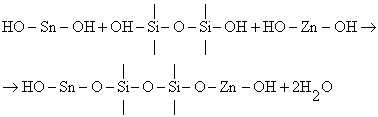
The
mechanism of this reaction is quite complicated, it depends on many factors
(e.g., the solvent type, pH of the medium, etc.), and results in the formation
of nanomaterials with different structure, but preferably of "guest"
(a semiconductor switch) – "host" (a dielectric matrix) type.
The
sol was coated on the substrates of monocrystalline oxidized silicon of
5×5 mm2 by centrifugation at the table rotation speed of 4000
rev/min. The annealing was carried out at a temperature of 600 degrees Celsius
for 30 minutes in the air. Planar silver contact pads were formed by thermal
evaporation in the vacuum.
The
main feature of the synthesized binary and ternary metal oxide nanomaterials is
a fractal type of structural organization (Fig. 1).
|
|
|
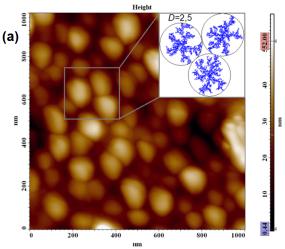
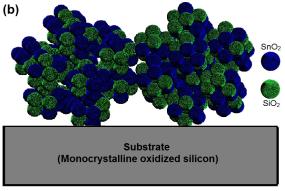
Fig.
1. An AFM image of binary metal oxide nanomaterials of SiO2-SnO2
composition with fractal structure (a) and the model of sensitive elements of
vacuum sensors on their base (b)
Figure
1 shows that the synthesized nanomaterials have a developed surface, formed by clusters
of quasi-spherical form, to describe which it is appropriate to apply either the
model of Witten–Sander fractal (box in Fig. 1a), or a three-dimensional Julien fractal
(Fig. 1b). However, regardless of the used model, it is well established and
confirmed by the experimental data that the multicomponent metal oxide nanomaterials
with fractal structure have a high porosity due to a high concentration of
macro, micro and mesopores [4]. In turn, the high porosity leads to active
gases interaction with the surface and the volume of the investigated
nanomaterials, and their desorption at pressure decrease lower than the
atmospheric one forms the basis of the offered vacuum sensors work.
As
the research shows, the sensitivity of vacuum gauges depends on the number of multicomponent
metal oxide nanomaterials, i.e. on the mass fraction of the alloying
components. Fig. 2 shows the relative change in resistance (R/R0)
of the sensitive elements of vacuum sensors based on the binary system SiO2-SnO2
by varying the vacuum level. R0
stands for the initial resistance at the atmospheric pressure.
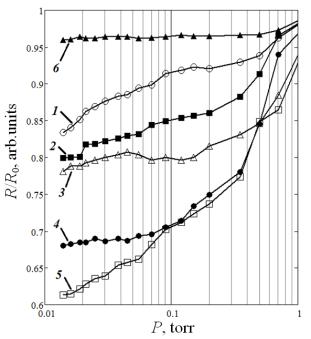
Fig. 2. The relative
change in resistance of the sensitive elements of the vacuum sensor based on
the binary system SiO2-SnO2 at different mass fraction of
tin dioxide:
1 – 50%; 2 – 60%; 3 –
70%; 4 – 80%; 5 – 85%; 6 – 90%
Figure
2 shows that the resistance of the sensitive elements of the proposed vacuum gauges
decreases monotonically with the decreasing pressure. Mass fraction of tin
dioxide has almost no influence on the form of the submitted dependencies
(curves 1-6 in Fig. 2), but it determines the value of the sensitivity, which
increases along with the content of the semiconductor component, and reaches
its maximum of 55.3% at 85% SnO2. A further increase in the mass
fraction of tin dioxide has the opposite effect, which is likely due to the
impossibility of forming an ultrathin silica matrix at a low content of SiO2.
It is most likely, that the main contribution to the sensory feedback of the developed
vacuum gauges is made by desorption of such gases as CO2, O2,
H2O. Desorption of the water vapor increases the resistance of the
sensitive elements of the vacuum sensors and desorption of carbon dioxide and
oxygen causes its decrease. The content of tin dioxide in the binary system SiO2-SnO2
affects the sensitivity only indirectly. Increasing in the mass proportion of SnO2
leads to the increase in the total porosity of the sensitive elements, and
hence, the efficiency of their interaction with the residual gas molecules.
The
use of ternary metal oxide nanomaterials of SiO2-SnO2-ZnO
composition as sensitive elements of the vacuum gauges can significantly
increase their sensor feedback (Fig. 3).
|
|
|
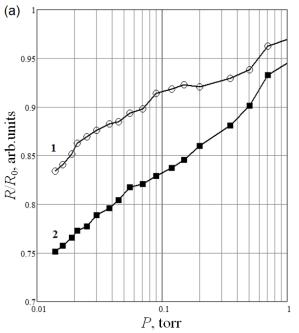
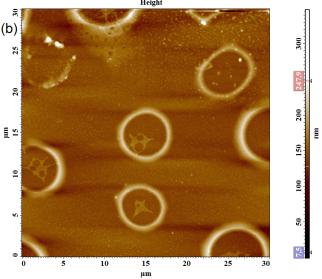
Fig.
3. The relative change in resistance of the sensitive elements of the vacuum
sensor based on the multicomponent
metal oxide nanomaterials of the following composition: 1 – SiO2-SnO2; 2 – SiO2-SnO2-ZnO
(a) and an AFM image of their surface (b)
Figure
3a shows that the resistance of the sensitive elements of the proposed gauges
decreases monotonically with the decreasing pressure, wherein the qualitative
composition of the multicomponent metal oxide nanomaterials has almost no
influence on the form of the submitted dependencies. However, the sensor
feedback from the ternary system (mass fractions of SnO2 and ZnO are
50 and 10 ω, %, respectively) is significantly higher than that of the
binary one (mass fraction of tin dioxide is 50 ω, %). The analysis of the
AFM images presented in Fig. 3b shows that the ternary metal oxide
nanomaterials of SiO2-SnO2-ZnO composition have
three-dimensional porous structure with high concentration of macro and
micropores. Probably, zinc oxide acts as an extra debonder of the inorganic
polymer structure [5]. The increased feedback of the ternary metal oxide
nanomaterials to pressure changes is associated with their higher overall
porosity, which determines the concentration of adsorption/desorption centers.
Thus,
the possibility of vacuum sensors creating based on the multicomponent metal
oxide nanomaterials of SiO2-SnO2 and SiO2-SnO2-ZnO
composition is demonstrated. It is concluded that the increase in the mass
fraction of the modifying impurities leads to an increase in the total porosity
of the sensitive elements, and consequently improves the sensor feedback of the
proposed vacuum gauges. It is shown that the use of ternary nanomaterials
instead of binary ones allows a greater control of their sensitivity.
This
work was financially supported by the Foundation for Assistance to Small
Innovative Enterprises in Science and Technology (program "UMNIK", No.
0015027), and scholarship of the President of the Russian Federation
SP-4686.2013.1
References
1.
Zheng X.J., Cao X.C., Sun J., Yuan B., Li Q.H., Zhu Z., Zhang Y. A vacuum
pressure sensor based on ZnO nanobelt film // Nanotechnology, 2011. – V. 22. –
№ 43. – P. 435501.
2.
Averin I.A., Igoshina S.E., Karmanov A.A., Pronin I.A., Moshnikov V.A., Terukov
E.I. Sensitive elements of vacuum sensors based on porous nanostructured SiO2-SnO2
sol-gel films // Technical Physics. The Russian Journal of Applied Physics, 2015.
– V. 60. – № 6. – P. 928-932.
3.
Moshnikov V.A., Gracheva I.E., Anchkov M.G. Investigation of sol-gel derived
nanomaterials with a hierarchical structure // Glass Physics and Chemistry, 2011.
– V. 37. – № 5. – P. 485-495.
4.
Grachova I.E., Maksimov A.I., Moshnikov V.A. Analysis of structural features of
tin dioxide-based fractal nanocomposites by atomic-force microscopy and X-ray
diffraction // Journal of Surface Investigation: X-Ray, Synchrotron and Neutron
Techniques, 2009. – V. 3. – № 5. – P. 761-768.
5.
Pronin I.A., Goryacheva M.V. Principles of structure formation and synthesis
models produced by the sol-gel method SiO2-MexOy nanocomposites
// Surface and Coatings Technology, 2013. – V. 235. – P. 835-840.