Vrzhashch E., Suchaeva A.
Nitrocarburizing of metallic details in an
electrostatic field
The development of
science and engineering demands the creation of new materials and improvement
of quality of existing materials. In
this scientific problem the very important role belongs to electro-physical
methods of superficial hardening in gas environment. Electro-physical methods
of chemical-thermal processing allow not only possible to intensify
technological process but also appreciably to raise quality of diffusion layer
in a sample [1-3].
We studied process of
steel nitrocarburizing in electrostatic field with initial concentration of
carbon in a sample at 0.20% (low-carbon steel). Nitrocarburizing is process of
saturation of metals by carbon and nitrogen from gas environment. In our case
gas environment was a mix of propane-butane and ammonia.
For the comparative
analysis two processes of steel nitrocarburizing were chosen: usual and under
an electrostatic field at identical gas-dynamic, temperature and other
technological parameters, which were chosen by us on the basis of mathematical
design of experiment [4,5]. The researches have shown that at the chosen test
facility (Fig.1) the optimum technological parameters made up: use of
propane-butane-0.37 l/min, use of ammonia-1.88 l/min, temperature-
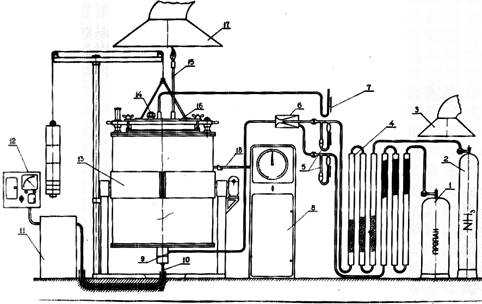
Fig.1. Scheme of the test facility
1-gas-container
with propane-butane mix; 2-gas-container with ammonia; 3- exhaust-ventilation;
4-cleaning; 5-reometeres; 6-mixer; 7-manometer; 8-potentiometer; 9-gas-pipe;
10-high-tension cable; 11-high-voltage rectifier; 12-control panel; 13-furnace;
14-dead joint; 15-removal used gases; 16-top-shutter; 17-exhaust-ventilation;
18-thermocouple.
As follows from the
general principles of kinetic of heterogeneous reactions the total speed at
multistage processes is determined by speed of slowest of its. Such stage names
as limiting stage. Limiting stage in most cases of chemical-thermal treatment
is diffusion. As show our investigations process of steel nitrocarburizing is
limited by diffusion stage too. In this case the depth of nitrocarburizing
layer on a surface of steel (h) depends on time (t) under the parabolic law (h~ - Fig.2).
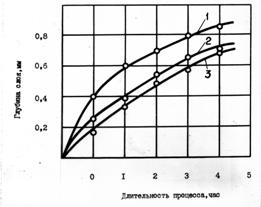
Fig.2. The depth of diffusion layer
(mm) under duration of steel nitrocarburizing (h):
1-in an electrostatic field (a
sample is cathode);
2- usual process; 3- in an
electrostatic field (a sample is
anode).
Therefore, first
physical part of our researches was calculation of diffusion coefficients of
carbon and nitrogen in nitro-cementation layer.
A meaning of these factors allows analyzing about efficiency of the
chosen technology of superficial hardening.
In our case the task
required the decision of system of the differential equations:


where:
С1, С2
- concentration accordingly of carbon and nitrogen depending on depth of a
layer (x) and time of process (t); D12
– coefficient of diffusion of carbon under action at a gradient of
concentration of nitrogen; D21 - coefficient of diffusion of
nitrogen under action at a gradient of concentration of carbon; D11
- coefficient of diffusion of carbon under action at an own gradient of
concentration; D22 - coefficient of diffusion of nitrogen under
action at an own gradient of concentration.
This system of the
equations was solved by an operational method on the basis of dates of the
level-by-level chemical analysis of the contents of carbon and nitrogen in a
layer [1]. The generalized results are shown in the Table 1.
Table 1. Diffusion coefficients of carbon and nitrogen in nitrocarburizing
samples
|
Nitrocarburizing |
Diffusion coefficient, 10-11
m2/s |
|||||
|
D11 |
D12 |
D21 |
D22 |
D1 |
D2 |
|
|
Usual process |
0.40 |
0.06 |
0.002 |
0.46 |
0.44 |
0.42 |
|
In electrostatic field |
1.00 |
0.03 |
0.007 |
0.75 |
1.05 |
0.74 |
The note: in the table D1
and D2 – diffusion coefficients accordingly of carbon and
nitrogen without interaction of the introduced
elements.
The analysis of the
received data [6] as shown that diffusion coefficients of the introduced
elements at nitrocarburizing in an electrostatic field (De) have the
large values, than about usual process (Du). So, for carbon De/Du=2,4,
and for nitrogen De/Du=1,8.
These data show that the
acceleration of diffusion process is caused not only gradient of concentration
of the introduced elements, but also presence of an electrostatic field in a
superficial zone of an explorer.
The following step was
the comparative analysis of structure and phase structure of diffusion layer.
In Fig. 3 are known the microstructures on nitrocarburizing layer by depth of
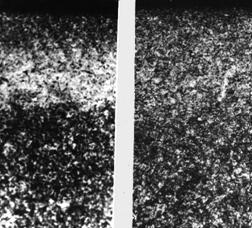
Fig.3. Microstructure of a
nitrocarburizing layer by depth of
in steel by usual
technology (left side) and using an electrostatic field (right side)-
x 100 times
It’s
possible to observe that in usual diffusion layer there are three zones:
outside, under-layer and transitive. Outside zone consists from finely needle
martensite, some residual austenite and inclusions of fine particles at
carbonitrides. Behind an outside zone is deep enough martensite-austenite
under-layer basing on fine-dispersed ferrite-cementite zone of transition to a
structure of a core. The nitrocarburizing layer in an electrostatic field is
characterized by smooth transition of structure from a surface to a core [7].
Its layer has a fine-dispersed structure.
Analysis
by X-ray shows multiphase structure of a superficial zone of nitrocarburizing
layer (Fig. 4).
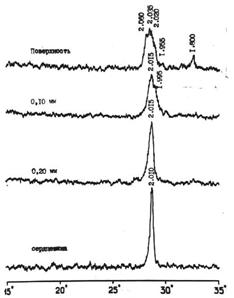
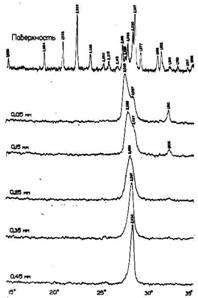
Fig.4. Level-by-level diffractograms
of nitrocarburizing layer formed by usual technology
(left side) and
using an electrostatic field (right side)
In a
layer formed in absence of an electrostatic field (Fig. 4 - left side), except
for α- and γ-phases, carbonitrides are formed of structure saturated
by nitrogen cementites Fe3(C,N) and, probably, carbonitrides of
hematite- and magnetite-structure of the type Fe2O3 and
Fe3O4. The researches of phase structure of a
nitrocarburizing layer, formed in an electrostatic field (Fig. 4 - right side),
also have revealed presence in its outside zone of α- and γ-phases.
Carbonitrides of hematite- and magnetite structure were not reveals. Such
structure of an outside zone is up to such fine-dispersed that it can be seen
at optical increase not less than in 500 times. The comparative analysis of the
sizes of carbonitrides, formed under usual technology and in an electrostatic
field, has shown that use of an electrostatic field reduces the sizes of
particles approximately by three times: from 0.3 – 3.0 up to 0.1 – 1.0 microns.
For
comparative study of mechanical and operational properties of samples
nitrocarburizing in an electrostatic
field and under usual technology the complex of tests was used: at stretching,
static bend, endurance, shock viscosity, wear-resistance, hardness and
microhardness. In all cases the depth of a diffusion layer was constant and
laid within the limits at 0.55 –
The
results of tests have shown that the application of an external electrostatic
field at its optimum parameters considerably raises mechanical and operational
properties of diffusion layer: durability at static bend by 40%, limit of
endurance by 47%, wear-resistance by 50% (Fig. 5,6). The appreciable increase
of hardness and microhardness of diffusion layer formed in an electrostatic
field is observed too.
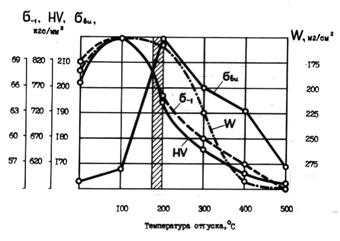
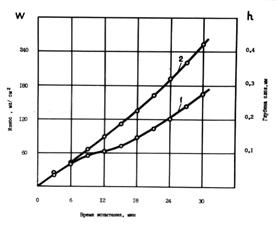
Fig.5. Influence of tempering on
mechanical Fig.6. Wear-resistance of
nitrocarburizing
properties of nitrocarburizing
steel formed in layer
formed: 1- in an electrostatic field,
an electrostatic
field: HV-Vickers hardness,
2- by usual technology
σви -durability at static bend, σ-1 –
limit of
endurance,
W-wear-resistance
(optimum of
tempering is 180-
SUMMARY
An
electrostatic field makes it possible to intensify the process of steel
nitrocarburizing by 1.5 – 2 times.
Solution
of the general problem of diffusion allows for the non-diagonal diffusion
coefficients to be estimated. Coincidence of diffusion coefficients D1
and D11 as well as D2 and D22 within the
experimental approximation shows the insignificance of the flux interaction at
carbon and nitrogen diffusion in steel.
The
diffusion layer formed in an electrostatic field has a fine-dispersed
structure, is characterized by smooth transition of structure from a surface to
a core and by significant size of tetragonal lattice of nitric martensite
phase.
According to the experimental data the
diffusion layer formed in an electrostatic field shows higher efficiency of the
physical, mechanical and operational properties.
The
technology of steel nitrocarburizing in an electrostatic field can be
recommended for superficial hardening of metals’ details including agricultural
assignment.
REFERENCES
- Wrzaszcz E. Influence of an electrostatic
field on structure, phase structure and mechanical properties of diffusion
layer at steel nitrocementation /Materiały III Międzynarodowej
Konferencji Naukowej - Agrolaser 2006. Lublin 2006. - S.99-105.
- Vrzhashch E.E. Diffusion processes in electrostatic
field at steel nitrocementation. //Agricultural and applied sciences in
the development of farming and forestry: actual problems, practice and
exchange of experience – International Scientific Conference.
- E.Vrzhashch, G. Jozefaciuk, A. Suchaeva.
The physical and technical principles of steel nitrocementation in
electrostatic fields at superficial hardening of metals’ details
/International Conference “Engineering problems in agriculture and
industry”/June 2-4, 2010.
- Wrzaszcz E. Mathematic design of an
experiment at the optimization of nitrocementation in the electrostatic
field. /Materiały II Międzynarodowej Konferencji Naukowej -
Agrolaser 2003. Lublin 2003. - S.93-96.
- Vzashch E.E., Pivnik L.V. The mathematical
design of experiments at optimization of technological processes.
//Problemy inżynerii rolniczej w aspekcie rolnictwa
zrównoważonego – Materiały Jubileuszowej
Międzynarodowej Konferencji Naukowej – Lublin 2005. - S.141-145.
- Вржащ
Е.Э. Влияние электростатического поля на диффузию углерода и азота при
нитроцементации стали/Материалы XII
Международной научно-практ.конф. «Актуальные достижения Европейской науки-2016», 17-25
июня
7. Wrzaszcz E., Yucis
E.
The comparative analysis of structure, phase structure and mechanical
properties of a nitrocementation layer formed under usual conditions and in an
electrostatic field. //Agricultural and
applied sciences in the development of farming and forestry: actual problems,
practice and exchange of experience – International Scientific Conference.