Khizhnyak
S.V. , Pampuha V.T., Kovalenko A.Y.
Cold-adapted
amylase producers from karst cave "Karaulnaya-2"
Krasnoyarsk State Agrarian University
Amylases
are one of the main enzymes used in industry and are occupying approximately
25% of the world enzyme market (De Souza,
2010). In recent yeas it is observed the growing interest to the psychrophilic
and psychrotolerant producers of cold-active amylases (Kuddus et al., 2011; Sarmiento et al., 2015).
Up to now the main sources of such producers were Antarctica, Arctic,
high-mountain and deep-water ecosystems. Our researches demonstrated that cold
limestone caves are the natural source of the psychrophilic and psychrotolerant
bacteria and fungi (Khizhnyak et al.,
2003). The present work is devoted to assessment of caves as an
alternative source of cold-adapted amylase producers.
Two
strains of cold-adapted amylolytic fungi of the genus Geomyces isolated from low-temperature karst cave "Karaulnaya-2"
were examined for their growth rates at different temperatures in the range of
+8 to +30°C and for the effect of temperature on amylolytic activity of their cultural
liquids (CL). Effect of temperature on growth rates of both strains is well
described by Ratkowsky et al. (Ratkowsky et al., 1983) equation with the coefficients
of determination R2 = 0.987 for the psychrophilic strain and R2 = 0.997 for the psychrotolerant
strain, theoretical optimum temperatures are +18.5 and +24.5°C, respectively (fig.
1).
Thet
effect of temperature on amylolytic activity of CL in the range of +31 to +50°C
is well described by the logistic function (R2 = 0.994 for the
psychrophilic strain and 0.997 for the psychrotolerant strain). The temperature
value of the sigmoid's midpoint for the psychrophilic strain is 7°C lower then
that of the psychrotolerant strain, what is almost equal to the difference in
the optimal growth temperatures of these strains (6°C). The slope of log-lin
plot of amylolytic activity of CL of the psychrophilic strain in the
exponential area of the temperature curve is 2 times higher than that of the
psychrotolerant strain (fig. 2).
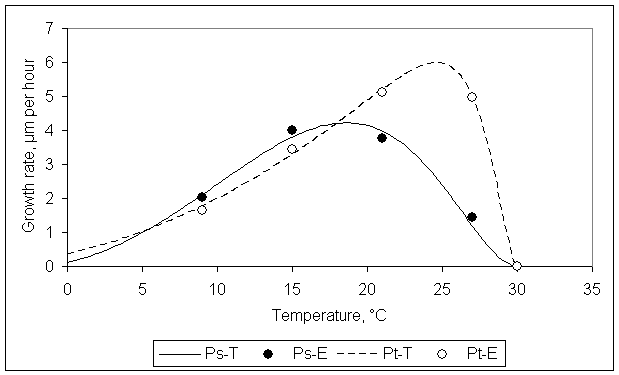
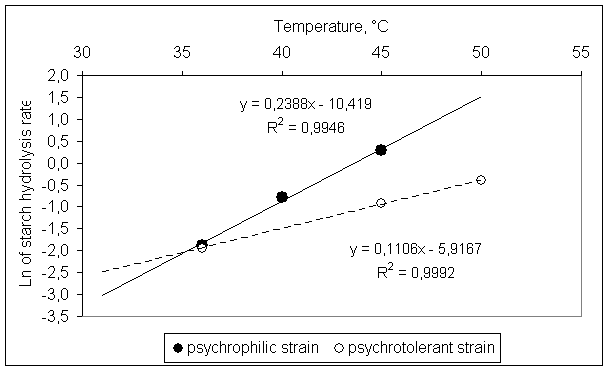 Fig 1. Effect of temperature on the hyphal apex
growth rate of the psychrophilic and psychrotolerant strains: Ps-E – experimental data for the psychrophilic strain,
Pt-E – experimental data for the psychrotolerant strain, Ps-T – the least
squares fit of Ratkowsky's equation for the psychrophilic strain, Pt-T – the
least squares fit of Ratkowsky's equation for the psychrotolerant strain.
Fig 1. Effect of temperature on the hyphal apex
growth rate of the psychrophilic and psychrotolerant strains: Ps-E – experimental data for the psychrophilic strain,
Pt-E – experimental data for the psychrotolerant strain, Ps-T – the least
squares fit of Ratkowsky's equation for the psychrophilic strain, Pt-T – the
least squares fit of Ratkowsky's equation for the psychrotolerant strain.
Fig 2. Log-lin plots
of amylolytic activity of CL of the psychrophilic and the psychrotolerant
strain in the exponential area of the temperature curve.
These results
show that decrease of optimal growth temperature in the process of adaptation
to cave environment leads to the corresponding decrease of the temperature
optimum of amylolytic enzymes and demonstrate perspectives of search for
low-temperature amylase producers in cave communities.
References
1. De
Souza, P.M. Application of microbial α-amylase in industry – A review. Brazilian
Journal of Microbiology, 2010, 4: 850–861.
2. Khizhnyak,
S.V., Tausheva, I.V., Berezikova, A.A., Nesterenko, Y.V., Rogozin D.Y.
Psychrophilic and Psychrotolerant Heterotrophic Microorganisms of Middle
Siberian Karst Cavities. Russian Journal of Ecology, 2003, 34 (4): 231-235.
3. Kuddus,
M., Roohi, J.M.A., Ramteke P.W. An
overview of cold-active microbial α-amylase: Adaptation strategies and
biotechnological potentials. Biotechnology, 2011, 10: 246–258.
4. Ratkowsky,
D.A., Lowry, R.K., McMeekin, T.A., Stokes, A.N., Chandler, R.E. Model for bacterial culture growth rate
throughout the entire biokinetic temperature range. J. Bacteriol., 1983, 154:
1222–1226.
5. Sarmiento,
F., Peralta, R., Blamey, J.M. Cold and Hot Extremozymes: Industrial Relevance
and Current Trends. Frontiers in Bioengineering and Biotechnology, 2015, 3(Article
148): 1-15.