Tagiev Sanan Mehman oglu
Kuzbass State Technical University, Kemerovo
Technologies for the Conversion of Biomass to Liquid
Transportation Fuels
Cellulosic
biofuels have been proposed as part of the solution to climate change and the
dependence on fossil fuels, not only because they can be produced domestically
from a variety of renewable biomass feedstocks, but also because they can
reduce the greenhouse gas emissions, since the carbon dioxide captured when the
feedstock crops are grown and cultivated balances the carbon dioxide released
when the fuels are burned. According to the Energy Information Administration,
biofuel consumption in primary markets is expected to reach 20% of renewable
energy sources by 2030. Although corn ethanol has led the adoption of renewable
biofuels in the transportation industry, the Renewable Fuels Standard (RFS),
part of the Energy Independence and Security Act of 2007establishes a target of
36 billion gallons of renewable fuels by 2022 with cellulosic biofuels
contributing more (16 billion gallons) than corn ethanol (15 billion gallons).
Biomass-to-liquids (BTL) technology, which converts cellulosic biomass to liquid
transportation fuels, has been considered a promising approach for overcoming
the market barrier resulting from the current vehicle technology and fuel
distribution infrastructure [1].
The
two major technologies reviewed here are gasification followed by Fischer-Tropsch
synthesis and fast pyrolysis followed by hydroprocessing.
Gasification
followed by FT synthesis
The
gasification technology produces transportation fuels through Fischer-Tropsch
synthesis with electricity as byproduct. There exist two techniques of
gasification: an oxygen-fed, low-temperature (870°C), nonslagging, fluidized
bed gasifier and an oxygen-fed, high-temperature (1300°C), slagging, entrained
flow gasifier. Both gasifiers are followed by Fischer-Tropsch synthesis, which
involves converting carbon monoxide and hydrogen into liquid hydrocarbons. The
major operational steps of this conversion technology are preprocessing,
gasification, syngas cleaning, fuel synthesis, hydroprocessing, power
generation, and air separation.
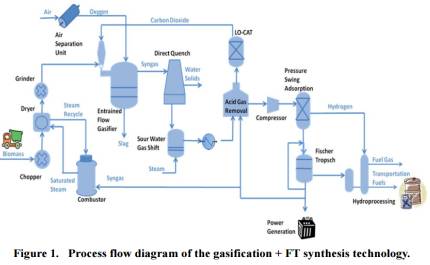 Biomass feedstocks are first dried to reduce the particle sizes during
pretreatment. Each gasifier requires a specific particle size. The
low-temperature (LT) option can handle larger feedstock size of 6 mm, whereas
the high temperature (HT) option requires a smaller feedstock size of 1 mm.
Low-temperature gasification also has the advantages of lower capital cost and
high heat transfer rates within fluidized bed; but it has lower thermal and
carbon efficiency. High-temperature gasification has advantages of higher
carbon conversion, low tar, and methane content [2].
Biomass feedstocks are first dried to reduce the particle sizes during
pretreatment. Each gasifier requires a specific particle size. The
low-temperature (LT) option can handle larger feedstock size of 6 mm, whereas
the high temperature (HT) option requires a smaller feedstock size of 1 mm.
Low-temperature gasification also has the advantages of lower capital cost and
high heat transfer rates within fluidized bed; but it has lower thermal and
carbon efficiency. High-temperature gasification has advantages of higher
carbon conversion, low tar, and methane content [2].
Fast
pyrolysis followed by hydroprocessing
Fast
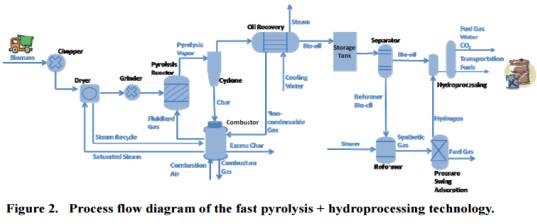
pyrolysis is a process of heating biomass without oxygen that converts
feedstock into gaseous, liquid, and solid products. Its processing steps
include biomass pretreatment, fast pyrolysis, solids removal, oil recovery,
char combustion, and hydroprocessing. Biomass feedstocks are dried to around 7%
moisture content, and particle size is reduced to diameter of 3 mm during
pretreatment. The dried biomass is then fed into a fluid bed pyrolyzer
operating at 480°C and atmospheric pressure. Pyrolysis vapors enter a cyclone,
which separates solids and vapors. The vapors are then condensed in an indirect
heat exchanger that yields bio-oil. Noncondensable gases and solids from the
pyrolysis reaction are sent to a combustor to produce the required heat for the
drying and pyrolysis processes. Bio-oil is collected in a storage tank that
acts as a buffer to the upgrading process [3].
The
hydroprocessing step involves hydrotreating and hydrocracking. Hydrotreating is
an exothermic process that removes undesired compounds such as oxygen in
bio-oil. Hydrocracking is a process that breaks down larger molecules into
naphtha and diesel. During hydrotreating, hydrogen can be provided from outside
source or can be extracted from the bio-oil. Around one-third of the bio-oil is
needed to produce the required amount of hydrogen in the hydrogen production
scenario. Separator, reformer, and pressure swing adsorption are needed before
hydroprocessing. A gravity separator separates pyrolysis lignin from the
water-soluble bio-oil. Aqueous bio-oil and steam are sent to a high-temperature
reformer, which produces syngas. This syngas is fed with methane into a
pressure swing adsorption reactor to produce hydrogen. In the end, bio-oil is
converted into transportation fuels via hydroprocessing [4].
The
results of the implementation report show the potential of BTL in detail. A
considerable amount of fuel can be produced with feasible technologies, thus
making an important contribution to the security of supply. BTL also has a high
potential to reduce carbon dioxide emissions. To exploit these possibilities, further
steps by industry and the state are required. The company is responsible for
the economic risk when assessing its decisions on how far to go in the
development and production of BTL. Today, the cost of BTL production, which is
higher than that of conventional fuels, is of great importance here. If
large-scale BTL production is to be made economically competitive with
first-generation biofuels, the optimization potential identified needs to be
exploited. Industry and investors will have to provide the necessary capital;
government investment grants and guarantees are also required for the first
plants. Reliable legal and political parameters are also of prime importance.
Cooperation and networking between all of the players involved - agriculture
and forest management, investors, operators, and the petroleum and automotive
industries - will be both beneficial and expedient. Reliance is placed on
market mechanisms for the long-term and cheap provision of biomass. The
producers must be shown the perspectives related to this and provided with
incentives to achieve attractive yields 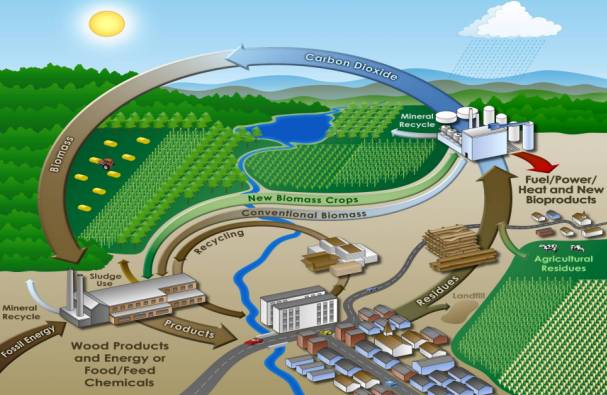 with suitable plant crops.
Bibliography:
1. Biomass as Feedstock for a Bioenergy and Bioproducts
Industry: The Technical Feasibility of a Billion-Ton Annual Supply; U.S. Department of Agriculture and U.S. Department of Energy:
2005.
2. Biomass Program Multi-Year Program Plan 2010; U.S. Department of Energy:
Office of Energy Efficiency and Renewable Energy: 2010.
3. Roadmap for Biomass Technologies in the United States; U.S. Department
of Energy: Biomass Research and Development Initiative: 2007.
4. National Biofuels Action Plan; Biomass Research and Development Board:
U.S. Department of Agriculture and U.S. Department of Energy: 2010.