Origin of the
concept "quality"
For more than two
decades “quality” and “quality management systems” have been leading buzzwords
in the business world. Numerous consultants have built their careers around
these topics, and quality issues in business have been responsible for the
development of new organizations and even industries, for instance, the
American Society for Quality and Six Sigma consulting. The notion of quality in
business focuses on the savings and additional revenue that organizations can
realize if they eliminate errors throughout their operations and produce
products and services at the optimal level of quality desired by their
customers. Errors can take almost any form—for example, producing the wrong
number of parts, sending bank statements to customers who have already closed
their accounts or sending an incorrect bill to a client. All of these errors
are very common, and the costs incurred seem minimal. But over time when
mistakes are repeated the costs add up to a significant amount, so eliminating
errors can result in significant increases to the bottom line of a business.
Business success may
simply be the extent to which your organization can produce a higher-quality
product or service than your competitors are able to do at a competitive price.
When quality is the key to a company’s success, quality management systems
allow organizations to keep up with and meet current quality levels, meet the
consumer’s requirement for quality, retain employees
through competitive compensation programs, and keep up with the latest
technology.
Quality is perhaps the
most important and complex component of business strategy. Firms compete on
quality, customers search for quality, and markets are transformed by quality.
It is a key force leading to delighted customers, firm profitability, and the
economic growth of nations (Deming 1982; Kennedy 1987; Rust, Zahorik, and
Keiningham 1995). Given this breadth, quality has roots in business practice
and in many disciplines including marketing, management, economics,
engineering, operations, strategy, and consumer research.
Quality is:
- Fitness for use
(Juran)
- Conformance to
requirements or specifications (Crosby)
- Usefulness at a
reasonable cost
- Esthetically appealing features
- Freedom from deficiencies
- Acceptable to
outstanding service
- Customer satisfaction with
all of the above
The quality of a product
or service is the fitness of that product or service for meeting or exceeding
its intended use as required by the customer intended use as required by the
customer. If the needs of the customer change so should the level If the needs
of the customer change so should the level of quality
[3,8].
Quality Characteristics:
1) Variable
Characteristics: Characteristics that are measurable and are expressed on a
numerical scale are called variables.
2) Attribute Characteristic:
A qyuality characteristic that cannot be measured on a numerical scale is
expressed as an attribute [1].
According to the
American Society for Quality, “quality” can be defined in the following ways [1]:
- Based on customer’s perceptions of a
product/service’s design and how well the design matches the original
specifications.
- The ability of a product/service to
satisfy stated or implied needs.
- Achieved by conforming to established requirements within an
organization.
Today, there is no
single universal definition of quality. Some people view quality as
“performance to standards.” Others view it as “meeting the customer’s needs” or
“satisfying the customer.” Let’s look at some of the more common definitions of
quality.
Table 1
|
Aristotle |
A difference is
between objects. Differentiation is observed by a sign "good -
bad". |
|
Hegel |
Quality is, first of
all, identical with the existence of definiteness so that something stops to be that it is, when it loses its own
quality. |
|
Chinese version |
A hieroglyph that
marks quality consists of two elements: "equilibrium" and
"money" (quality = an equilibrium + money), thus, "quality is
identical to the concept" high quality", "expensive". |
|
Shuhart |
Quality has two
aspects: objective physical descriptions; subjective side: how much a thing
is good. |
|
Ishikawa K. |
Quality that really
satisfies consumers. |
|
J.M Juran |
Fitness for the use
(accordance to setting). Quality is a degree of a consumer's pleasure. For
realization of quality a producer must know the requirements of consumers and
make his best to satisfy these requirements. |
|
A. Feigenbaum |
General set of
technical, technical and operational characteristics of a product or services
by means of which the product or service will meet the requirements of the
consumer. |
|
J. Harrington |
Satisfaction of
expectations of the consumer for the price. Excess of expectations of the
consumer for lower price, than it is offered. |
|
G. Taguti |
These are the losses
put to society from the moment of delivery of a product. |
|
State Standard 15467-79 |
Quality of products is
totality of properties of products that
stipulates their fitness to satisfy certain needs in accordance with their
setting. |
|
International Standard ISO 8402-86 |
Quality is totality of
properties and descriptions of products or services that add the ability to
satisfy the conditioned or predictable needs. |
Formulations of foreign
experts in the field of quality management,
provided in Table 1[1-9], testify that most of the authors connect the
concept "quality" with satisfaction of certain expectations and needs
of buyers concerning these or those goods or services.
The definition of
quality depends on the role of the people defining it. Most consumers have a
difficult time defining quality, but they know it when they see it. For
example, although you probably have an opinion as to which manufacturer of
athletic shoes provides the highest quality, it would probably be difficult for
you to define your quality standard in precise terms. Also, your friends may
have different opinions regarding which athletic shoes are of highest quality.
The difficulty in defining quality exists regardless of product, and this is
true for both manufacturing and service organizations. Think about how
difficult it may be to define quality for products such as airline services, child
day-care facilities, college classes, or even OM textbooks. Further
complicating the issue is that the meaning of quality has changed over time.
Today, there is no single universal definition of quality. Some people view
quality as “performance to standards.” Others view it as “meeting the
customer’s needs” or “satisfying the customer.” Let’s look at some of the more
common definitions of quality.
Table 2
|
Conformance to specifications |
How well a product or service meets the targets and
tolerances determined by its designers |
|
Fitness for use |
A definition of quality that evaluates how well the
product performs for its intended use. |
|
Value for price paid |
Quality defined in terms of product or service usefulness
for the price paid. |
|
Support services |
Quality defined in terms of the support provided after the
product or service is purchased. |
|
Psychological criteria |
A way of defining quality that focuses on judgmental
evaluations of what constitutes product or service excellence |
• Conformance to specifications
measures how well the product or service meets the targets and tolerances
determined by its designers. For example, the dimensions of a machine part may
be specified by its design engineers as 3 .05 inches. This would mean that the
target dimension is 3 inches but the dimensions can vary between 2.95 and 3.05
inches. Similarly, the wait for hotel room service may be specified as 20
minutes, but there may be an acceptable delay of an additional 10 minutes.
Also, consider the amount of light delivered by a 60 watt light bulb. If the
bulb delivers 50 watts it does not conform to specifications. As these examples
illustrate, conformance to specification is directly measurable, though it may
not be directly related to the consumer’s idea of quality.
• Fitness for use
focuses on how well the product performs its intended function or use. For
example, a Mercedes Benz and a Jeep Cherokee both meet a fitness for use
definition if one considers transportation as the intended function. However,
if the definition becomes more specific and assumes that the intended use is
for transportation on mountain roads and carrying fishing gear, the Jeep
Cherokee has a greater fitness for use. You can also see that fitness for use
is a user-based definition in that it is intended to meet the needs of a
specific user group.
• Value for price paid
is a definition of quality that consumers often use for product or service
usefulness. This is the only definition that combines economics with consumer
criteria; it assumes that the definition of quality is price sensitive. For
example, suppose that you wish to sign up for a personal finance seminar and
discover that the same class is being taught at two different colleges at
significantly different tuition rates. If you take the less expensive seminar,
you will feel that you have received greater value for the price.
• Support services
provided are often how the quality of a product or service is judged. Quality
does not apply only to the product or service itself; it also applies to the
people, processes, and organizational environment associated with it. For
example, the quality of a university is judged not only by the quality of staff
and course offerings, but also by the efficiency and accuracy of processing paperwork [1].
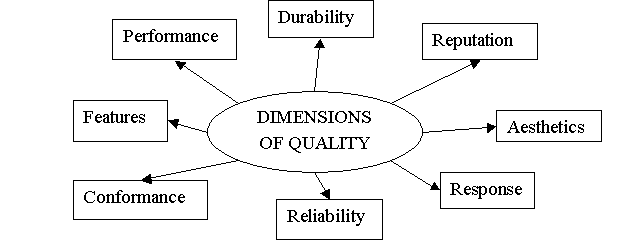

Figure 1. Dimensions of quality
Performance: Primary
product characteristics, such as the brightness of the picture.
Features: Secondary
characteristics, added features, such as remote control.
Conformance: Meeting
specifications or industry standards, workmanship.
Reliability: Consistency
of performance over time, average time for the unit to
fail.
Durability: Useful life,
includes repair. Service: Resolution of problems and complaint, ease of repair
Reputation:
Human-to-human interface, such as the courtesy of the dealer.
Aesthetics: Sensory
characteristics, such as exterior finish.
Response: Past
performance and other intangibles, such as being ranked first [2,4,5,6,7].
Therefore, quality
products can be determined by using a few of the dimensions of quality.
Everyone has had
experiences of poor quality when dealing with business organizations. These
experiences might involve an airline that has lost a passenger’s luggage, a dry
cleaner that has left clothes wrinkled or stained, poor course offerings and
scheduling at your college, a purchased product that is damaged or broken, or a
pizza delivery service that is often late or delivers the wrong order. The
experience of poor quality is exacerbated when employees of the company either
are not empowered to correct quality inadequacies or do not seem willing to do
so. We have all encountered service employees who do not seem to care. The
consequences of such an attitude are lost customers and opportunities for
competitors to take advantage of the market need.
Successful companies
understand the powerful impact customer-defined quality can have on business.
For this reason many competitive firms continually increase their quality
standards. For example, both the Ford Motor Company and the Honda Motor Company
have recently announced that they are making customer satisfaction their number
one priority. The slow economy of 2003 impacted sales in the auto industry.
Both firms believe that the way to rebound is through improvements in quality,
and each has outlined specific changes to their operations. Ford is focusing on
tightening already strict standards in their production process and
implementing a quality program called Six-Sigma. Honda, on the other hand, is
focused on improving customer-driven product design. Although both firms have
been leaders in implementing high quality standards, they believe that customer
satisfaction is still what matters most.
REFERENCES:
1.
American
Society for Quality. www.asq.org, accessed February 15, 2004.
2.
Crosby,
Philip B. Quality Is Free. New York: New American Library, 1979.
3.
Crosby,
Philip. Quality Without Tears: The Art of Hassle-Free Management. New York:
McGraw-Hill, 1984.
4.
Deming,
W. Edwards. Out of Crisis. Cambridge, Mass.: MIT Center for Advanced
Engineering Study, 1986.
5.
Evans,
James R., and William M. Lindsay. The Management and Control of Quality. 4th
ed. Cincinnati: South-Western, 1999.
6.
Garvin,
David A. “Competing on the Eight Dimensions of Quality,” Harvard Business
Review, Nov.–Dec., 1987, 101–10. Garvin, David A. Managing Quality. New York:
Free Press, 1988
7.
Goetsch,
David L., and Stanley Davis. Implementing Total Quality. Upper Saddle River,
N.J.: Prentice-Hall, 1995
8.
Juran,
Joseph M. “The Quality Trilogy,” Quality Progress 10, no. 8(1986), 19–24
9.
Kitazawa,
S., and Sarkis, J. “The Relationship Between ISO 14001 and Continuous Source
Reduction Programs,” International Journal of Operations and Production
Management, 20, no. 2, 2000, 225–248.