Економічні науки/10.Економіка
підприємства
PhD, Associate Professor Marynenko N.
Yu.
Ternopil Ivan Puluj National Technical University, Ukraine
Problem situations identification in
the process of enterprise development
Dynamic development of external environment makes
it necessary to use new and more effective tools and methods
for managing problem situations that arise in the process of enterprises’ adaptation to the new conditions of the market
functioning and determine the possibility of economic structures adaptation to them.
The task for problem situations timely identification and removal in the process of enterprises’ adaptation within the production and economic structures (PES) is of urgency and is caused by the
fact that the pace of the company’s external environment change faster than
the management system reaction
to them.
As a result, few problem issues should be taken
into account: 1) companies have significant discrepancy of technological, industrial
and institutional capacity to
the requirements of the environment; 2) activity under uncertain conditions enforces
enterprises to rebuild internal industrial relationships and to improve
the structure without proper consideration of the entity’s external environment etc.
By
their nature and type the given problem situations occur at different stages of
the enterprises’ adaptive development within a specified PES. Therefore,
approach, the use of which would make it possible to identify and correct
problem situations occurring at the stages of the enterprises’ pre-adaptation,
co-adaptation and adaptation is proposed (fig. 1).
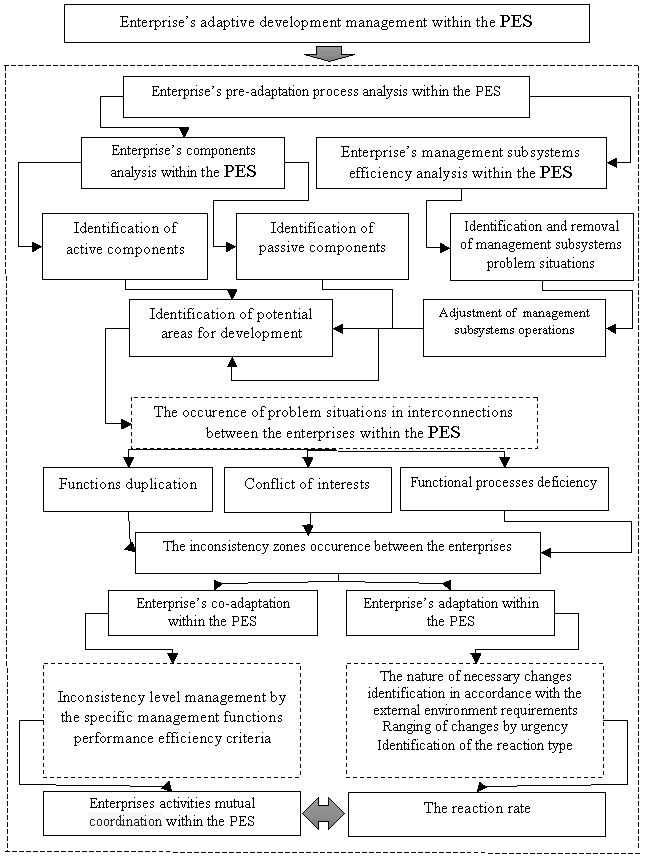

Figure 1. Problem situations managing
approach in the PES adaptive development process
Note: developed by the author
The
industrial enterprise’s adaptive development within the PES at the pre-adaptation stage involves the use of
analysis as a method for identifying problems that may occur in the development
of each company within the PES based
on the its structural elements analysis. By the analysis of the components of
the enterprises within the PES
and their management subsystems efficiency it
is possible to conclude about the development level
of the enterprise’s functional
identity and on which direction the company may potentially develop in terms of adaptation.
The inconsistency level between the enterprises at the co-adaptation stage in the initial phase of the regulation cycle has a maximum value (is shown in fig.
2 as features of low process efficiency when circles 1, 2 and 3 don’t intersect). The values of
target characteristics are found in the “high inconsistency” zone as a result of poor enterprise’s adaptive development management quality within the PES.
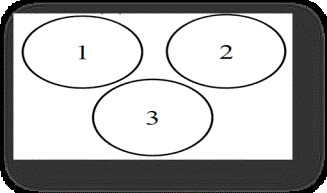
Figure 2. High
inconsistency zone between enterprises within the PES under co-adaptation
Note: developed by the author
The low
inconsistency zone,
shown as a partial intersection of circles 1, 2 and 3, is an effective and practically acceptable balance of
interests between the enterprises within the PES at the co-adaptation stage (fig. 3). It is characterized
by the mutual understanding and
support between the enterprises for their strong functional characteristics being identified at
the pre-adaptation stage during the analysis.
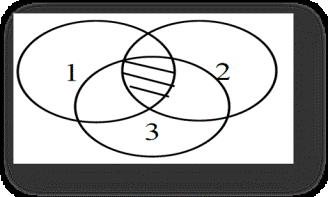
Figure 3. Low
inconsistency zone between enterprises within the PES under co-adaptation
Note: developed by the author
The perfect consensus zone is shown as circles 1,2 and 3 being shaded and indicates the unattainable high level of interests coordination between
the enterprises within the PES (fig. 3).
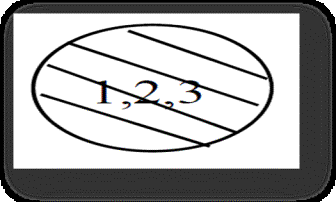
Figure 4. Consistency
zone between the enterprises’ interests within the PES under co-adaptation
Note: developed by the author
For obtaining the adaptive management development
coefficient efficiency maximum value it is necessary to increase the quality and intensity of the adaptive management functions use
by the indicators of enterprises’ consistency interests within the PES at the co-adaptation stage.
It should be noted
that in parallel with the co-adaptation
stage of enterprises within the PES its adaptation to the external environment takes place. This fact also involves the problem situations occurrence in the process of necessary changes at
enterprises implementation in
accordance with the new external requirements. The task of managing changes is the choice of a
such changes vector
that will provide the desired (or maximum)
effect under conditions of resources
and costs constraints [1].
For the enterprise’s adaptation management the
ratio of accuracy and management reaction rate to the external environment changes and the rate of macroenvironment changes is of great importance, that is ratio
of accuracy and changes reaction rate in the enterprise’s
internal environment compared with the rate and direction of changes in the external environment [2].
Thus, the approach to managing problem situations occurring at the stages of the
enterprises’ pre-adaptation, co-adaptation and adaptation within PES is
proposed in the paper.
References:
1. Гамалей Н. Ю. Управление
изменениями фирмы в конкурентной среде / Н. Ю. Гамалей, С. А. Иващенко //
Международный научный альманах. – Актюбе : Актюб. ун-т, 2010. – Вып. 8. – С. 71–73.
2. Ревенко Д. Метод
діагностики стійкості функціонування підприємства в умовах макроекономічної
нестабільності / Д. Ревенко, В. Либа, І. Мошкіна // Економіка та управління
підприємствами машинобудівної галузі: проблеми теорії та практики. – 2013. –
№ 3 (23). – с. 34–43.