Tovma
Nataliya
Improvement
energy audits
Annotation. In modern conditions of managing important task is to increase energy
efficiency and energy efficiency as one of the priorities of economic policy.
Energy management and energy audit is the first steps in improving energy
efficiency. The purpose of this paper is to develop theoretical and
methodological approaches and scientific and practical recommendations aimed at
improving energy management and energy audits. In this paper authors gives
definition of the concepts of energy management and energy audit, the stages of
the energy audit, energy efficiency standards for the Republic of Kazakhstan.
Implementation of the proposals for the development of energy management and
energy audit will improve the management efficiency, the optimal
interconnection between strategic and tactical goals, to bring to an optimum
level of productivity.
Keywords: energy efficiency, energy management, energy audit, energy consumption
and energy savings.
Introduction
To
achieve the goals of sustainable development is necessary to ensure the
improvement of energy efficiency of enterprises. Energy efficiency - one of the
most important areas in the complex of measures to stimulate economic growth
and strengthen the international position of the companies. In modern
conditions, energy conservation and energy efficiency is one of the priorities
of the economic policy of many private companies and government agencies,
focused on the rapid development, both in terms of reducing the cost of
production of goods and services, and in accordance with the general thrust of
government programs aimed at reducing energy intensity of the economy. World
practice shows that energy efficiency is achieved largely due to organizational
changes in the system of energy management, by improving energy management
system. Therefore, energy efficiency as the energy management system is
introduced in the enterprises.
Positive
developments in the energy efficiency of the economy possibly in obtaining
objective data that can be obtained with the help of an energy audit, which to
be conducted properly and in accordance with international standards.
Kazakhstan has implemented concrete steps to improve the energy efficiency.
Government adopted the Law "On energy saving and energy efficiency"
(2014), which establishes certain requirements for businesses such as mandatory
energy audit, the introduction of energy managers, development of strategies
for energy efficiency. The main instrument of state policy in the field of
rational and efficient use of energy in the Republic of Kazakhstan is a
comprehensive plan to improve energy efficiency of Kazakhstan for 2012-2015.The
practical stage of implementation of energy saving policy in Kazakhstan started
in 2013: more than 3000 standards of energy consumption, requirements for
energy efficiency for buildings and design documentation, transportation and
electric motors, adopted by more than 200 technical standards for energy
efficiency.
Energy
facilities and infrastructure in Kazakhstan require speedy modernization. It is
estimated that over 90% of the gas turbines, nearly 60% of the steam turbine and
steam boiler 33% have worked at least twenty years. Investments are needed not
only for the producers of electricity, but also for its end-users: the lion's
share of Kazakhstan's industry consumes a great deal more energy to produce
(five times) than similar enterprises in European Union.
There
are many studies worldwide identifying a wide variety of sector-specific and
cross-cutting energy efficiency improvement opportunities for industry.
Significant numbers of energy efficiency measures is discussed in various
studies (DeCanio 1998; Golove and Eto 1996; de Groot et al. 2001; Jaffe and
Stavins 1994; Thollander and Ottosson 2008; Rohdin and Thollander 2006; Rohdin
et al. 2007). Questions of energy management and energy audit is discussed in
Kazakhstan (Zeinolla and Tleppayev 2015).
This
paper aims to develop theoretical and methodological approaches and scientific
and practical recommendations aimed at improving energy management and energy
audits.
In
accordance with this purpose we had the following research objectives:
1)
practice of the concept of "energy management" and "energy
audit";
2)
identify the stages of the audit and specific features;
3)
develop a model of energy management;
4)
develop a standard of energy audit .
Results
The
concepts of "energy audit"
Energy
management recommends special benchmark tests for estimation of current state.
As results, the enterprise can estimate sufficient "reserve" for
implementation of effective energy management.
We
recommend for Kazakhstan's enterprises following a model of energy management
(Figure 1).
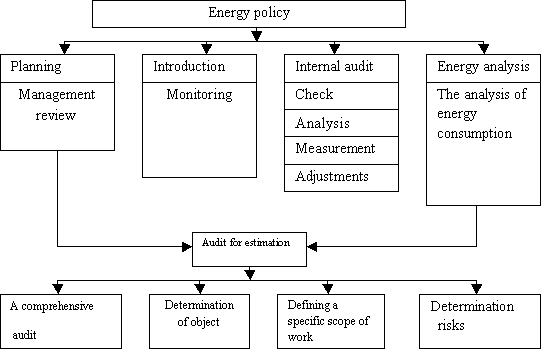
Figure 1-
Model of energy management
The
main instrument of energy management is an energy audit. Energy audit is a
necessary tool for the assessment of the actual state, identifying the main
causes of the loss and the development of recommendations aimed at reducing
energy consumption.
Thus,
an energy audit is necessary in the event that management of the company or
institution has taken a course to reduce energy costs, improve product quality
and enhance the energy security of the enterprise. As a result of the energy
audit is compiled opinion on energy conservation and efficiency. The main
purpose of the energy audit is energy-saving recommendations and assistance to
business entities in determining the areas of energy efficiency. The main tasks
of the energy audit:
-
identification of reserves and potential energy savings;
-
development of a program of energy saving measures, energy-saving technologies;
-
determination of the economic effect of the introduction of energy-saving
measures;
-
definition of the payback period of energy-saving measures and the costs of
their implementation;
-
improving the system of control and metering of energy resources;
-
energy passport of the enterprise.
We
allow to clarify that an energy audit conducted to assess the effectiveness of
the use of fuel and energy resources (electric and thermal energy, natural and
associated gas, solid fuel, oil and processed products) to identify
opportunities to conserve resources and to develop a set of energy saving
measures. This definition is more fully and clearly reflect the concept of
energy audits.
Currently,
there are many techniques for energy audits, which are designed for individual
systems, types of equipment, technological and power plants in various
industries. They regulate the audit process, and the need to prioritize those
or other measurements.
In
Kazakhstan the procedure of energy audit are determined by "Rules of the
audit" (2012).
In
accordance with these Rules, an energy audit consists of 4 main steps:
I
stage. Preparatory: a program of energy auditing, including a program of
instrumental examination.
Stage
II. Measuring (Test).
Phase
III. Analytical: a technical report on energy audit.
Stage
IV. Final: an action plan for energy conservation and efficiency.
According
to other researchers, energy audit consist from the following activities:
1.
Analysis of the state of power supply systems, heating, water supply, the
technical equipment of the park industrial enterprise.
2.
Assessment of the systems and measuring instruments.
3.
Identification of unreasonable losses.
4.
Assessment of the system of regulation of energy consumption and energy use.
5.
Checking the energy balances of the enterprise.
6.
Calculation of the specific energy consumption standards for manufactured
products or types of work.
7.
The evaluation of the major energy-saving measures.
In
our opinion, the main stages of the energy audit can be shows in figure 2.
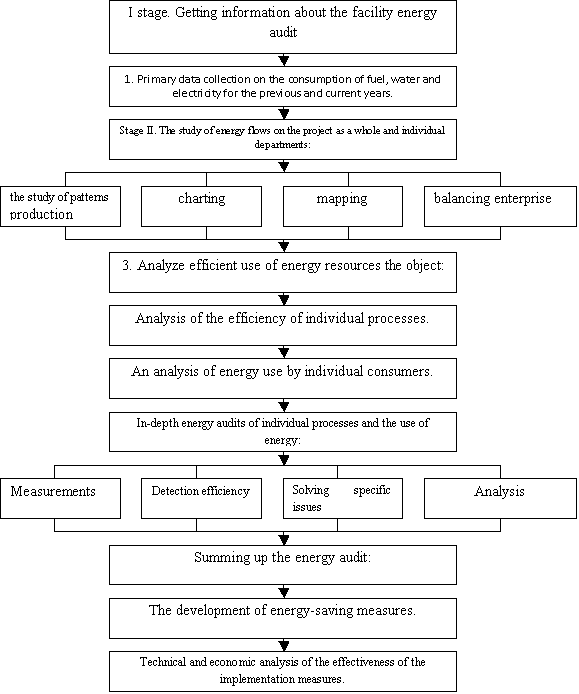
Figure 2- Stages
of energy audits in Kazakhstan
The
result of the energy audit may be:
-
conclusion about the quality of produced energy, particularly electricity;
-
recommendations for an energy-saving measures and technologies;
-
recommendations for the steps (including changes in technology), aimed at
improving the energy efficiency of products.
Currently,
standards for energy management systems already exist in certain countries
(such as Denmark, Ireland, Sweden, the USA, Spain, South Korea) or under
development (China, Europe through CEN (CEN) and CENELEC (CENELEC), South
Africa, Brazil). The experience of these countries shows that standards can
achieve sustainable energy savings in the industry. In July 2009, European
standard EN 16001: 2009 "Energy management systems - Requirements with
guidance for use" (Energy Management Systems - Requirements with guidance
for use) has been issued, which has received national status in 30 European
countries:
-
UK (BS EN 16001: 2009),
-
German (DIN EN 16001: 2009),
-
France (NF EN 16001: 2009),
-
Sweden (SS EN 16001: 2009),
-
Italy (UNI EN 16001: 2009).
The
International Organization for Standardization (ISO) approved the most
innovative standard in the field of energy management: "ISO 50001: 2011
Energy management systems - Requirements with guidance for use" by June
15, 2011.
ISO
50001 includes the requirements for the development and implementation of
energy policy, objectives, targets and action plans in the field of energy
management, taking into account the legislative regulatory acts.
The
benefits of the energy management system based on ISO 50001:
1.
The ability to identify and minimize risks associated with your future energy
supply system.
2.
Measurements and monitoring energy use to determine ways to increase its
effectiveness.
3.
Increase the overall efficiency and reduction of energy consumption and the
related costs.
4.
Reduce carbon emissions and compliance with the relevant government targets.
5.
Demonstration of the achievements in the field of ecology and empower effective
participation in tenders.
Companies
that have implemented an energy management system according to ISO 50001, can
reduce the costs of consumption of energy resources and to reduce carbon
dioxide emissions into the environment.
There
are several standards related ISO 50000:
-
ISO / CD 50002 Energy audit;
-
ISO / CD 50003 Energy management system audits and competence of auditors;
-
ISO / CD 50004 Guidelines for the implementation, maintenance and improvement
of the energy management system;
-
ISO / CD 50006 Basic use of energy and energy efficiency (EnPIs) - General
Principles and Guidelines;
-
ISO / CD 50015 Monitoring, measurement, analysis and verification of the
organizational level of energy efficiency.
The
Japanese company Toyota, after the
implementation of ISO 50001 in 2002, has reduced energy consumption by 23% per
unit of the product.
In
the CIS countries such as major companies as "Lukoil",
"Severstal", "Gazprom" implemented this standard.
Kazakhstan
has not a national standard of energy efficiency. Although the actual standard
allows doing the following:
1)
to estimate the energy management system of the company;
2)
to identify the mutual influence of the energy management system and operations
at each other;
3)
to assess and manage the risks;
The
standard should be designed for independent use, and for its use in the other
quality management systems, environmental impact (Figure 3).
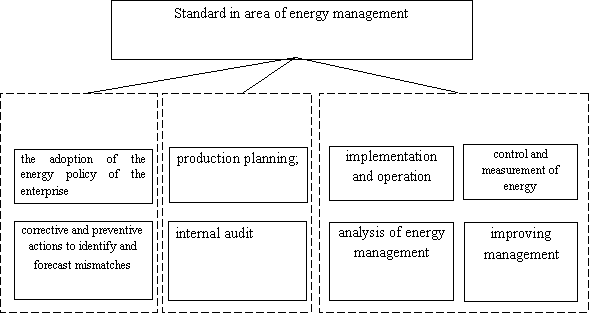
.
Figure 3 – Standard of
energy efficiency
The
implementation of the standard should reduce the financial costs of greenhouse
gas emissions and other environmental impacts through systematic management of
energy. Successful implementation depends on commitment from all levels and
functions of the organization, and especially from top management. The standard
will enable organizations to develop a strategy to improve energy efficiency,
reduce costs and improve the environmental aspect of operations.
Conclusions
Energy
management is becoming an integral part of the modernization of the enterprise.
The successful introduction of energy management to a large extent depends on
the attitude towards him the company's management. Tangible results can be
achieved only if management takes the initiative.
References
1.DeCanio, S. J. (1998). The efficiency paradox: Bureaucratic and
organizational barriers to profitable energy-saving investments. Energy Policy,
26(5), 441–454.
de Groot, H., Verhoef, E., & Nijkamp, P. (2001). Energy saving by
firms: 2.Decision-making, barriers and policies. Energy Economics, 23(6),
717–740.
Golove, W.
H., & Eto, J. H. (1996). Market barriers to energy efficiency: A critical
reappraisal of the rationale for public policies to promote energy efficiency.
Lawrence Berkeley National Laboratory, LBL-38059. Retrieved on October 30, 2008
from http://eetd.lbl.gov/ea/emp/reports/38059.pdf.
3.Jaffe, A. B., & Stavins, R. N. (1994). The energy-efficiency gap:
What does it mean? Energy Policy, 22(10), 804–810.
On energy saving and
energy efficiency (2014), Law, Astana 2014
4.Rohdin,
P., & Thollander, P. (2006). Barriers to and driving forces for energy
efficiency in the non-energy intensive manufacturing industry in Sweden.
Energy, 31(12), 1836–1844.
5.Rohdin, P., Thollander, P., & Solding, P. (2007). Barriers to and
drivers for energy efficiency in the Swedish foundry industry. Energy Policy,
35(1), 672–677.
The rules of the audit
(2012). Government Decree №115, 31 August 2012
6.Thollander,
P., & Ottosson, M. (2008). An energy efficient Swedish pulp and paper
industry—Exploring barriers to and driving forces for cost-effective energy
efficiency investments. Energy Efficiency, 1, 21–34.
7.Tleppaev, A.,
Zeinolla, S. (2015). Benchmarking of energy audit in Kazakhstan. Al-Farabi
Kazakh National university bulletin. Economy series, №2/1(108), 164-170.