Tagiev Sanan Mehman oglu
Kuzbass State Technical University, Kemerovo
Economic overview coal to liquids
technologies
In
absolute terms, CTL will be expensive to build and expensive to run. Therefore,
it will only be deemed worthwhile proceeding if concerns about the security of
oil and gas supplies are such that substitute oil products via CTL can provide
a level of reassurance at a price that is deemed worth paying. As with all
‘insurance policies’ this will always seem unnecessary until it is actually
needed. Also, as with all insurance policies, under-investment or failure to
pay the premiums will mean that benefits will not be paid out when they are
needed [1].
CTL,
by whichever route, is capital-intensive and therefore benefits substantially
from economies of scale. Most studies on process economics have assumed that a
full-scale commercial plant would produce 50,000-100,000bbl/day of liquid
products . Such a plant would process 15,000-35,000 tonnes/day of bituminous
coal or up to double that amount of sub-bituminous coal or lignite.
Sasol
have stated that their prerequisites for contracting with an organization to
proceed with a CTL FT plant would be assume a minimum plant size of 80,000
bbl/day, to take advantages of the economies of scale. At the same time, access
would be needed for to up to 400 million tonnes of coal over the project
lifetime. This would most likely be ‘stranded coal’ due to its low-quality or
location, making it unsuitable for alternative applications, such as
electricity generation.
Of
equal importance would be the need for government support for the very large
capital investments, on the grounds of improved energy security through
decreased dependence on imported energy, and to shield developers from oil
price volatility. In late 2006, the likely cost of such a plant was given as
US$ 5-6 billion with annual operating costs of some US$ 250 million [2].
In
2006, the IEA noted that for CTL to be competitive, a plant would need to have
access to coal at less than 20 US$/t. Although this is less than half of the
current international price, over 80% of the world’s coal is not
internationally traded, and at least 30–40% of the world’s coal is mined for
less than 20 $/t - including most low rank coals. On that basis, at a steam
coal price of 20 US$/t, CTL can be competitive with a crude oil price of under
40 US$/bbl, and the average production cost of synfuels would be about 50
$/bbl. There will be economies and cost reductions associated with the building
of a series of CTL plants as operational experience is gained and the initial
designs are copied and refined.
MIT
examined the possible impact of including CCS on a CTL unit. In broad terms,
the capital cost of a synthetic fuels production facility would be around
$53,000 per bbl/d of liquids output with no CO2 capture. This would
increase to $56,000 per bbl/d with CO2 capture. This assumes a
20-year plant life, a three-year construction period, and a 15.1% capital
carrying charge factor on the total plant cost, a 50% overall thermal
efficiency for the FT plant, and a 95% plant capacity factor. Using these
factors, the production cost of FT fuels is estimated to be 50 $/bbl without
CO2 capture (similar to the IEA estimate) and 55 $/bbl with CO2
capture [3].
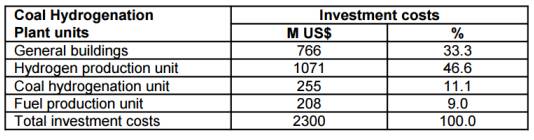 Table
1. Modified investment costs structure for 1 Mt fuels per year plant
Table
1. Modified investment costs structure for 1 Mt fuels per year plant
In Poland, the investment costs for industrial coal
hydrogenation plant were estimated in the 1970s and 1980s by GBSiPPW SEPARATOR.
In 2006, these estimates were updated at the Central Mining Institute, based on
the indices of the cost of apparatus and equipment, and on indices of investment
cost increases in the chemical industry (Chemical Engineering Archive
1979–2005). The investment cost for a plant of 1 Mt per year of coal-based
liquid fuels, recalculated for 2006 is 2.8 billion US $ (± 30%).
Analysis of the investment costs structure showed that
the cost of the hydrogen production unit is much higher than those of the coal
hydrogenation and fuel production units. This is due to the assumed
postreaction residue separation by low temperature carbonization and hydrogen
production in the Winkler reactor. An application of new technologies,
industrially proven over the last twenty years, such as supercritical
post-reaction residue separation and advanced gasification processes for coal
and residue – based hydrogen production, should decrease the investment costs
for hydrogen production.
Based on the literature and material balance data,
economic estimates for a modified concept of the Coal Liquefaction Plant CMI
2006 (CMI 2006) producing 1 and 3 million tonne of liquid fuels (gasoline and
diesel oil) were prepared. The calculations were carried out for two coal price
levels of 54 US$/t (Poland) and 20.5 US$/t (China). The modified investment
cost structure for the 1 Mt per year plant is given in Table 1.
This analysis allows an evaluation of the impact of
coal price and plant production capacity on the basic economic indicators of
the plant (required product market price and required crude oil market price)
to ensure that the required product price selling price can be met. The
calculations were carried out for 2006 prices using simplified economic models
based on indices given in DTI, 1999.
As can be seen, the production capacity and coal price
are key to the economics of a coal liquefaction plant. For a plant producing 3
Mt of liquid fuels per year, assuming a coal price below 54 US$/t, the required
selling price for liquid fuels produced is within the range of prices met by
refineries processing crude oil of the price level of 44 US$/bbl, while for a
plant of capacity of 1 Mt of liquid fuels per year, the limiting crude oil
price is 63 US$/bbl [4].
Production of 3 Mt of fuels per year would increase
the share of coal – based fuels in the total fuel consumption in the transport
sector in Poland. For example, the production of coal hydrogenation plant would
cover 34% of the amount of engine fuels used by the transport sector in 2005.
Assuming an annual increase in fuel consumption of 1%, the production level
would satisfy 27% of the transport sector demand in 2030. This suggests that
the development of such plant would strengthen the national energy independence
in terms of engine fuels in a longer time perspective.
The key point is that the results of these various
studies are consistent with each other and show that the production of liquid
fuels from coal is broadly economic, given the range of oil prices to be
expected over the coming decades. When the security of energy supplies is also
taken into consideration, CTL to provide transport fuels becomes an attractive
proposition providing that there is enough coal available to make sufficient
quantities of the required fuels.
Bibliography:
1.
Tagiev
S. M. Coal to liquid technologies in the World and development prospects in
Australia // Materials of XI International Research and Practice Conference. – Sheffield
UK, 2015
2.
Parker D. Brown
coal to diesel a world first in scale. The Australian.
www.theaustralian.news.com.au. 28.04.2007
3.
Kavelov B.,
Peteves S. D. The Future of Coal, EUR
22744 EN, ISBN 978-92-79-05531-7, ISSN 1018-5593 Luxembourg: Office for
Official Publications of the European Communities, European Commission, 2007
4.
Euracoal (2005)
Coal Industry across Europe 2005. Euracoal, Brussels