Современные методы преподавания
Konyrbayeva N.N.
Uralsk, M.
Utemisov WKSU, 2 year undergraduate
Kulzhumieva A.A.
Uralsk, M. Utemisov WKSU, Physics and Mathematics
department head, candidate of physical and mathematical sciences
FORMATION OF STUDENTS' SPATIAL THINKING WITHIN
ACTIVITY APPROACH
The system and activity approach is a
cornerstone of new generation education standards. The purpose of this approach
is a development of personality [1]. Participation of a child in educational
process as the doctrine subject is a cornerstone of activity approach
technology. The basic principle of activity approach is that knowledge is not
presented in ready form; students receive information participating in research
activity independently. That is this standard helps to teach to study as
knowledge is exactly generated in a process.
The concept of system and activity approach was introduced in 1985 as a
special type of concept. Even at that time scientists tried to remove
contradictions in psychological science between system approach which was
developed in researches of classics (such as B.G. Ananyev, B.F. Lomov and a
number of researchers), and activity which was always a system (it was
developed by L.S. Vygotsky, L.V. Zankov, A.R. Luriya, D.B. Elkonin, V.V.
Davydov and many other researchers). System and activity approach is an attempt
of these approaches association.
The concept of system and
activity approach specifies that the result can be reached only if there is a
feedback.
System and activity approach
provides:
- formation of readiness for
self-development and continuous education;
- design and designing of
social environment of the students' development in an education system;
- students' activity in
educational cognitive activity;
- creation of educational
process taking into account specific age, psychological and physiological features
of students.
This approach in training is
aimed at the development of each student, at the formation of their individual
abilities, and also allows to strengthen knowledge considerably and to increase
the rate of material studying without students' overload. The technology of
activity method of training does not destroy "traditional" system of
activity, and transforms it, keeping all necessary for the realization of new
educational objectives.
System
and activity approach in teaching Mathematics demands formation of practical
abilities of the theory application. The position of Mathematics teacher has to
be is as follows: not with an answer for the class, but with a question. Students have to be able to allocate, compare,
generalize, estimate mathematical concepts at the lesson, to create
mathematical models, i.e. to own those universal ways which will be useful to
them in practice.
As
V.A. Dalinger noted, the base for practical activities on many specialties is
an orientation of a person in space [2]. Development of spatial thinking of
school students has a special importance.
Spatial
thinking is quite difficult many-sided and multilevel mental process which
takes place in the solution of tasks demanding orientation in practical and
theoretical space (both visible and imagined).
A
large number of works of teachers, psychologists and mathematicians such as
I.S. Yakimanskaya, G.D. Glazer, I.Ya. Kaplunovich, V.A. Dalinger, E.N.
Kabanova-Meller, A.D. Botvinnikov, G.I. Sarantsev and V.A. Krutetsky who considered
this question in various aspects [3-6], is devoted to the problem of
development of school students' spatial thinking.
However,
practice of Mathematics training establishes the fact of weak spatial
representations existence and insufficiently developed spatial thinking of
students.
As
a rule, complaint about weak spatial thinking of students begins in the tenth
grade. It is explained by transition from planimetry to systematic studying of
stereometry course and, in this regard, sharp increase of complexity in
operating not by two-dimensional, but three-dimensional objects. And such situation of teachers strongly excites
and all the time pushes each of them on new searches. We are not talking about
stereometric knowledge of students and inability to solve their complex
problems, and about their geometrical thinking and geometrical representations
as development of geometrical thinking and spatial representations of students
is the most important problem of Geometry lessons and Mathematics teacher first
of all.
How to organize the process of training for receiving
maximum results in assimilation of knowledge by students, skills development,
cogitative activity, spatial thinking in particular?
Developed spatial
thinking is an indicator of the child's developed imagination. As far as child
imagining figures in mind can carry out various operations over this figure.
The question is: How to develop a child's imagination? Development of
imagination is a purposeful process pursuing tasks to develop brightness of the
imagined figures, their originality and depth, and also fruitfulness of
imagination.
A person is not born with the developed imagination. Development of
imagination is carried out during ontogenesis of a person and demands
accumulation of a known stock of representations which can serve further as a
material for creation of imagination figures. Imagination is developed in close
connection with the development of the whole personality, in the course of
training and education, and also in unity with thinking, memory, will and
feelings [7].
All mental processes including spatial imagination are improved as a
result of activity. This activity has to be stimulated and directed, i.e. the
system of exercises is necessary.
For the solution
of many of these tasks special knowledge is not needed, i.e. they can be
offered already in the V grade, and some — and at elementary school.
1. Divide round sausage with three cuts into 8
parts. [Answer in fig. 1].
2. Put four correct triangles out of
six matches so that the whole match will be the party of each of them.
[Triangular pyramid with edge a equal to a match].
3. Arrange 5 identical coins so that
each of them will touch four others. [Answer in fig. 2].
4. Is it possible to arrange 6
identical pencils so that each of them will touch five others? [It is possible,
the answer in fig. 3].


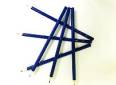
fig. 1 fig. 2 fig. 3
5. In fig. 4a the bald line showed
the figures bent from a wire. Represent three of their projections: on a
forward side of a cube, on its lateral edge and on the upper edge. [Answers in
fig. 4b are under the images of the corresponding figures].
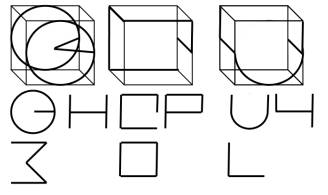
a
b
fig. 4
However in all cases, models are desirable to do after the decision, but
not for the decision. If a teacher begins consideration of the offered tasks
with models, the students' imagination is not involved and incentive for its
development turns out weak.
In summary we will note that originality of tasks causes interest in
students both during the work at the lesson and in out-of-class activity, and
it is one of necessary conditions of subject successful studying.
References:
1.
State
educational obligatory standard of the Republic of Kazakhstan, 12-year
secondary general education. Astana. 2006.
2.
V.A. Dalinger, Technique of
students' spatial representations formation at Geometry lessons. – Omsk: OGPI,
2005.
3.
I.S. Yakimanskaya, Psychological
bases of mathematical education: manual. – M.: Publishing center
"Akademiya", 2004.
4. G.D. Gleizer, Methods of formation and development of spatial
representations of school students at Geometry lessons. - M.:1984.
5. I.Ya. Kaplunovich, Psychological regularities of spatial thinking
development // Psychology issues. - 1999. - №1. - P. 64-68.
6. E.N. Kabanova-Meller, Educational activity and
evolutive training. – M.: Education, 1981.
7. A.G. Maklakov, General psychology. SPb: Piter, 2001.