Korovaiko
Irina Vladimirovna, candidate of Pedagogical Sciences
Burumbayeva Aliya,
master
Pavlodar State University
named after S. Toraigyrov
The
Issue of Formation of Value Family Orientations among Young People
Annotation: The article describes the issue of formation of value family
orientations among young people. It provides survey results among students for
whom family and marriage represent life values.
Key words: family, marriage, family and matrimonial relationships, readiness of
youth to create a family, psychological readiness to create a family, social
and moral readiness to family life, legal marriage, civil marriage, guest
marriage.
The issue of family, its preservation and fortification presently takes
important place among the social problems. The number of divorces is
increasing, birthrate is decreasing, and the number of illegitimate children,
children living in incomplete families is increasing, as the number of crimes
related to family abuse. At present it is noted that regulatory impact of family
behavior rules and standards earlier established and fixed in public
consciousness has considerably weakened.
Strengthening of negative processes in family and matrimonial
relationships is largely connected with special social settings and motives formed among young people quite recently under the influence of changed
social conditions and standards. Marriage and family in some people’s mind is
becoming more the means of satisfaction of needs in intimate and informal
socializing. Preparing of young people to family life, formation of adequate visions
of a family and marriage in conditions of the existing critical situation in
demographical area is a significant issue and a vital nationwide problem.
In modern Kazakhstan considerable attention is paid to fortification of
the institution of the family and marriage. The “Kazakhstan-2030” message of
our President, N.A. Nazarbaev assigns a high priority to efficient
demographical policy in family’s support. Traditional family campaign is
carried out with the purpose to revive best family standards capable of
strengthening a modern family, ensure its normal functioning in the changing
world conditions [1].
The
problems of family and marriage have been reviewed in works of such scientists
like Kon I.S., Berne E.L., Barsukova S.Yu., Bendas T.S.. Zherebkina I.A., Iskakova
M.S. Lebedeva O.A. etc.
Most
of scientists consider that steadiness of marital and family relationships
depends on readiness of young people to the family life, where readiness to
marriage is understood as the system of social and psychological settings of a
person that determine emotionally positive attitude to a family lifestyle [2]. Readiness
to marriage is an integral category including a set of aspects:
1. psychological;
2. social
and moral.
Psychological
readiness to create a family suggests presence of communications skills, unity
or similarity of views of life in common and family life in particular,
disunion of these views often becomes the reason for divorce. The ability to create
moral and psychological climate in family, steadiness of character and
feelings, developed personal leadership qualities are essential. Especially important
are tolerance and justice in assessment of family members’ deeds, the ability
to self-control, goal orientation, self-dependence, determination, insistence,
endurance, self command and self discipline. It is also important to feel
the condition of another person, foresee his or her emotional reaction.
Social
and moral readiness to family life stipulates civil maturity (mandatory
secondary education, profession, moral consciousness, age), economical
self-dependence and health. Developed moral consciousness of young men and women
is one of the most significant conditions to be ready to marry. It manifests
itself by understanding social importance of family, serious attitude to
marriage, and conscious choice of a partner [3].
The
aim of our research was to find out the attitude of young people to family life
and determine their readiness to create a family. 40 students of Pavlodar State
University named after S. Toraigyrov from 1 to 4 course were interrogated (girls and boys equally). Anonymous survey was selected as the main
method of research as it allowed obtaining true answers.
The questionnaire contained the below questions:
1.
In your
opinion, what are the reasons to marry?
2. Are you ready to create a family
while studying at the college?
3. What does a family mean to you?
4. Name drawbacks of family life.
5. What is your attitude to a civil
marriage?
6. What types of marriage are the most
steady?
To
the first question of the questionnaire: “In your opinion, what are the
reasons to marry” we received the following answers:
-
love,
-
acquisition of a person who will take care of you,
-
desire to have children,
-
tradition,
-
desire to improve one’s material well-being,
-
pregnancy,
-
acquisition of social status.
Information on the first
questionnaire item (in %) are shown in Figure 1.
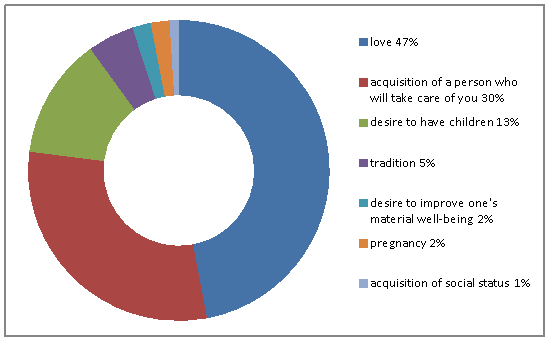
Figure 1. Results of
answering to the questionnaire item “In your opinion, what are the reasons to
marry?”
To the second question:
“Are you ready to create a family while studying at the college?” 84
% of the interrogated people replied negatively, explanations were as
follows:
-
first, it is difficult to combine studying and family life;
-
second, parents will be absolutely against it;
-
third, in the society it is usual to get married after graduating from the
college.
To the third question: “What does a family
mean to you?” we received the following results:
-
56% of students indicated that family and marriage are the most important
things in life;
-
6% of respondents noted that the family is important, but the marriage itself
is a formality;
-
32% of students replied that at
the time of studying at the college it is early for them to think about
creating a family;
-
6% failed to answer this question.
The
questionnaire results of: “What does a family mean to you?” are shown in Figure
2.
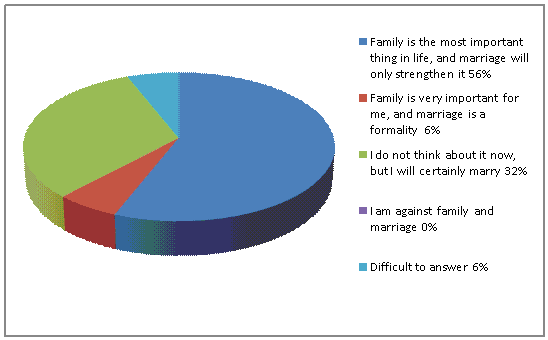
Figure 2. The questionnaire results
on: “What does a family mean to you?”
In reply to question 4, the below aspects were
listed among drawbacks of family life:
- a fear of responsibility,
-
limited freedom of spouses,
-
limited time to study,
-
difficulty in building a career.
Table
1 shows students’ answers to question 4 (in %).
Table 1. Drawbacks of family life
|
# |
Answers |
(%) |
|
1 |
Considerable
limitation of freedom |
15% |
|
2 |
Family prevents
from career growth |
6% |
|
3 |
Responsibility
for material support of the family |
17% |
|
4 |
Difficult to
combine family and study |
11% |
|
5 |
Growth of
responsibility |
3% |
|
6 |
Do not see any
drawbacks |
47% |
|
7 |
Difficult to
answer |
1 % |
Recently
there exist various kinds of marriage, and often the preference is given not to
a legal union, but to a co-residence without formal registration (‘civil
marriage’). Therefore the questionnaire proposed students to answer the fifth
question: “What is your attitude to a civil marriage?”, and we received the
following answers: 78% –
negative, 22% – positive. The answers were explained as follows:
- civil marriage is a trial marriage, a life
experiment;
-
civil marriage is an outrage against the traditional family;
-
civil marriage is the proof that love and trust are more important than a ‘stamp
on the passport’.
To
question 6: “What type of marriage is the most steady?”:
-
legal marriage secured by a stamp on the passport and mutual responsibility;
-
civil marriage “representing co-residence of a man and a woman without formal
registration” [4];
-
guest marriage, where a couple has neither common residential space, nor common
household.
The most steady marriage type chosen by the
students under this questionnaire item:
-
civil marriage is 83% (out of which: by
love – 72%, interested marriage – 4%, based on common religion – 7%);
-
civil marriage is 9%;
-
guest marriage is 8%.
The
questionnaire results confirmed that the majority of young people in Kazakhstan
stick to traditional views, family and marriage for them represent solid life
values. Love and children are considered the main things in family life. Young
people in the majority are serious about creating a family, they understand
hardness and responsibility of being a spouse, therefore they do not hurry to begin
marital and family relationships while still being students. However, some new trends
are also noted: age of marrying is postponed, interested marriage, civil and
guest marriage, marriage based on common religion are accepted as alternatives.
All of this is the indicator of gradual deepening of critical tendencies in
family life sustenance. Understanding of new realities and growing risks in this
area requires rethinking of educational work both in family and at the college
to be more oriented at support of the family role and importance.
References:
1.
Iskakova M.S.,
Lebedeva O.A. Features of the family adaptation and behavior of the young
couple at the stage of forming a family // Bulletin KazNPU. Ser. Psychology. -
2006. - № 2. - p. 45-53
2.
Andreeva T.V.,
The psychology of the modern family. - SPb .: Speech, 2005.
3.
Shubovich M.M.,
Faizova V.B., - Formation of the system of values that form the
psychological readiness for marriage among students // Bulletin of Tomsk State
Pedagogical University, number 4, 2013
4.
Barsukov S.M.,
Chulanov V.A., Unregistered marriage in the estimates of modern youth SRSTU //
Bulletin number 6, 2012