Vasyl Pysarenko
National technical
university of Ukraine «KPI»
methods of
automatic control of cutting process on cnc machines
Presented on the main feature - based on what
information is made basic methods of managing the impact of automatic process
control cutting CNC for given volume allowance is cut at a time. The possible
implementation of the scheme of each method in the design of control programs
and machining on CNC machines.
Keywords: CNC, automatic
control of morphogenesis, a priori information.
Introduction. The development of modern
high-performance machines and mechanisms require the use of high-precision
parts with complex shapes, especially the manufacturing process which is metal
cutting. The use of metal-cutting machine tools with numerical control (CNC),
as compared to the universal equipment, can significantly improve the
efficiency of metalworking. The accuracy and efficiency of manufacturing
details on CNC machines largely depend on the quality of the programmed control
information, the complexity of its preparation, the extent of considering the
peculiarities of the process and cutting equipment, implementation of control
functions exactly the geometric parameters of machined parts and cutting tools.
When processing complex the 3-D surfaces lion's share of time spent on its
formation, but under certain conditions, the difference in time, the
application of the methods of automatic control of up to 300%.
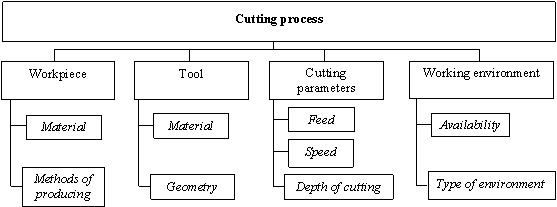
Fig.1. Parameters of cutting process
Formulation of the problem. Considering diagram
(see fig.1) and components included in it, it is obvious that the only effect
of which can be controlled during the course of the cutting process has cutting
parameters. But despite this, still has no clear method of automatic control
which would in all cases, to manage the process of cutting and guarantee
consistent accuracy and quality of the processed surface of the 3-D with
minimal processing time. Unfortunately, the methods of automatic control of the
cutting process, in most cases in modern productions hardly used, but some of
the leading manufacturers of CAM systems and CNC electronics [1-5] offer a
variety of management practices that differ in one important feature - the
processing of the control action . Algorithms and mathematical models that form
the basis of the methods of automatic control of the cutting process does not
cover the companies, and their results differ, pointing out that the developed
algorithms are not the best. Therefore, the choice of automatic control of the
cutting process, the development of algorithms and mathematical models of its
implementation is an urgent problem in engineering.
The solution of the problem. Despite the large variety of management techniques,
they can be divided by one extremely important feature - on the basis of what
information the manager made an impact. This is the time factor, which
determines the time of filing information [10, 11]. This approach allows us to
distinguish three main methods of management:
- A priori;
-
Current;
- A posteriori.
Any
cutting process is carried out under conditions of influences, which are
divided by the nature of the impact on the deterministic and random, and the
proportion of a particular component can vary over a considerable range. It is
important to determine in advance the impact of each component, and depending
on it to make the right decision regarding the most effective method of
control. Thus, the mathematical model of the cutting process, which always
presents it with some degree of adequacy must be taken into account in the
design of the ACS.
Consider
each method separately on the example of forming the cutting process.
Control
is performed by a priori information on the basis of a mathematical model of
the system, it is assumed in advance. A priori information is contained in the
processing of transfer functions and WE WEES that have
been pre-determined. These transfer functions are completely determined by the
geometrical parameters of the treated surface, cutting conditions, tool geometry,
stiffness EES, as well as other pre-known parameters. As for the random
component of the process will determine the overall results of stochastics, the
advance can only be defined its parameters assuming a normal distribution law.
The essence of the management of a priori
information and explains the scheme of Fig.2 is that based on the study of the
process of formation, which is carried out in a closed process system,
determine the modification of the transfer functions and WE WEES
that provision, and calculate the amount of the allowance given Qt1,
as a function of shear submission to the Cartesian coordinate system,
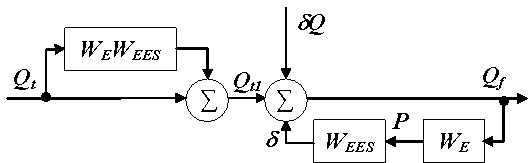
Fig.2. The control circuit of a priori information
The correction element should be implemented in the preparation of the
management of the program given by moving the instrument. Thus, this method
involves the use of management imperative CNC machine. The control system is
open and therefore its effectiveness is totally dependent on the accuracy of
the a priori information.
Control method provides information on the current ongoing management
directly in the implementation of the cutting process. If you are able to
obtain reliable information the instantaneous value of the error or the actual
amount of the allowance cut off directly at the point of processing, it is
possible to build a self-propelled guns, which corrects the theoretical amount
of the allowance Qz cut, by comparing it with the actual Qa
of volume, which is measured by the feedback channels communication: δQz
= Qz- Qa. This automatic control system consists of the
control feed drives morphogenesis and measuring feedback devices. Fig.3 shows
the control circuit of the present method.
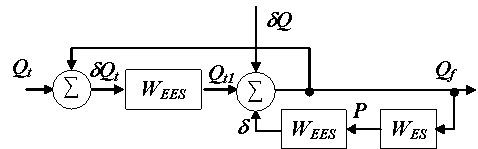
Fig.3. The control circuit for current information
Control method up to a posteriori information
involves the use of already treated parts to manage the processing of the
following items, ie performed with a certain delay of one cycle (Fig.4).
On the block diagram of Figure 4 the same notation
as before, and the delay reflected the transfer function be-τs,
where b - factor correction, τ - cycle time and measurement of one piece,
s - Laplace operator. The latter involves the creation of the complex, which
automatically measures the workpiece and transmits the information to the CNC
machine for the appropriate correction tool positions by the amount of the
expected error of the following items.
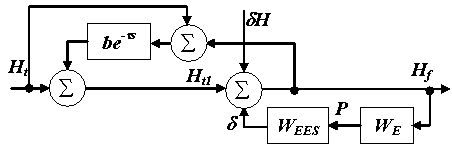
Fig.4. The control circuit by
the a posteriori information
Correction may take place at a certain constant
value, independent of the coordinates of the current processing or considering
such a relationship. In the first case, a control method is known as auto-adjustment
which permits automatic correction. In the second case, you do not adjust the
position of the tool as a constant, independent of the current position and the
trajectory of the relative motion of the shaping. Thus, it is a correction
function depending on the coordinates, which is defined and the number of the
processing cycle from the beginning of the process. Since the transfer
functions and WE WEES during processing changes, this
correction should be continuous and cover the entire range of the coordinate
sets.
Conclusion. Analysis of the
methods of automatic control allows to make the following conclusions:
- Better in terms of accuracy, a method of
controlling by the current information. It provides full compensation for the
deterministic component of the error handling and the highest ratio of
refinement operation, indicating a significant decrease in the influence of the
random component of the error handling.
- Control method for a priori information with
adequate process model is completely deterministic component compensates for
error handling and almost no effect on the random component. This method has
the greatest prospects for use in any kind of blade machining, especially in
cases where the deterministic component in the overall balance of error
prevails.
- To implement the control a posteriori
information necessary to use CNC and organize a system of automatic control to
include control and measuring machines (CMMs).
References:
1) http://www.cgtech.com/products/about-vericut/vericut-reviewer/
2) http://www.mastercam.com/en-us/Solutions/Latest-Enhancements
3) http://www.delcam.com/ru/software/vortex/index.asp
4) http://www.omative.com/Optimization.html
5) Layegh, S.;
Lazoglu, I.; Erdim, H. Tool Deflection in Five-Axis Milling International
Conference and Exhibition on Design and Production of Machines/Dies/Molds
TR2013-057 June 2013.
6) Петраков
Ю.В. Розвиток САМ-систем
автоматизованого програмування верстатів
з ЧПУ: монографія. – К.: Січкар, 2011. – 220 с
7) Петраков Ю.В.
Автоматичне управління процесами обробки матеріалів різанням / УкрНДІАТ, Київ,
2004.-384с.