The honored science and education member of the RANS,
corresponding-member of the IAS of HS, Dr.S. (eng.). Professor, Pil E.A. Russia, Saint-Petersburg,
Saint-Petersburg State Marine Technical University
VARIANTS
OF MACROECONOMY DEVELOPMENT AFTER BEING AFFECTED BY INTERNAL AND EXTERNAL
FORCES
When affected by external or internal forces (or by both
of them combined), economic shells deform, and their deformation can be sorted
into the following types presented in the table.
At the simultaneous expansion (retraction) of economic
shells (or at their expansion and retraction combined) it is implied that it
may take place proportionally, i.e. according to one mathematical law and by
one and the same relative value percentagewise, as well as disproportionally, i.e.
according to different mathematical laws and by different values
percentagewise.
Complex deformation of an economic shell is understood as deformation
during which there is simultaneous influence of external and internal forces
applied to different locations. That said in one or several areas the economic
shell retracts under the influence of external forces, and in one or several
locations it expands under the influence of internal forces. In this case
external and internal forces affecting the economic shell may be similar or
different in value.
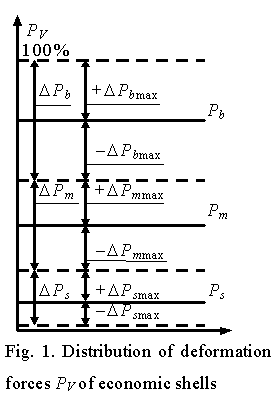
As forces PV affecting an economic shell may differ in
their relative value, let us introduce the following three levels for them:
·
Pb is a major external (internal) force;
·
Pm is a medium external (internal) force;
·
Ps is a minor external (internal)
force.
Let us set the force value as PV
with the “-” sign for external forces that retract an economic shell so that it
deforms and its volume decreases. If an economic shell is affected by internal forces, let us consider
them positive, i.e. with the “+” sign, as in this case the economic shell also
deforms, but its volume increases. In order not to complicate further description, we will omit the
“+” sign.
Hereafter in diagram descriptions there will be the “forces” term which
will imply both forces and force. This is done in order not to complicate the
description.
Now let us give definitions to all the three forces.
The major external (internal)
force Pb is a force under whose influence an economic shell deforms
significantly and receives at least one fracture.
The medium external (internal)
force Pm is a force under
whose influence an economic shell deforms significantly, but in this case it
does not receive any fractures.
The minor external (internal)
force Ps is a force under
whose influence an economic shell deforms slightly.
Fig. 3 presents the distribution view of the deformation force PV
of an economic shell on whose
basis we can deduce the following formulas (1-3)
DPb = +DPbmax + ï-DPbmaxï, (1)
DPm = +DPmmax + ï-DPmmaxï, (2)
DPs = +DPsmax + ï-DPsmaxï, (3)
where: DPi is the value of the deformation force PV of an economic shell. Hereafter we
will understand the “force PV” term as forces similar in
value and affecting an economic shell homogeneously which is shown below on the
figures;
+DPmax is the maximum deviation of the value of deformation force PV
of an economic shell increasingly;
-DPmax is the maximum deviation of the value of deformation force PV
of an economic shell decreasingly;
Thus, the value of deformation force PV
of an economic shell can be
presented by the following equation (4)
PV = DPb + DPm + DPs = +DPbmax + ï-DPbmaxï + (+DPmmax) + ï-DPmmaxï + (+DPsmax) + ï-DPsmaxï =
100%. (4)
Here we must specify that the values of DPb exceed the values of
DPm and exceed by many
times those of DPs, i.e. DPb > DPm, DPh >> DPs, and that said the
values of DPb must change in time
much rarer than those of DPm, and far much rarer
than those of DPs. Otherwise, the
economic system will be unstable and face often economic perturbations in the
form of world economic crises. Moreover, it is difficult to imagine that every
month there might be such laws adopted or such cataclysms happening that would
lead to this state of the economic shell.