UDC 339.92
THE DEVELOPMENT
PERSPECTIVE FOR THE ECONOMIC PARTNERSHIP OF THE REPUBLIC OF KAZAKHSTAN AND TURKEY
ПЕРСПЕКТИВЫ РАЗВИТИЯ ЭКОНОМИЧЕСКОГО
СОТРУДНИЧЕСТВА РЕСПУБЛИКИ КАЗАХСТАН И ТУРЦИИ
Onalbek Abraliyev
Yerkimbekuly Rauan
Annotation
In
the article the state of the economic partnership between Kazakhstan and Turkey
is considered. In the work exports from
Kazakhstan to Turkey and imports from Turkey to Kazakhstan are analysed.
Аннотация
В статье
рассматривается состояние экономического сотрудничества между Казахстаном
и Турцией. В данной работе проведен анализ экспорт из Казахстана в
Турцию и импорта из Турции в Казахстан.
Key words: Kazakhstan
and Turkey, economic partnership, the volume of imports, the volume of exports.
Ключевые слова: Казахстан и
Турция, экономическое сотрудничество, объем импорта, объем экспорта.
Turkey
and Kazakhstan have strong economic and cultural ties [1]. Turkey was the first
country to recognise the sovereignty of the Republic of Kazakhstan. Both Turkey
and Kazakhstan have common long term have strategic, financial, commercial and
economic interests.
In
the international trade the national markets of the sovereign states interact
and cooperate with each other, as well as participation in the international
division of labour. Moreover, the external economic relationships play the
significant role in the economy of any countries as the process of regional
economic integration or simple trade contracts. In the global market a country
does not benefit from creating a closed economy without having different
economic or financial interactions with other countries.
Increasing
the volume of export is the necessary condition to expand the participation of
the state in the international division of labour in order accelerate the
social and economic development of the society. The relationship between
trading countries should be based upon the mutually beneficially basis which
considers demands and abilities of both sides.
Economic
cooperation and integration may bring economic growth, increase in the demand
for the labour force and decrease in unemployment, increase in the GDP,
improvement of the living conditions [2, 3]. There is the economic
interdependence in trade, which may lead to industrial cooperation between two
countries or their different sectors of economy [4].
According
to Parkin et al. (2014) the comparative advantage of difference between
different sectors of economy and the structural differences in economy may
determine the trade between two countries [5, pp. 149-155]. The availability of
natural resources and developed oil sector in Kazakhstan determine that oil and
copper have the highest share among exports [6].
Opportunity
costs between producing and importing, as well as absence of natural resources
or production infrastructure, development difference between sectors of economy
also impact the international trade [7, pp. 610-623].
In
2014 the volume of imports from Turkey to Kazakhstan is around 1 billion USD,
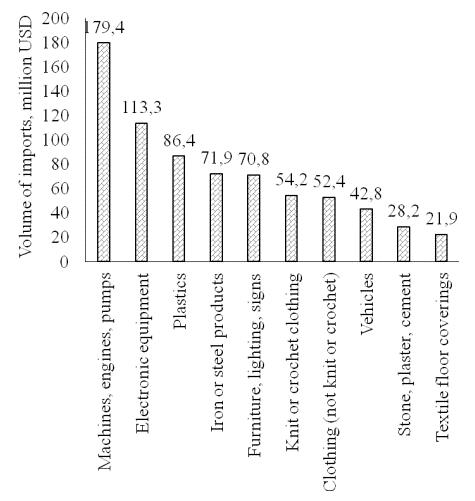
or around 2.5% of total Kazakhstani imports. Table 1 shows the most significant
import segments in 2014 from Turkey to Kazakhstan.
Table 1 – Top imports of Kazakhstan
from Turkey in 2014, million USD
Resource: World’s Richest Countries (2015) Top Kazakhstan Imports from the World.
Retrieved 2 May, 2015 from http://www.worldsrichestcountries.com/top_kazakhstan_imports.html
According
to table 1 the biggest volume of imports are machines, engines and pumps –
179.4 million USD. The second place is owned by an electronic equipment – 113.4
million USD, which is 36.845% or 66.1 million USD less than the top import
segment. The volume of imports for plastics is 86.4 million USD, which is in
the third place among the top imports.
The
tenth place belongs to the segment of textile floor coverings – 21.9 million
USD, which is 87.79% or 157.5 million USD less than the segment of machines,
engines and pumps. The average of top ten imports from Turkey is 72.13 million
USD. The standard deviation of top imports is 46.465 million USD. The first
quartile of the top ten import segments is 45.2 million USD, the third quartile
is 82.775 million USD. Therefore, the interquartile range is 37.575 million
USD.
The
volume of exports from Kazakhstan to Turkey in 2014 – 2.3 billion USD, which is
1.3 billion USD higher than the volume of imports. The volume of imports from
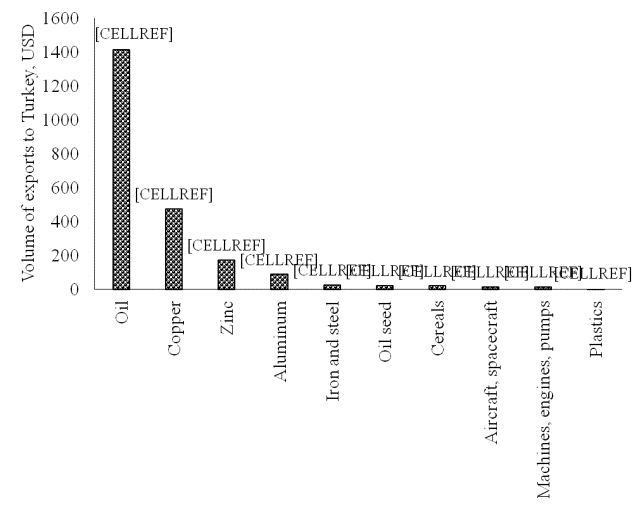
Kazakhstan is 2.9% from Turkish overall exports. Table 2 shows the biggest
export segments in 2014 from Kazakhstan to Turkey.
Table
2 – Top exports from Kazakhstan to Turkey in 2014, USD
Resource: World’s Richest Countries (2015) Top Kazakhstani Exports to the World.
Retrieved 2 May, 2015 from http://www.worldsrichestcountries.com/top_kazakhstan_exports.html
Table 2 demonstrates that the top
segment of imports in 2014 belongs to oil - $1.4 billion. The second place
belongs to copper - $474.5 million, and the third place is owned by zinc export
- $170.7 million.
Among exports of agricultural
products the most highest volume belong to oil seeds – $22.8 million and
cereals – $19. 5 million.
The last place among the top exports
is owned by the segment of plastics – $5.7 million, which is 99.596% less than
the oil export sector.
In conclusion, analysis of tables 1
and 2 demonstrates that the trade between Kazakhstan and Turkey has high
potentials: the volume of imports to Kazakhstan from Turkey in 2014 is around 1
billion USD, and exports – 2.3 billion. The participation of Kazakhstan and
Turkey in the international labour division and the global trade allows both
countries to satisfy the economic demands more efficiently and stimulate the
development of economy. Therefore, developing trade between Kazakhstan and
Turkey upon the mutually beneficially basis is the important step to achieve
the economic prosperity in the Eurasian region.
References
1. Jody, I. (2012) Kazakhstan-Turkey
Relations. EU: Cred Press.
2. Lim, S. (2015) ‘How
Beneficial Would the Construction of a Rason-Hunchun Sub-Regional Economic
Cooperation Zone in the Northeast Asian Borderlands Be?’. North
Korean Review, 2(1), pp. 63-81.
3. Tomasz, Z. (2015). The Economics of International Environmental
Cooperation. Frankfurt am Main : Peter Lang AG.
4. Trouille, J. (2013)
‘Economic And Industrial Cooperation between France and Germany: Assessment and
Future Prospects’. German Politics &
Society, Issue 106, 31(1).
5. Parkin, M., Powell,
M., & Matthews, K. (2014) Economics,
9th edition. Harlow, the
UK: Pearson Education
Limited.6. World’s Richest Countries (2015) Top
Kazakhstani Exports to the World. Retrieved 2 May, 2015 from http://www.worldsrichestcountries.com/top_kazakhstan_exports.html
7. Lipsey, R., &
Chrystal, A. (2007) Economics, 11th
edition. Oxford:
Oxford University Press