Chris Waliszewski, PhD
The Poznan University of
Economics
Personal financial advisor in the U.S. – the
profession of the future
Abstract
This article is dedicated to personal financial
advisor profession in the U.S. – its current state and prospects for the
future. The hypothesis of the article is as follows: the demand for personal
financial advisory services, taking into account various determinants, will be
likely to increase and will allow them to become the profession of the future.

The reasons for
the creation and operation of personal finance advisors are, on the one hand,
changes taking place in today's financial markets and, on the other hand,
changes in financial behavior of households. A simple sale of financial
products without matching them to the needs and objectives of individual
customers is a short-term action. Financial advisors offered to customers more
than simple sale – professional help in the area of personal financial
management. Institutional differentiation system of financial intermediation,
higher popularity of financial markets as a place to raise capital for deficit
entities and investment for surplus ones, as well as financial innovations
leading to an increasing variety of financial instruments available for
individual customers are the reasons for the increase in popularity of
financial advisors. Households' economic and financial knowledge is relatively
low, they do not have time for individual comparison of offers, are less
oriented in terms of instruments and financial services institutions and
possess less bargaining power with respect to financial intermediaries, hence
the increasing role of the financial sphere in the life of households
(financialization). An important reason supporting the above arguments is the
fact that advisory services industry is growing in strength and in the future
will be more popular as the demographics change and the state pension system
begins to fail. This implies the need for voluntary retirement of capital
accumulation, and the customer needs help in selecting the investments for
retirement period in order to secure a decent pension and the standard of
living comparable to the period of professional activity.
Warschauer lists
six areas in which financial planners make recommendations: emergency fund
management, debt management, insurable risk reduction, investment risk control,
goal assessment, and tax and estate assessment. There is a large number of
special areas of knowledge for financial planners so more detailed categories
of advice could be identified[1].
For financial advisors, establishing and maintaining clients' trust is
critical. Surveys conducted by the Certified Financial Planner Board of
Standards in 2004 and State Street Global Advisors rank trustworthiness as the
most important criterion when choosing a financial advisor. Several factors
make trust paramount in a financial context: large sums of money are entrusted
to advisors, significant investment risk is present, sales-based incentives can
create conflicts of interests, and fee schedules often lack transparency. With
the recent financial crisis and the Madoff scandal, investors are now more
acutely aware of these issues.[2]
Modern financial crisis (2007-2009) seriously weakened public confidence in the
profession of a financial advisor, due to aggressive
sales commissions based on the salary credits. This caused investment and
insurance areas to be considered one of the reasons of the crisis. Incorrect
recommendations have led to serious customer advisors financial problems - loss
or insolvency of failed investments. The creation of a
post-crisis financial system security architecture in the U.S. (The Dodd-Frank Wall Street Reform and Consumer
Protection Act of 2010) covered the financial advisory industry,
particularly investment advisors. Specific
changes resulting from this legislation relate to methods of registration and
supervision of investment advisors.
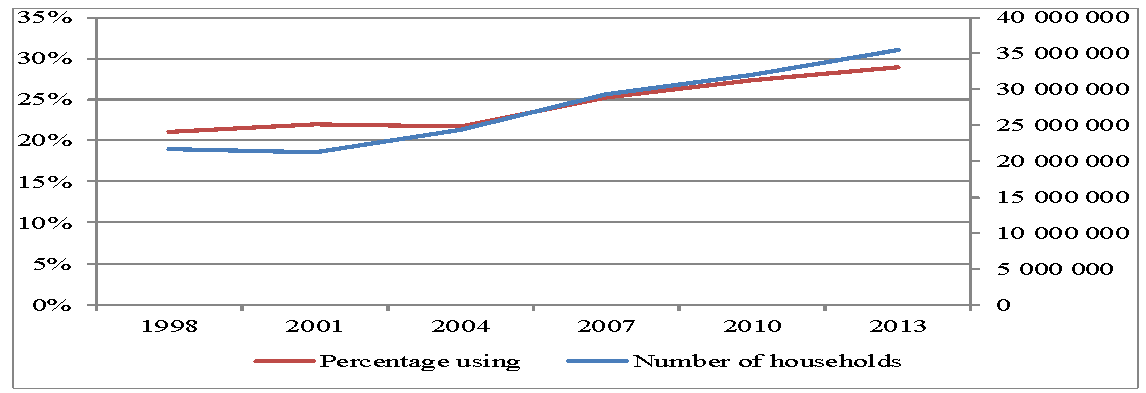
Research conducted by Hanna Sherman[3]
and the data from the Survey of Consumer Finances indicates that the scale of
using the services of financial advisors among U.S. households is still growing
– in 1998 it was about 21% and in 2013 approximately 29%. This indicates growth
by about 7 pp which reflects growth
from 21.67 million to 35.5 million in sheer number of households in the same
period.
Chart 1. The percentage of the
U.S. households using personal financial advisor and estimated number of
households using personal financial advisor
 Source: own study based on S.
Elmerick, C. P. Montalto, J. F. Jonathan, Use
of Financial Planners by U.S. Households, Financial Services Review , Vol.
11, No. 3/2012; S. D. Hanna, The Demand
for Financial Planning Services, Journal of Personal Finance, Vol. 10, No.
1, November 2011 and 2013 Survey of Consumer Finances
Source: own study based on S.
Elmerick, C. P. Montalto, J. F. Jonathan, Use
of Financial Planners by U.S. Households, Financial Services Review , Vol.
11, No. 3/2012; S. D. Hanna, The Demand
for Financial Planning Services, Journal of Personal Finance, Vol. 10, No.
1, November 2011 and 2013 Survey of Consumer Finances
According to Wall Street Journal research and the data from the
Financial Industry Regulatory Authority (FINRA), there are 208 financial
services professionals operating in the U.S. with individual designation who
advise the public – 101 of them are tracked in a database kept by the FINRA.[4]
They differ by organization issuing certificates, educational requirements, continuous education/experience
requirements and investor-complaint process. Some of them are universal
(overall) financial planners/advisors, but some are specialists in a selected
area of personal financial planning and management, for example retirement and
pension planning, estate planning, investment advisory, asset and wealth
management, insurance counseling, tax advisory, credit and debt management. The
most common are the following: AEP (Accredited
Estate Planner), CASL (Chartered Advisor
for Senior Living), CEBS (Certified
Employee Benefit Specialist), CFA (Chartered
Financial Analyst), CMA (Chartered
Market Analyst), CFP (Certified
Financial Planner), ChFC (Chartered
Financial Consultant). Certification systems for personal financial
advisors are characterized by multi-leveling, which means that there are
several types of counselors with different knowledge, experience and
requirements in each system. Multiplicity of types of financial services
specialists contributes to advisory market maturity in the U.S. A large group
of financial advisors in the U.S. is certified
in accordance with the CFP standards and this certification system is
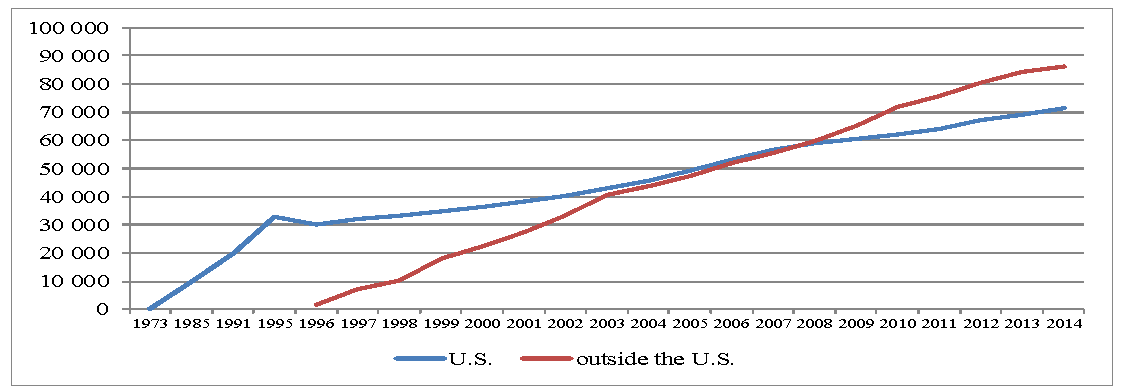
also widespread internationally. As of 31st December 2014 there are 157,586 CFP
holders from 26 territories around the world. 45% of them, i.e. 71,296 operate
in the U.S. (chart 2). More than half of CFP professionals practice outside the
U.S.[5]
Since the origins of personal financial planner profession at the Chicago
airport meeting of Loren Dunton, called the father of advisor profession, with
12 individuals in 1969, and the first issuing of 42 certificates in 1973, the
CFP movement of financial planners and financial advisory industry connected
with education, certification, examination and continuous education, as well as
operating compliance with the code of ethics, has gained in importance on the
international field.[6]
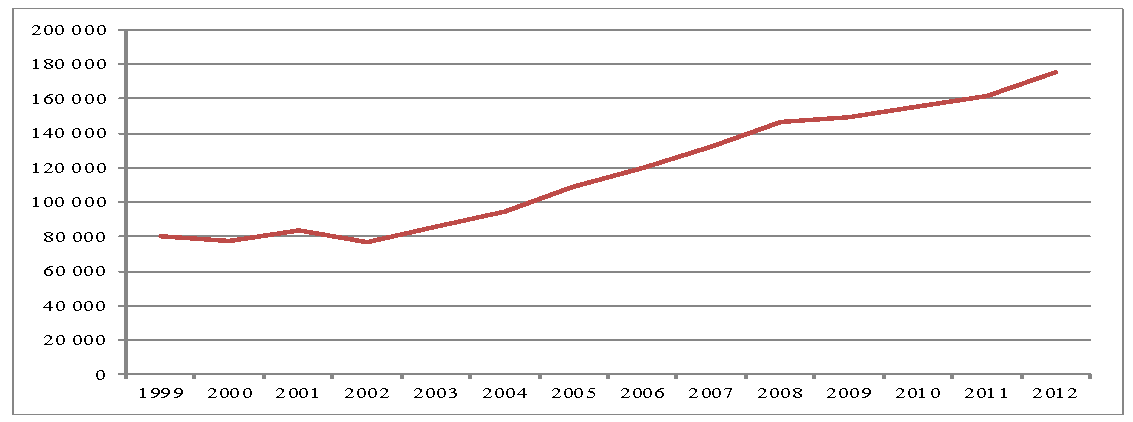
As chart 3 shows, particularly dynamic increase in the number of
advisors could be observed between 2002 and 2008, i.e. in the pre-crisis period
when the number of advisors almost doubled. In 2012 more than 20% of personal
financial advisors were self-employed. The industries that employed the most
personal financial advisors in 2012 were the following: other
financial investment activities (27%), credit intermediation and related
activities (21%), securities and commodity contracts intermediation and
brokerage (19%), insurance carriers and related activities (4%), professional,
scientific, and technical services (3%).
Chart 2. CFP holders in the U.S. and outside the U.S.
 Source: own study based on data from Financial Planning Standards Board
Ltd.
Source: own study based on data from Financial Planning Standards Board
Ltd.
According to the data of the U.S. Bureau of Labor Statistics (BLS), in
2012 there were 223,400 personal financial advisors. The data indicates that
between 1999 and 2012 the number of advisors hugely increased (in 1999 there
were 79,970 advisors).
Chart 3. The number of personal financial advisors in the U.S.
Source: own study based on Occupational
Employment Statistics, The U.S. Bureau of Labor Statistics
Financial planning services are provided by a wide
variety of firms, ranging from very large financial service companies to
one-person boutiques. This range of provider types has an equally wide variety
of compensation methods, ranging from commission-based companies to fee-only
firms, as well as entities with mixed compensation methods[7].
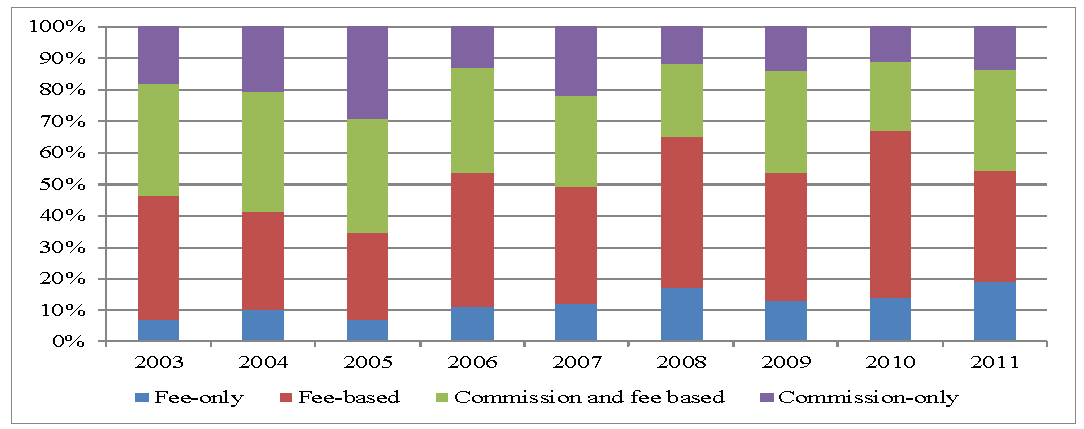
The BLS data from 2012 indicates that personal financial advisors earned
$67,520 per year and $32.46 per hour. In the last decade (2003-2011) the
structure of remuneration of financial advisors changed. While in 2003 commission and fee-based, as well as commission-only models were dominant, in
2010 the share of fee-only and fee-based models increased to 66%, and
in 2011 fell to 54% (chart 4). This indicates that commission is less significant than fee in remuneration structure and that is was presumably the
greater willingness of customers to pay consultants for services, so that
advice could be more independent, impartial and of higher quality.
Chart 4. Increase in fee-based advice in the U.S.
|
Key: |
fee |
commission |
|
Fee-only |
>90% |
<10% |
|
Fee-based |
50%-90% |
10-50% |
|
Commission and fee-based |
10-50% |
50-90% |
|
Commission-only |
<10% |
>90% |
Source: R. Sullivan, US Groups
Have a Head Start in UK Post RDR, Financial Times, 27 May 2012
The growth factors of personal financial advisory market services in the
U.S. in the future will rest on the following:
1.
Aging population and higher life
expectancy should increase the demand for estate, pension and retirement planning.
2.
Large numbers of baby boomers
approaching retirement will seek planning advice from personal financial
advisors[8].
3.
Longer life spans will lead to
longer retirement periods, further increasing the demand for financial planning
services.
4.
Decreased funds for corporate and
state pensions are also expected to contribute to the trend of hiring personal
financial advisors. Private corporations, as well as state and local
governments are facing shortfalls in their pension funds, which may lead to
benefit reductions.
5.
Increasing the awareness of the
public and the financial benefits of using the services of financial advisors.
6.
The need to manage debt and make
responsible decisions in the area of consumer and mortgage credits.
7.
Greater awareness of the risks and
property and life insurance.
8.
Tax optimization in the management
of personal finance (investment, loans, pensions) and succession planning.
9.
Soaring scale of using the services
of financial advisors – in 2013 29% of U.S. households were using personal
advisory services and this indicator is still growing.
10. Rebuilding of public confidence in the profession of financial advisor,
seriously diminished by the financial crisis.
11. Greater importance of new technologies in the area of financial advisory
services, such as the creation of applications for personal finance managing
(PFM).
12. Democratization of access to financial advisory services – they are not
reserved for the wealthy people but particularly for middle-class population.
According to BLS estimations, the employment of personal financial
advisors is projected to grow by 27% to 283,700 advisors in the years
2012-2022, much faster than the average for all other occupations (for the
occupations in business and financial sectors the projected growth rate in
2012-2022 will be 13% and for all other occupations - 11%). This means that
personal financial advisory services branch will become a very perspective
workplace, not only for former financial institutions workers, but also for
finance and economics graduates. The structure of personal financial advisors
employment in 2022 will be as follows: self-employed (18%), other financial
investment activities (33%) – the biggest growth rate from 2012 at a level of
about 6 pp, credit intermediation and related activities (19%), securities and
commodity contracts intermediation and brokerage (19%), insurance carriers and
related activities (3%), other (8%).