Экономические
науки/6. Маркетинг и менеджмент
Netreba I.O.
PhD in Economics, Associate Professor
Taras Shevchenko National University of Kyiv
Kyiv, Ukraine
Knowledge management system at the
enterprise: organizational model
At the
present stage of business development, strategic planning of information
technology to assess the effectiveness of the company under the influence of
information technology and the processes of interaction between employees. The
strategy of information system should be carried out as part of a strategic
program of technical and technological training. This is due to the dominant
factor in management:
1.
Permanent changes in the structure of business processes.
2. Many
of alternative management decisions and necessity to choose the best option.
3.
Necessity of increase contacts with business partners and customers.
4.
Increased competitiveness in the market.
5. The
need to resolve problems in management of the enterprise the purpose of economy
material resources.
6. The
need evaluations of the scope and difficulty of market infrastructure.
7.
Construction of system capital accumulation.
Based
on these factors, it became necessary to replace the existing information
systems, which do not satisfy the requirements of the business. Information
systems could not meet new business needs of the enterprise, did not form a
consolidated system of the company, did not provide full processing of data,
which is used for management decisions, could not manage the logistics and
planning of innovative activity of the enterprise.
It is
reasonable to build the organizational model of information and technological
support of enterprise, including structural element "Knowledge management
system." The main objective of this system is the creation, accumulation
and application of knowledge in the company. The criterion of its effectiveness
of enterprise employees is the ability promptly receive the information, ideas
and knowledge. The basis of organizational knowledge management model the
company has three key elements (Table 1):
Table 1. Key elements of the
organizational model of knowledge management at the enterprise [1, p.165; 2, p.
82]
|
Element of model |
Types of element |
The role played by the element in the model |
|
TECHNOLOGY |
information management manufacturing |
Identify
the sources of knowledge; The
choice of tools of exchange, accumulation, storage and diffusion of
knowledge: · traditional
tools (corporate repositories of knowledge, corporate and intracorporate Web-portals,
employee motivation methods the exchange of information); · software
for management of corporate knowledge; Building
of movement knowledge way at the enterprise |
|
STAFF |
The generator of ideas Owner of knowledge Consumer of knowledge |
Search application areas
using of the new knowledge; Developing recommendations
for the application of new knowledge |
|
BUSINESS PROCESS |
Typical Modified New |
Knowledge Using; Variables and
correction of business processes |
The
interaction of these elements provides communications between subject and
object management. The result of this process is the evaluation of data on
internal and external factors that are the basis for making optimal management
decisions in the manufacturing sector (Figure 1).
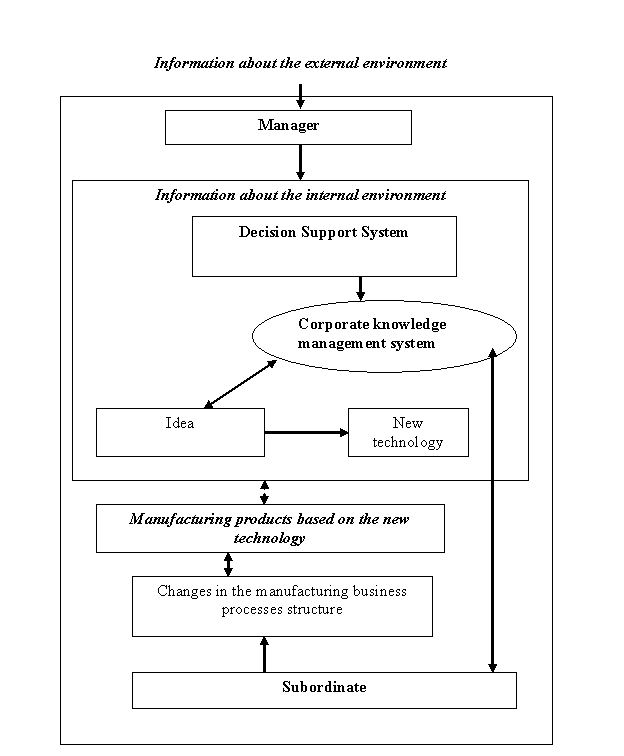 Figure 1. The organizational model of knowledge management at the
enterprise*
Figure 1. The organizational model of knowledge management at the
enterprise*
*Source: created by
author
As
shown in Figure 1, the strategic development of enterprises depends on the
ability to innovate. Based on this scheme to the following conclusions [3, p.
58; 4, p. 43]:
1.
A precondition the sustainable development of innovative processes in
the manufacturing sector is the introduction of knowledge management system.
2.
Obtaining better performance is achieved by using in the production of
information that accumulated over a long period and transformed into knowledge.
3.
Knowledge management can be evaluated as a development strategy, which aims to
search for useful information for the company, for staff development, getting
experience.
Therefore,
the urgency to implement knowledge management system due to necessity of
creating of new knowledge during the information diffusion and exchange. At the
same time, it is appropriate to select a number of factors that limit the use
of knowledge management [5, p. 400]:
1.
Human component: low realization the effectiveness of corporate
knowledge, problems finding the necessary information, the availability of
knowledge that can not be formalized, insufficient training of staff to
understanding of new knowledge.
2.
System component: In the process of production necessary to consider
information relating to the different systems of knowledge and interaction
between different social spheres, which are constantly changing.
3.
Time component: low speed search (receipt) of storage expertise required
information an important variable of technological solutions and influences the
rate of decision-making at different levels of management. An important role is
played by the degree of ownership of HR tools and techniques in data search
system. This factor should be given special attention during the training of
system users.
Thus, the introduction of knowledge management systems is important for
solving practical problems enterprises that implement innovations
References:
1.
Yu Chung Hung, Shi Ming Huang, Quo Pin Lin, Mei Ling
Tsai, (2005) «Critical factors in adopting a knowledge management system for
the pharmaceutical industry» Industrial Management & Data Systems,
Vol. 105 (2), 164 – 183.
2.
Hansen, D. J. (2003). «E-Learning: Strategies for Delivering Knowledge
in the Digital Age». Educational Technology & Society,
6(3), 80-81.
3.
Chih-Ping, W., Jen-Hwa, H., and
Hung-Huang, C.(2002). “Design and evaluation of a knowledge management system”, Software Journal, 19(3), 56-59.
4.
I. Nonaka, H. Takeuchi (1991). «The knowledge-creating company: How
Japanese Companies Create the Dynamics of Innovation», Harvard Business Review,
November-December, 22 (28), 40-44.
5.
Wiig K.M. (1997). «Integrating intellectual capital and knowledge
management», Long Range Planning.
Vol. 30 (3), 399-405.