THE GROWTH PROCESSES OF RUSSIAN INFANTS:
ECOLOGICAL ASPECTS
Fedotova T.K., Gorbacheva A.K.
Lomonosow MSU, Science Research
Institute and Museum of Anthropology, Moscow, Russia
Abstract. The present study deals with the specificity of
growth processes of infants of modern Russia, growing in the contrasting
conditions of the natural and anthropogenic stress, and is held in the context
of the investigation of the ecological diversity of human species. The growth
dynamics of modern infants of 5 cities is compared: Moscow megalopolis with the
high level of the anthropogenic pressure; industrial center Kursk with the
level of pollution of the environment within the normal limits; Arkhangelsk,
climatically equated to the regions of Far North, high level of industrial
pollution; small «city of scientists» Obninsk of Kaluzhskaya province with
relatively favourable ecology; small city Balashikha, located near Moscow,
industrial center with the unfavourable ecology. Material on the development of children from Moscow, Obninsk
and Balashikha was collected by the
authors on the base of child' out-patient clinics and present the longitudinal
data with monthly dynamics of the main body dimensions (body length and mass,
chest circumference), supplemented with the detailed anamnesis and family data.
The study is held according to the legislation of Russian Federation, ethic
norms and principles of Helsinki Declaration (1964) with the latter additions
and changes. Moscow sample was examined in 2009
and 2013 in the districts Maryino and Ramenki, the total quantity is 162 boys
and 183 girls, Balashikha sample was examined in 2014 and consists of 154
infants, Obninsk sample in 2011 and consists of 231 infants. The data on the
development of infants from Kursk and
Arkhangelsk were borrowed from the literary references, the samples were
examined by the cross-sectional method, each sex-age group including about
hundred children. To establish the direction of the territorial differences of
the growth dynamics of different traits we used preliminary standardized growth
curves through the age interval from 1 to 12 months. The analysis of the
presented data allows to speak about
the activation of growth processes in
the concentrated urban environment (Moscow and Arkhangelsk), about the increase
of the asthenizaion of the body build and some retardation of the biological
maturation (motor and dental age) under the further increase of the anthropogenic pressure in Moscow, about
the similarity of skeletal growth curves (body length) under the influence of
the similar urbanization level in
the small cities (Obninsk and Balashikha), and to confirm the postulate
about the higher ecosensitivity of the males as compared to the females.
Key words: anthropology,
anthropoecology, human ecology, urban ecology, anthropogenic stress, ecological
diversity of human species, growth and development, infants.
Introduction
The study of the
specificity of the growth processes of children in different ecological niche
is one of the branches of the anthropoecological
investigations in Science Research Institute of Anthropology, Lomonosov MSU,
having almost a half century history and important achievements. Among the
latter are vast observations of modern populations of different landscape zones
of the USSR, investigation of the longеvity phenomenon in
Abkhazia; cоnception of the adaptive type
as the norm of biological morphofunctional reaction to the environment [1,2];
conception of the age osteomorphic status as the integral indеx of the population
medical status in different regions
[4,6,7,8,26,27]; conception of biological (skeletal) age as the personal health
criterion [25]; creation of the new branch of human morphology —
geroanthropology — describing standard age changes of adults and the old [28];
and, as mentioned above, monitoring of the growth processes of children in
traditional populations and in the urban environment, particularly in
megalopolis [8,12,13,15-20].
Population
monitoring of the dynamics of physical development and sexual maturation of
children and adolescents of different territorial groups allows to interpret
the basic conformities of the ontogenesis of the human species, to evaluate the
diversity spectrum of the growth processes in different ethnic and territorial
groups. It is a component of the studies on the morpho-physiological adaptation of human to various ecological conditions, having fundamental
significance in the complex of the studies of Homo and describing the ecological
variation of our species. It is hardly possible to estimate the exact contribution
of separate factors in growth and development. Still generalization of growth
studies in Russia and former USSR, which is a natural laboratory for
anthropoecological studies, allowed to postulate, that the wide range of
climatic anf geographical conditions, while they are not extreme and do not
demand deep reconstruction of the organism (for instance, the adaptation
towards hypoxia), do not influence significantly the growth processes of
children, being inferior to the anthropogenic factor. Thus growth curves of
ethnically russion children, dwelling in the contrastive climatic conditions
(Siberia, Middle Asia, subtropics etc.), are similar through the whole growth
period from birth to 17 years, in the infancy, preschool and school ages
[16,19,20,23,24,32]. Still it's worth mentioning that some fundamental studies
discuss the correlation between the physical status and average year
temperature, altitude and ultra violet radiation for different regions of the
Earth [3,9,33,34]. By analogy, the generalization of 70 growth studies of
school children of former USSR [21] allowed to fix the west-east gradient of
the height decrease of children of different ethnic groups. While the
generalization of data on 80 samples of newborn allowed to fix the tendency of
the body length increase in connection with the level of insolation of the
region [10], which illustrates the significance of ultra violet for the growth
of the bone tissue. The west-east gradient of the increase of the newborn body
length in connection with the geographical longitutude of the region is fixed
as well. While infants of different ethnic groups show the decrease of body mass-length parameters from the north
to the south and from the west to the east, from the Baltic towards the Middle
Asian and the Far East groups.
These correlations
are more expressed for the rural groups of children compared to the urban due
to the domination of the anthropogenic factor for the latter, which is the
strongest factor of convergence, comparable to the genetic influence. Thus, the
amazing resemblance is marked for the maturation rates of the russian girls of
the big cities — Moscow, Arkhangelsk, Nizhny Novgorod, Omsk, Tomsk, Irkutsk,
Ulan-Ude, Yuzhno-Sakhalinsk [22]. Simultaneously their is a definite dependance
between the size of the city, or the level of urbanization, and the menarche
age of girls. By analogy the most intensive growth processes of the infants of
the USSR of 1970th were registrated for the samples of Moscow and
Murmansk — cities with the highest urbanization level compared to the other
examined cities of Russia of that historical period [20, 21]. While the
distress conditions in the zone of the ecological overload in Donetzk resulted
in the retardation of growth processes of children, deceleration of body length
and head circumference growth through the first year of life.
The urban
ecological niche presents the level of stress, significantly exceeding the
stress of any natural niche, and is alternative to the conditions, in which the
genome of the modern human was forming. And the anthropogenic environment of
megalopolis may be characterized as the state of opposition and extreme tension
of the relationship «man-environment» due to the high level of technogenic
pollution of water, air, soil; high level of the information pressure and the
abundance of information fuss; far from ideal nutrition structure, for example
the strategy of bottle-feeding of infants; extreme hypokinesia or «motor
hunger»; finally, the decrease of the natural selection factor (e.g. the
decrease of the differential mortality of the newborn due to the sucsesses of
the medicine).
Modern urbological
and paleoecological studies witness to the accelerating, activating
physiological functions influence of the moderate level of the anthropogenic
stress [13,14]. Though its strengthening is extremely negative, distressive
according to Selye [30,31], the striking factor of the exhausting of the
physiological functions, which we can observe while monitoring the population
of megalopolis of the III millennium. The processes of desynchronization of
morphological development and sexual maturation, the decrease of the indices of
the functional capability (dynamometry, vital lung volume), the increase of the
differentiation of the development rates as well as the body mass range
(deficiency-obesity) are the results of
the broad spectrum of sensitivity of the population to one and the same
environment conditions. Moscow children aged 3-17 years at the beginning of the
XXI century compared to the children of 1960th-1990th (against the background of the increase of
the level of anthropogenic stress) show the negative tendency of the
significant increase of adopisity
combined with the absence of significant secular dynamics of the skeletal and
muscle components of the body build, describing the development of the
locomotion apparatus [15]. This
specificity is more expressed in school children comparaed to preschool.
At the same time for the modern abkhazian of the longlivity regions,
characterized in the 1980th by the slow rates of development, the
anthropogenic factor became accelerating [5]. In the beginning of the XXI
century they got the increase of the somatic development rates, the rates of
skeletal maturation and the rates of the bone system aging, due to the war
events of 1990th and the corresponding social stress consequences.
The present study deals with the specificity of
growth processes of infants from modern Russia, growing in the contrastive
conditions of natural and anthropogenic stress.
Material and
methods
The growth dynamics
of modern infants of 5 cities is compared: Moscow megalopolis with the high
level of the anthropogenic pressure, 12 million population, one of the most
polluted capitals of Europe; industrial center Kursk, half million population,
the level of pollution of the environment within the normal limits, situated in
the zone of the moderate continental climate; Arkhangelsk, 350 thousand
population, climatically equated to the regions of the Far North, high level of
industrial pollution; «city of scientists» Obninsk of Kaluzhskaya province, 100
thousand population, moderate continental climate, relatively favourable
ecology; Balashikha, located near Moscow, the biggest city of the province, 250
thousand population, industrial center with unfavourable ecology (high
concentration of chemical admixtures in the air, both local and brought from
Moscow by the south-east wind direction). Material on the development of
children from Moscow, Obninsk and
Balashikha were collected by the authors on the base of child
out-patients' clinics and present the longitudinal data with the monthly
dynamics of the main body dimensions (body length and mass, chest
circumference), supplemented with the detailed anamnesis and family data. The
study is held according to the legislation of Russian Federation, ethic norms
and principles of Helsinki Declaration (1964) with the latter additions and
changes, regulating sciense research of Homo, and the International ethical guidelines for biomedical research involving human
subjects of CIOMS. The investigation is completely anonymous. Moscow sample was
examined in 2009 and 2013 in the districts Maryino and Ramenki, the total
quantity is 162 boys and 183 girls, Balashikha sample is examined in 2014 and
consists of 154 infants, Obninsk sample in 2011 and consists of 231 infants.
Data on the development of infants from Kursk and Arkhangelsk were borrowed
from the literary references [29] and were examined by the cross-sectional
method, each sex-age group including about hundred children. To establish the
direction of the territorial differences of growth dynamics of different traits
we used special diagrams [11]: the growth dynamics of each territorial group of
boys and girls is presented not by the growth curves of the traits, but by the
standardized differences Zi = (Mi – Mo) / S of
the arithmetic means of the anthropometric traits in different samples (Mi)
from the values of the Moscow sample (Mo). The procedure is based on
the common average for all data series
meanings of standard deviations of the traits (S). Thus, the zero level of each diagram corresponds to the Moscow data,
while other data series take place higher or lower, depending on the
specificity of the growth rates through the age interval from birth to 12
months.
Results and discussion
The highest indices of the body length of the boys (Fig.1)
through the first year of life and body mass (Fig.2) through the first 6 months
are registered for the Arkhangelsk infants. Moscow boys' length indices are
insignificantly less, the differences reduce towards 1 year of life, while mass
indices stay the least among the whole sample pull, pointing to the expressed
lepthosomy of the body build of Moscow boys at the beginning of the
ontogenesis. Significantly lower indices of the body length of the boys of
Kursk (up to 1 standard deviation in some months compared to Arkhangelsk) and
Obninsk (up to 0,6 standard deviations in some months) are combined with
relatively high indices of the body mass, close to the level of the Arkhangelsk
infants. The dynamics of the length indices of
Balashikha boys almost repeat the dynamics of the indices of the Obninsk
sample.
The differences of the body length growth charts of
girls (Fig.3) from the different cities are not so distinct, due to the fact,
may be, that girls are less ecosensitive than boys. At the same time the
dynamics of the mass indices growth curves of the girls (Fig.4) point to the
same tendency of the mass “lag” of Moscow girls as shown for Moscow boys, which
is combined with the least indices of the chest circumference in Moscow girls. Thus, the high level of the anthropogenic pressure for Moscow and Arkhangelsk infants is the factor,
accelerating skeletal growth and partly intensifying the asthenization of body
build as compared to the infants from the regions with more moderate
anthropogenic stress. While the infants from the small cities Obninsk and Balashikha with the similar urbanization
level have the coinciding skeletal growth curves (body length). The tendencies
are apparent for the ecosensitive boys first of all.
Similar somatic specificity was revealed while
undertaking secular comparison of the modern Moscow infants with the infants of
1950th-1960th against the background of the increasing of
the anthropogenic stress in megalopolis [12,18]. Similar results were
observed as well for the number of
infant samples of the former USSR [32]: the lower levels of the dynamics of
somatic traits were registered in the environment with the combined anthropogenic
and natural stress (trans-polar industrial center Norilsk) and the lowest
dynamic levels of the traits, describing the exhausting of the adaptive
resources of the child organism, were fixed in the distress anthropogenic
conditions (the zone of ecological overload Donetsk). It's worth mentioning
that Moscow infants, compared to the infants of the province (Obninsk), have
some retardation of the motor development and dental age. Thus, the age of the
first tooth eruption for Moscow girls is 7,9 months, while for Obninsk girls is
6,5 months, the difference is statistically significant (P<0,001); the age
when girls begin to hold the head is 2,1 and 1,6 months in Moscow and Obninsk
correspondingly (P<0,05), the age when girls begin to sit is 7,4 and 6,3
months (P<0,05). The differences for boys have the same direction but less
significant. So the indices of biological age add to the somatic differences of
the ecological diversity.
Conclusion
Growth and development of the infants are not such a
clear mirror of the environment parameters as growth and maturation of the
adolescence. Growth processes of the infants are not as a whole the
manifestation of the genetic potential. Infancy is the period of the searching
of the individual ontogenetic trajectory, smoothing the limitations of the
intrauterine growth, and the “organism-environment” relations are mediated by
the maternal factor (feeding and nursing). Still even the beginning of the
ontogenesis reveals the apparent correlations of the morphological and the
ecological parameters, e.g. with the anthropogenic factor, similar to that of
the elder groups of children. The analysis of the presented data allows to speak about the activation of growth processes under the influence of
the concentrated urban environment (Moscow and Arkhangelsk), about the increase
of the asthenizaion of the body build (lepthosomy) and some retardation of the
biological maturation (motor and dental age) under the further increase of the anthropogenic pressure in Moscow, about
the similarity of skeletal growth curves (body length) under the influence of
the similar urbanization level in
the small cities (Obninsk and Balashikha), and to confirm the postulate
about the higher ecosensitivity of the males as compared to the females.
The investigation of the ecological diversity of the
growth charts has both theoretical and applied value. It points to the
necessity of the elaborating and the
renovating of the regional local growth standards for the correct evaluation of
the child development in the pediatric practice.
References
1 Alexeeva T.
Adaptation of Homo in different ecological niche of the Earth (biological
aspects). Mosco.: Publishing House MNEPU, 1998. 280 p. (In Russian)
2 Alexeeva T.
Anthropological aspects of human ecology: results and prospects // Anthropoligy
on the brink of the III millennium.V.2. Moscow: Stariy Sad, 2004. P.
706-718. (In Russian)
3
Barnicot N. Biological diversity in the
modern Homo populations // Human biology. Moscow: Mir, 1979. P. 229-365. (In Russian)
4 Batzevich V., Deryabin V., Pavlovsky
O. The experience of correlation of
environment and health parameters with the chronobiological indices of the
adult population of the russian villages // Ecological anthropology. Year-book.
Minsk, 1999. P. 43-45. (In Russian)
5 Batzevich V., Godina E., Prudnikova A.
et al. Secular changes of somatic traits of children and adolescents of rural
Abkhazia through the last 25 years // Modern rural Abkhazia:
social-ethnographic and anthropological studies. — IEA RAS Moscow, 2006. —
P. 189–218. (In Russian)
6 Batzevich V., Pavlovsky O., Mansurov
F., Yasina O. Regional aspects of
anthropoecology and onthogeny dynamics in human populations // Races and
nations: modern ethnic and racial problems: Year-book. — V. 34. — Moscow: Science, 2009. —
P. 78–115. (In Russian)
7 Batzevich V.,
Kobilyanski E., Yasina O. Ontogenetic
changes of the sceleton of the adult population in different social and
geographical environment: anthropoecological study. // Archeology,
ethnography and anthropology of Eurasia. — 2013. — № 4. —
P. 146–154. (In Russian)
8 Batsevich V., Mansurov F., Yasina O. Territorial
variations of the maturation rates of hand and wrist bones of children and
adolescents // Bulletin of Moscow University. Series 23.
Anthropology.— 2014. — no. 3. — P. 49–50.
9 Beall C.M., Steegmann A.T. Human adaptation to
climate: temperature, ultrа
violet radiation, and altitude / Eds. S. Stinson, B. Bogin, R. Huss-Ashmore, D.
O’Rourke // Human biology: An evolutionary and biocultural per- spective. N.
Y.: Wiley-Liss, 2000. P. 163–224.
10 Borovkova N., Gorbacheva A.,Fedotova T.,
Ethno-territorial diversity of the newborn body dimensions.
//Bulletin of Moscow University. Series 23. Anthropology. — 2012. — № 3. —
P. 56–71. (In Russian)
11
Deryabin V., Fedotova T., Yampolskaya Yu.
Secular changes of the somatic status of Moscow school clildren aged
8-17 years through the last 40 years of XX century. The science anthology of
the Department of anthropology. Issue 4. Moscow: Encyclopaedia of russian villages., 2006. P. 59-87. (In
Russian)
12 Deryabin V.,Fedotova T., Gorbacheva. Secular changes of
body dimensions of Moscow infants. // Bulletin
of Moscow University. Series 23. Anthropology. — 2010. — № 2. —
P. 4–20. (In Russian)
13 Fedotova T.
About secular trends, adaptive strategies and lepthosomic bodybuild. //
Bulletin of anthropology. Science anthology. Issue 13. Moscow, 2006. P.
121–149. (In Russian)
14 Fedotova T. Anthropoecological studies of MSU Science
Research Institute and Museum of Anthropology.
// Bulletin of Moscow University. Series 23. Anthropology.— 2011. —
N 1. — P. 16–24. (In Russian)
15 Fedotova T., Gorbacheva A., Khramtzov P. Secular Changes
of physical development of Moscow children aged 3-17 (1960th-2000th). // School
of health. — 2011. — № 4. — P. 3–9.
(In Russian)
16 Fedotova T., Gorbacheva A. Growth from birth to 2 years
in connection with the ecological conditions. // The
problems of modern human morphology. Proceedings of the international
science-applied conference, Moscow, september 25-17, 2013. — Moscow, 2013. — P. 62–64. (In Russian)
17 Fedotova T., Gorbacheva A. Physical development of Moscow
children aged 3-6 years (subject of RF - Moscow) //
Physical development of children and adolescents of Russian Federation. Data
collection. Issue VI. — Moscow: Pediatr, 2013. — P. 80–81. (In Russian)
18 Fedotova T., Gorbacheva A., Sukhova A. Secular
peculiarities of growth processes of modern moscow infants compared to the
infants of the 1970th // Bulletin of Moscow University. Series
23. Anthropology. — 2014. — no. 3. — P. 51–51.
19 Fedotova T., Gorbacheva A. Geographical variations of
body dimensions of newborn and infants. // Bulletin
of archeology, anthropology and ethnography (on-line journal) — 2014. —
№ 1. — P. 96–102. (In
Russian)
20 Fedotova T., Gorbacheva A. Ecology and physical
development of children. // Научният потенциал на света 2014. — V. 5. — Бял
ГРАД-БГ ООД София, 2014. — P. 86–99.
(In Russian)
21
Godina E. The dynamics of growth processes and development of Homo: space and
time aspects. Author's abstract of the dissertation of the Doctor of biology.
Moscow 50 p. (In Russian)
22
Godina E. Auxology. // Anthropology. Textbook for the students of colleges.
Moscow: Publishing Center VLADOS, 2003. P.113-172. (In Russian)
23 Gorbacheva A., Fedotova T. The peculiarities of growth
processes of infants in the different ecological niche. //
International science conference Modern problems of human ecology, dedicated to
the memory of O.Pavlovsky and V.Volkov-Dubrovin. December 7-9, 2011 г.: Lecture
theses — Moscow: Paralleli, 2011. — P. 81–83. (In Russian)
24
Miklashevskaya N., Solovieva V., Godina E. Growth processes of cyildren and
adolescents. Moscow: Publishing house
of Moscow University, 1988. 184 p. (In
Russian)
25 Pavlovsky O.
Biological age of Homo. М.: Изд-во МГУ, 1987. 280 p.
(In Russian)
26 Pavlovsky
O.M., Kobyliansky E.D. Population
Biology of Human Aging.
Angelo-Pontecorboli Editore. Italy, Firenze, 1999. 152 p.
27 Pavlovsky O. Population
ecology of the human age in the adult periods of ontogenesis. // Anthropoligy
on the brink of the III millennium.V.2. Moscow: Stariy Sad, 2004.P.
719-745. (In Russian)
28 Pavlovsky O.
Population ecology of the human age and the geronthological problems // Problems of anthropology. 2005. Issue 95.
P. 36-55. (In Russian)
29
Physical development of children and adolescents of Russian Federation. Data
collection. Issue VI. — Moscow: Pediatr, 2013.
(In Russian)
30 Selye Hans. The
level of the organism as a total.
Moscow: Science, 1972. 122 p.
(In Russian)
31 Selye Hans.
Stress without distress. Moscow: Progress, 1982. 124 с. (In Russian)
32 Sukhova A., Fedotova T., Gorbacheva A. Growth
from birth to 2: Ecological aspects // Bulletin of Moscow University.
Series 23. Anthropology. — 2014. — no. 3. — P. 62–62.
33 Weiner J. Human
ecology. // Human diology. 1979. С. 472-596. (In
Russian)
34 Wells J.C.K., Cole T.J. Birth weight and
environmental heat load: A between-population analysis // Am. J. Phys.
Anthropol. 2002. Vol. 119. Iss. 3. P. 276–282.
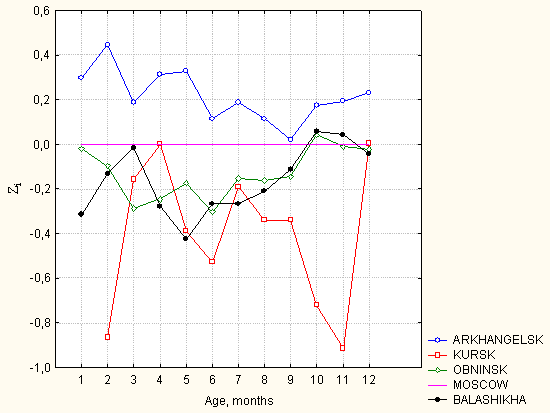
Figure 1 The dynamics of the body
length of boys aged 1-12 months
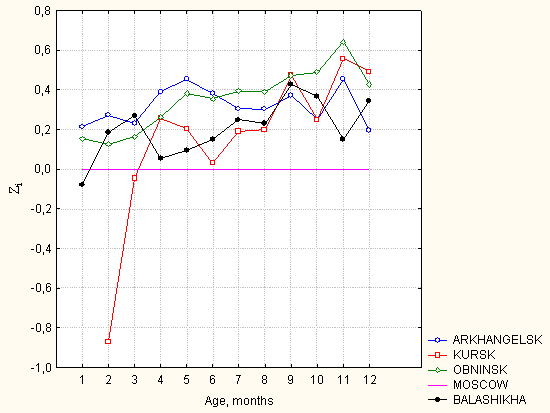
Figure 2 The dynamics of the body
mass of boys aged 1-12 months
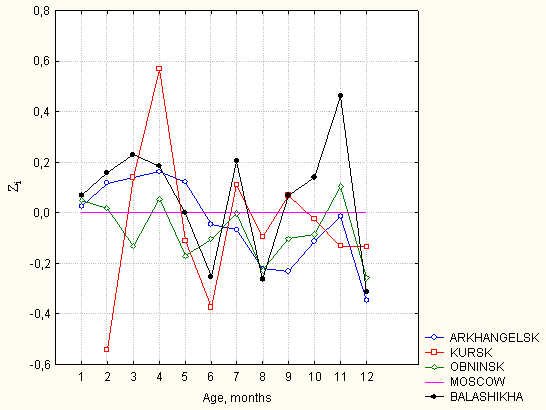
Figure 3 The dynamics of the body
length of girls aged 1-12 months
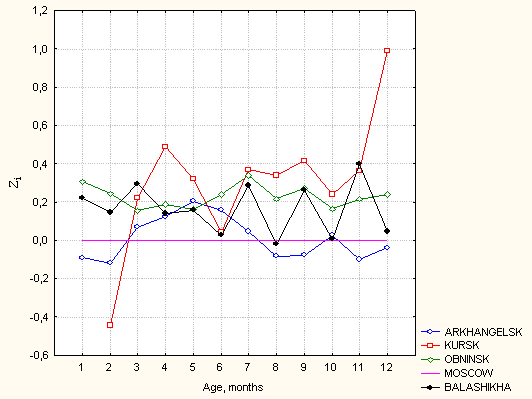
Figure 4 The dynamics of the body
mass of girls aged 1-12 months