P'yanov
A.I.
PhD in Sociology, Assistant Professor,
North
Caucasian Federal University, Stavropol
Semykina I.V.
Student, North Caucasian Federal University, Stavropol
MODERN ASPECTS
OF DEVELOPMENT AND USE OF OUTSOURCING IN THE RUSSIAN FEDERATION
Modern world tendencies allow us to speak about the growth of
competition, the emergence of innovative technologies to optimize many business
processes in the organization, thereby reducing costs which in turn lead to an
increase in the competitiveness of the business units. One of these tools allow
you to effectively debug business processes outsourcing is seen, which is
associated with the release of the organization of routine processes. Current
representations define outsourcing as the transfer of business processes and
functions of the organization outside the executor – the supplier – in whole or
in part, for a certain period of time [1, p. 33]. This suggests that some of
the costly administrative and specialized organization for efficient operations
outsource, saving money, getting the flexibility and accuracy of business
processes.
The personnel management system, outsourcing is a lease functions a
certain organization, the use of personnel to perform the part of their own
projects [2, p. 87].
Development
of outsourcing decomposed to such a concept as “offshoring”. In the economic
literature and practice, the term “offshoring” means the attraction for
performing certain tasks (business functions) by a third party located abroad.
Why offshoring is considered as outsourcing abroad. Accordingly, the
off-shoring of staff serves innovative human resource management technology
organization, with which the transfer of jobs to the same company from one
country to another in order to minimize staff costs and increase capitalization
[3, p. 86].
In modern conditions offshoring becomes a tactic of competitive advantage
for companies not only in the world, but also in the domestic market. Thanks to
the staff offshoring companies can minimize their costs
by transferring production to countries with cheaper labor. Just use offshoring
strategy allows companies not only to minimize costs and increase
capitalization, but also develop more rapidly. However, the ratio of the spread
of off-shoring is ambiguous because it is damaging to the internal labor
market.
The use of both outsourcing and offshoring are usually associated with
large corporations, but studies conducted by reputable international
organizations to provide audit, tax and advisory services to private and public
companies Grant Thornton International has revealed that currently around 40 %
of medium-sized businesses at a global level using or planning to use
outsourcing services. This figure rises to 43 % among large enterprises, which
have the economies of scale, and this service can give good results. The most
popular are the operations related to taxation, IT-technologies and personnel
administration. The share of transactions submitted for outsourcing is
presented in Figure 1.
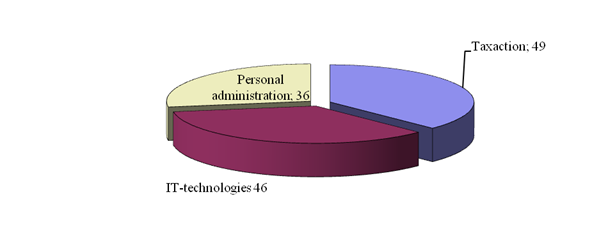 Figure 1 – The
share of transactions submitted for outsourcing, %
Figure 1 – The
share of transactions submitted for outsourcing, %
However, when such
significant figures, many companies distrust towards outsourcing non-core
business processes and are cautious in this matter. Here the experts identified
three key aspects: First, the previous negative experience, and secondly, not
wanting to lose control of key processes, and thirdly, high costs for the
organization of the outsourcing process. Obstacles hindering the development of
the outsourcing companies are presented in Figure 2.
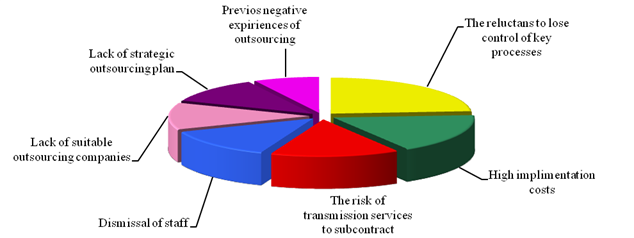
Figure 2 – Obstacles
hindering the development of the outsourcing companies, %
However, the company is
actively using outsourcing, have the advantages of its implementation. For
example, reduced the cost of non-core business processes that have a positive
impact on the sustainability performance of business operation; there is an
opportunity to focus employees on the company's main objectives; involve narrow
specialists without expanding its own employees of the state. The benefits of outsourcing are presented in Figure
3.
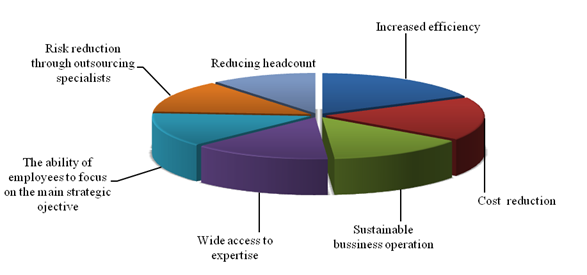
Figure 3 – The
benefits of outsourcing, %
In Russia, the development
of outsourcing non-core business processes begins with the 1990s, and is
generally in line with global trends, but it is worth noting that the volume of
the market and the range of services largely lag behind the developed countries.
So according to the rating agency “Expert RA” in 2011, the total
revenues of the leading providers of outsourcing functions HR and accounting
amounted to 5 bn. rub., while in 2015 this figure reached 6 bn. US dollars,
which allows to talk about the significant development and growth of the market
concerned [4].
In the structure
of revenues in areas of outsourcing non-core business processes in the Russian
accounting and tax accounting is the most popular service, accounting for 47 %;
followed by service payroll – 27 %. Revenue breakdown by areas of outsourcing
non-core business processes in Russia is represented by Figure 4.
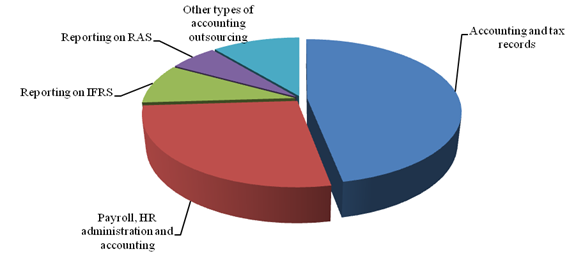
Figure 4 – Revenue breakdown by areas of outsourcing
non-core business processes in Russia
The growing need for designated
areas due to the fact that companies are interested in high-quality preparation
of all financial and tax reporting, as well as providing support in
collaboration with the regulatory authorities.
Payroll in our
country is more in demand than service personnel records and paperwork.
However, the development of this service hinders the presence of tax
minimization factor payroll through the payment of salaries for the “gray”
schemes, in which the calculation functions cannot be outsourced.
There is a high demand for
services in the preparation of statements in accordance with Russian Accounting
Standards (RAS) and International Financial Reporting Standards (IFRS). Clients
in the area of reporting on the RAS are mostly small and
medium-sized businesses that require high-quality reporting to attract funding.
Demand for services related to the preparation of reports on the IFRS, as a
rule, due to the factor of development of investment processes, so this
reporting is required when lending; for access to the exchange; for
shareholders of information and business management that is used as a tool to
identify key performance indicators.
Unlike western
companies, who for a long period of time attract contractors to perform not
only accounting and operational functions, but consulting services (risk
management, compliance, financial planning etc.), Russian companies with
sufficient care resort to such contractors. However, this process is gaining
increasing attention in recent years.
Certainly the use
of outsourcing has many advantages, which include the traditional cost
reduction and increased efficiency of business processes. However, Russian
demand for services outsourcing of financial services and accounting (FA) is
due to the following factors:
- The growth of
the tax burden from the 2012 salary was more than 43 thousand rubles, that
makes us think about optimizing their costs;
- Growth in
lending to small and medium-sized businesses and the need to prepare quality
reports to obtain financing;
- Engaging in
outsourcing service companies, which do not need to carry out the audit reports
(organizations with revenues of up to 400 million rubles and the sum of the
balance sheet assets of not more than 60 million rubles);
- The need for
foreign companies to transform regular reporting under RAS in management
reporting and harmonization of the methodology of the Russian accounting to
international standards, in which the parent companies operate;
- Intensification
of interest in outsourcing from the state.
According to reports of “Expert RA” the amount of
revenue the companies working on the Russian market of outsourcing of
accounting functions increases, but if you look in terms of growth in total revenue,
then there is a significant decline. Changes in companies operating in the
Russian market of outsourcing of accounting functions for the years 2010 – 2014
are shown in Figure 5.
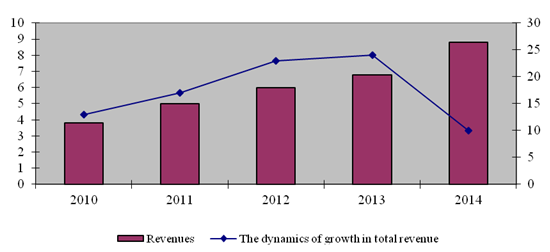
Figure 5 – Changes in companies operating in the
Russian market of outsourcing of accounting functions for the years 2010 – 2014
However, despite the significant decrease in the
dynamics of growth of the main indicators, the revenue growth in Russian
companies is observed every year this area is 15 – 20 %. The key drivers of
growth, industry experts include three key components.
Firstly, information industry; since introduction of
electronic document management systems, reduction of IT-solutions, the
implementation of remote working systems – a positive effect on the cost of
operations, outsourcers companies endure back-offices in regions with cheap
labor, without prejudice to the basic processes.
Second, despite
the increase in the tax burden, the amount of taxes every year increases, as
companies are interested in building a transparent business that allows you to
pay part of the functions of a third party contractor with minimal risk.
Third, an economy
of scale when outsourcing company efficiently loads human resources, the
objective function becomes productivity. As a rule, this practice is much more
difficult to implement in the company, for which the non-core business process
[4].
At the same time
it can be traced significant obstacles to growth-outsourcing companies in the
Russian Federation:
- Inertia owners.
Many owners are not willing to give up control of bookkeeping outside company
because of the fear of losing control over significant operations;
- The complexity
of the movement document. Currently, electronic document management system in
Russia is at the implementation stage that, on its turn, creates the need to
turn paper documents. Further complications arise from the personnel
documentation in connection with the fact that the responsibility for the
storage of documents entrusted to the company-customer, besides access to
personnel records is regulated by the Federal Law “On Personal Data”;
- The cost of
services the company-outsourcer. This price does not always lower than the
wages of a similar “standard unit”;
- Lack of
flexibility. This is reflected in the fact that most small and medium-sized
companies, outsourcers are considering outsourcing accounting and HR services
exclusively from the point of view of interaction with the state – for the
purpose of tax accounting. Many companies require customers to record keeping,
not only and not so much from the point of view of taxation, as from the point
of view of management reporting;
- Difficulty in
the change of contractor. It lies in the fact that the inertia of the owners
does not allow them to quickly change contractors, regardless of the number of
errors and the convenience of working with them.
Summarizing, we
can say that in Russia outsourcing services are more in demand by large
companies with a transparent and fully legal business, as well as foreign companies
operating in our country.
In the segment of
small and medium enterprises still has a significant share of shadow capital,
so companies do not tend to attract outsourcers. Currently, however, there is a
tendency to build a more transparent business, including through the ongoing
legislative changes, as well as the development of the investment market.
Negative impact on
the development of the Russian market affects lack of awareness about
outsourcing services to potential customers, but also not conducive to
outsourcing of the economic situation, combined with the general immaturity of
the Russian market.
Among Russian
companies there is such an element as a distrust of providers. In addition, the
company plans to bring the accounting functionality of outsourcing, often use
the services of private accountants, the share of which according to various
estimates up to half of the market of outsourcing of accounting functions.
Outsourcing is
developing in Russia different from Western countries by. While in developed
countries initially developed HR and FA-outsourcing services, and then there
was the market of IT-outsourcing, in Russia the situation is reversed. Thus, we
can say that with proper awareness and the availability of qualified service
providers, Russian companies willing will attract outsourcers to perform
non-core business processes.
References
1.
Kutuzova, T. Outsourcing as factor of
increase of efficiency of activity of the enterprises / T. Kutuzova, O. Rudenko
// Actual problems of economy and management. – 2015. – No. 4 (8). – P. 32 –
36.
2.
Savchenko, I. Benefits of outsourcing in the system of personnel management /
I. Savchenko, I. Esaulova // The First International Conference on Economic
Sciences (Vienna, 2014). – 2014. – P. 87– 89.
3.
Makarova, I. Innovative personnel technologies: safety and protection of the
labor law of citizens in the conditions of globalization of labor market / I.
Makarova // The International cooperation of the Eurasian states: policy,
economy, right. – 2015. – No. 2 (3). – P. 85 – 91.
4.
Official site of RAEX rating agency («Expert RA») [An electronic resource]. –
URL: http://www.raexpert.ru/ratings/outsourcing/ (date of the address:
3/15/2016).