Экономические науки / 5. Управление трудовыми ресурсами
Phd of Economics, Biliavska Y
Kyiv national
university of trade and economics
PLANNING MEASURES FOR
IMPROVING MOTIVATION POLICY WITH TAKING INTO ACCOUNT THE CRISIS SITUATION
Motivation – is one of the most important components in the labor
management system. In crisis situation motivation becomes special relevance.
Ukraine is facing the real threat of default. Ukrainian companies not only face
financial difficulties and lose market position but also lose staff. Keeping
key staff – is one of the main tasks of management at the stage of crisis. For
achieve this goal is necessary to inform staff and develop an effective
motivational policy.
At the current stage of Ukrainian economic stagnation the main resource
is staff, which affects the labor productiveness and efficiency. Appropriate
use of labor and staff development in each enterprise depends on labor
motivation. Motivation is the main element activation of human factor, which
creates the material preconditions for manufacture. Thus, among the factors
affecting labor productivity is: material interest (29.5%), moral encouragement
(6.3%), flexible workday (4.2%) and staff training (11.8%).
Labor has always been a source of material and moral values that’s why
encouraging people to work will be always relevant topic. In the first stages
of public production people have tried to explain the behavior of workers and
to promote increasing of motivation.
Evolution of forming scientific views concerning labor motivation is
related to the development of public production, improving the quality of
workforce, improving human welfare, needs, culture and religion.
Nowadays scientists distinguish theoretical and practical approaches to
labor motivation: compulsion and stimulation minimum wages, carrot and stick
approach, substantial, procedural and comprehensive (pic. 1) [5, p. 121].

Picture -1.
Classification of approaches to labor motivation
Understanding the nature of motivation system should be based on the
concept of the definition of motivation. In the literature, there are a
significant number of definitions of motivation, revealing the essence from the
various aspects. All definitions of motivation can be divided into two groups.
On the one hand, this concept identifies motivational system of one employee or
co-workers.
Features of work motivation are: formation and achieving company’s
objectives; keeping balance between economic and social responsibility;
performance of сcommunication
functions between chief and employees; support understanding; creation of
economic motivation; structure and dynamic of staff costs; gradual transition
from authoritarian up to democratic style of management.
Thus, we can formulate following requirements to the concept of
«enterprise’s motivation system of staff»: presence of systemic features and
terms, simplicity and completeness of motivation at the enterprise, existence
of economic components; improvement of quantitative and qualitative labor
results; strong connection between rewards and employees; coordination of all
enterprise’s interests; creating conditions for health protection, labor safety,
social security; promotion professional development, improving employee skills;
providing conditions for learning.
During consideration of labor motivation it’s necessary to focus on the
factors that force people to act and enhance its performance. The most
important of them are: needs, interests, motivations and incentives. The
structure of staff motivation includes: internal and external components (pic.
2).
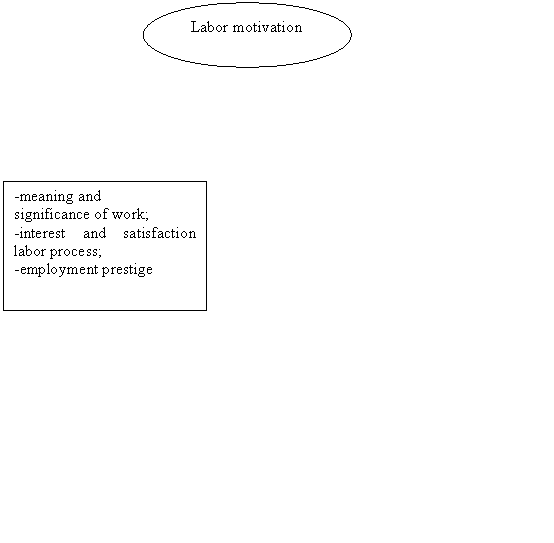
Picture -2.
Structure of labor motivation
Finally, an inspiring leader is keen at pointing out
moments of achievement with praise and acknowledgment. As employees sail the
organization through rough and tumble waters, the captain needs to continually
call out words of encouragement and support while more formally addressing
triumphs as the waters calm. As you advance toward your goals take the time to
congratulate and praise the good ideas, the late nights, the lunch-less days,
and early morning arrivals that keep the organization moving forward.
Similarly, each employee is a necessary cog in the
machine, all working to keep the machine functioning efficiently and
effectively, and all efforts to advance the organization should be praised
regardless of how rudimentary they may seem.