Педагогические науки/Социальная педагогика
Хоменко Л.М.
Сумський Національний Аграрний Університет, Україна
Students’ motivation as the key to academic
success
Teachers and educators
all over the world nowadays are facing the challenge of how to motivate the
students entering colleges
and universities who are often
psychologically, socially, and academically unprepared
for the demands of student
life. Education
programs, however, do not address the whole problem. Lack of
motivation is not limited to the academically weak student. Successful remedial
and study strategies courses aimed at the underprepared student have
demonstrated that students who really want to improve their skills can do so
when motivated. However, even the best curricula have failed to positively impact the
student who is both underprepared academically and unmotivated. When students
have both a lack of academic skills and lack motivation, the greater problem is
motivation [5]. Faculty often have neither the time nor inclination to address difficult
motivational issues in the classroom, consequently, the task of trying to
effectively motivate such students often falls to academic advisors. Therefore, the purpose of this article is to give a general
understanding of student motivation, to analize the factors influencing it and
find the most effective ways to get them excited about learning.
Opinions
about the role of motivation in academic achievement and what can be done about
it vary widely among college faculty, administrators, and student services
professionals. Consideration about unmotivated students opens a Pandora’s box
of questions: Can anything be done about these students? Can motivation be
taught? What kind of strategies can be used to influence motivation? Is this
time wasted that might better be used on those students who are already
motivated? The problem of
devising effective strategies that influence motivation relies initially on the
identification of specific motivational factors. The histories of psychology
and education are abundant with research on motivation and its effect on
behavior. The study of motivation in education has undergone many changes over
the years, moving away from reinforcement contingencies to the more current
social-cognitive perspective emphasizing learners’ constructive interpretations
of events and the role that their beliefs, cognitions, affects, and values play
in achievement[8].
“There are three things
to remember about education. The first is motivation. The second one is
motivation. The third one is motivation.” (Former U.S. Secretary of Education
Terrel Bell). Practice shows that the
best lessons, books, and materials in the world will
not get students excited about learning and willing to work
hard if they are not motivated.
A student may arrive in class with a certain degree of
motivation. But the teacher's behavior and teaching style, the structure of the
course, the nature of the assignments and informal interactions with students
all have a large effect on student motivation. We may have heard the
utterance, "my students are so unmotivated!" and the
good news is that there is
a lot that we can do to change that. Because learners have different
purposes for studying, it is important for instructors to identify students'
purposes and needs and develop proper motivational strategies. Students should
understand why they need to make an effort, how long they must sustain an
activity, how hard they should pursue it, and how motivated they feel toward
their pursuits.
Motivation, both
intrinsic and extrinsic, is a key factor in the success of students at all
stages of their education, and teachers can play a pivotal role in providing
and encouraging that motivation in their students. They say, “It is easier said
than done”, as all students are motivated differently and it takes time and a
lot of effort to learn to get your students enthusiastic about learning,
working hard.
What Is Student Motivation?
Numerous cross-disciplinary theories have been suggested to explain
motivation. While each of these theories has some truth, no single theory seems
to adequately explain all human motivation. The fact is that human beings in
general and students in particular are complex creatures with complex needs and
desires. With regard to students, very little if any learning can occur unless
students are motivated on a consistent basis. The five key ingredients
affecting student motivation are: student, teacher, content, method/process,
and environment.Motivation is defined as the act or process of motivating; the
condition of being motivated; a motivating force, stimulus, or influence;
incentive; drive; something (such as a need or desire) that causes a person or
student to act [7]. Some theories claim
that people or students are motivated by material rewards, desire to increase
their power and prestige in the world, interesting work, enriched environments,
recognition, or being respected as an individual. Each of these theories has
some truth but no single theory seems to adequately explain all human
motivation.According to
Jere Brophy, a leading researcher on student motivation and effective teaching,
“Student motivation to learn is an acquired competence developed through
general experience but stimulated most directly through modeling, communication
of expectations, and direct instruction or socialization by others (especially
parents or teachers).” [1].
Student motivation
naturally has to do with students' desire to participate in the learning
process. However, it also concerns the reasons or goals that underlie their
involvement or noninvolvement in academic activities. Although students may be
equally motivated to perform a task, the sources of their motivation may
differ.
The question of what motivates
students’ behavior in achievement contexts is one of long-standing interest to
psychologists and educators. Much of the research in this area has classified
motivation as either intrinsic (i.e., inherent to the self or the task) or
extrinsic (i.e., originating from outside of the self or the task). That is,
students are often thought to be learning either for the sake of learning or as
a means to some other end, whether it be praise, good grades, etc. A student
who is intrinsically motivated undertakes an activity
"for its own sake, for the enjoyment it provides, the learning it permits,
or the feelings of accomplishment it evokes"[6]. An extrinsically motivated
student performs "in order to obtain some reward or avoid some punishment
external to the activity itself," such as grades, stickers, or teacher
approval. Numerous research studies have shown that intrinsically motivated
students have higher achievement levels, lower levels of anxiety and higher
perceptions of competence and engagement in learning than students who are not
intrinsically motivated. However, every
student is not and cannot be always intrinsically motivated towards certain
tasks. The majority of researchers believe that motivation is not exclusively
intrinsic or extrinsic in orientation.A balanced pedagogical approach in the
classroom includes the combination of both types [3].
Several specific motivational factors have come to
light in recent educational research from the social cognitive approach
including: Intrinsic Goal Orientation, Extrinsic Goal Orientation, Task Value,
Control of Learning Beliefs, and Self-Efficacy for Learning and Performance.
These factors are defined as:
Intrinsic Goal Orientation is having a goal orientation toward an academic
task that indicates the students' participation in the task is an end all to
itself rather than participation being a means to an end. Also included here is
the degree to which students perceive themselves to be participating in a task
for reasons such as challenge, curiosity, and mastery [2].
Extrinsic Goal Orientation concerns the degree to which students perceive
themselves to be participating in a task for reasons such as grades, rewards,
performance evaluation of others and competition. Students with high in
extrinsic goal orientation engage in learning tasks as the means to an end. The
main concern here is the students with high Extrinsic Goal Orientation relate
to issues rather than those directly related to participating in the task
itself [2].
Task Value refers to students' evaluation of how
interesting, how important, and how useful the task is. High task should lead
to more involvement in learning. Task value refers to the students' perceptions
of the course material in terms of interest, importance, and utility[2].
Self-Efficacy for Learning and Performance comprises two aspects of expectancy: expectancy
for success and self-efficacy. Expectancy for success refers to performance
expectations, and relates specifically to task performance. Self-efficacy is a
self appraisal of one's ability to accomplish a task and one's confidence in
possessing the skills needed to perform that task [2].
Test Anxiety has been found to be negatively related to
expectancies as well as to academic performance. Test anxiety is thought to
have two components: a worry, or cognitive component, and an emotional
component. The worry component refers to students' negative thoughts that
disrupt performance, whereas the emotionality component refers to affective and
physiological arousal aspects of anxiety. Cognitive component and preoccupation
with performance have been found to be the greatest sources of performance
decrement. Training in the use of effective learning strategies and test-taking
skills should help reduce the degree of anxiety [2].
These
factors identified in the social-cognitive model of motivation can be narrowed
to three motivational constructs: expectancy, value, and affect. The expectancy
construct assesses perceptions of self-efficacy and control beliefs of
learning. The self-efficacy construct postulated by Bandura in his social
learning theory has guided extensive motivational research. The second
construct of expectancy is a refined construct based on Rotter’s locus of
control. Rotter’s locus of control construct, first presented in 1966, is
perhaps one of the most highly researched concepts in modern psychological
study. The value construct includes intrinsic and extrinsic
goal orientation as well as task value beliefs. Ryan, Connell, and Deci (1985)
who researched the role of intrinsic and extrinsic motivation in their
“Cognitive Evaluation Theory” argue that perceptions of autonomy and competence
are fundamental to intrinsic motivation. Commitment to educational attainment
and learning are necessary to sustain motivation. Commitment to learning is a
syndrome of variables such as belief in the value of learning.The third
motivational construct is affect and can be measured in terms of test-anxiety.
A meta-analysis of 562 studies that related test anxiety and academic
achievement found that test anxiety does cause poor performance, is negatively
related to self-esteem, and is directly related to students’ fear of negative
evaluation [4]. Ryan and Deci (2000) proposed a Self Determination Theory (SDT) in order to make the critical distinction between behaviors that are volitional and
accompanied by the experienceof freedom and autonomy. They
propose that some types of extrinsic
motivations are weak, whereas, some are active and agentic
states. They describe different forms of extrinsic motivation as a continuum
starting from a motivation
(not motivated); to external regulation (where a
task is attempted to satisfy an external demand); introjected regulation
(a task is done for ego enhancement); identification (where the task is valued
for itself) and integrated regulation which is the most autonomous kind of extrinsic motivation and
exists when external regulations are fully assimilated in a person's self
evaluations and beliefs of their own
personal
needs. Understanding
the different types of extrinsic
motivation
is very important
as the types of extrinsic motivations show how much a student is self determined during a learning task
and also shows the quality of effort he or she is putting into a task.
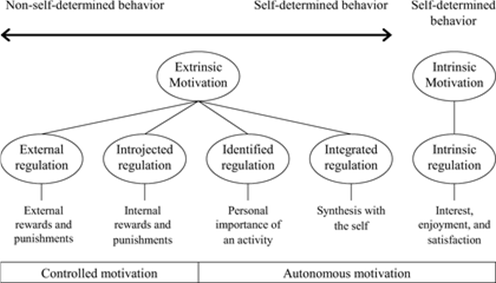
Figure.
Ryan and Deci’s Self Determination Theory Model
Students display more motivational benefits from teachers they like over
teachers they dislike. The following
suggestions are offered regarding teacher contributions to student motivation:
- Subject knowledge and motivational level: The professor’s knowledge
of the subject matter and the motivational level of the professor are most
important to motivate college students to do well in college. That may be
because professors could influence the student’s internal state of wanting
to do well in college.
- Teacher skills: One important extrinsic factor in the educational
environment is the instructor. Teacher skills include staying calm,eliminating negative thoughts
or feelings, disengaging stress, remembering that students have their own
realities and are doing their best, not taking students’ actions
personally, remembering that students are not bad rather just in the
process of development, and maintaining a sense of humor.
- Teacher qualifications: Qualifications of the teacher employed in
universities should be questioned and improved. Educators need to acquire
new qualities and continue to grow and evolve, as they are role models for
the students.
- Test giving: Teachers need to know how to give tests that are
motivating to the students. In general, test-taking instructions,
terminology, layout, and item choices need not to be ambiguous, confusing,
illogical, unclear, imprecise, or poorly designed.
- Scientific management and human relations: The educator must
consider whether to approach students from the viewpoint of scientific
management, human relations, or both. Here are some tips on how to add
components of both scientific management and human relations:
− Use inventive
teaching techniques,
− Encourage your
students to embrace technology,
− Make learning both
interesting and entertaining,
− Require significant
effort both inside and outside the classroom,
− Convey a real sense
of caring to the students,
− Make each student
feel special,
− Help students
outside of the classroom and at odd hours,
− Teach them how to
use information to make proper decisions for real life,
− Students need to
know you are approachable,
− Motivate them to
achieve at their maximum level,
− Instill a fire in
your students,
− Go beyond the
confines of the academic setting,
− Discuss contemporary
topics,
− Share personal
relevant experience,
− Capture the interest
of your students,
− Be devoted to your
students,
− Learn students’ individual
needs and respond appropriately,
− Develop specialized
assignments and schedules when needed,
− Provide tools for
their careers,
− Promote practical
work experience,
− Foster relationships
with local area professionals,
- Know your students and build on their strengths:
Use the
strengths that students bring to the classroom.
- Value and build relationship:
Some of the
necessary elements that build and maintain constructive relationship
include trust, be on their side, treat everyone with respect all of the
time, be in charge and lead them to achievement, work together, and show
you can listen and accept what the student says.
- Enthusiasm: When the teacher is more enthusiastic about a topic,
then the students will be more inclined to believe that the topic has
value for them. That is, teacher enthusiasm can motivate students.
Enthusiasm can be expressed by facial expressions, body language, stating
preferences, describing personal experiences or amazing facts, showing
collected artifacts, using humor, putting energy into their lesson
preparation, and meticulously preparing materials.
Here are five effective ways to get your students
excited about learning:
1. Encourage Students
Students look to teachers for approval and positive
reinforcement, and are more likely to be enthusiastic about learning if they
feel their work is recognized and valued. You should encourage open
communication and free thinking with your students to make them feel important.
Be enthusiastic. Praise your students often. Recognize them for their
contributions. If your classroom is a friendly place where students feel heard
and respected, they will be more eager to learn. A “good job” or “nice work”
can go a long way.
2. Get Them Involved
One way to encourage students and teach them responsibility
is to get them involved in the classroom. Make students work in groups and
assign each a task or role. Giving students a sense of ownership allows them to
feel accomplished and encourages active participation in class.
3. Offer Incentives
Setting expectations and making reasonable demands
encourages students to participate, but sometimes students need an extra push
in the right direction. Offering students small incentives makes learning fun
and motivates students to push themselves. Incentives can range from small to
large giving a special privilege to an exemplary student, to a class pizza
party if the average test score rises. Rewards give students a sense of
accomplishment and encourage them to work with a goal in mind.
4. Get Creative
Avoid monotony by changing around the structure of
your class. Teach through games and discussions instead of lectures, encourage
students to debate and enrich the subject matter with visual aids, like
colorful charts, diagrams and videos. You can even show a movie that
effectively illustrates a topic or theme. Your physical classroom should never
be boring: use posters, models, student projects and seasonal themes to
decorate your classroom, and create a warm, stimulating environment.
5. Draw Connections to Real Life
“When will I ever need this?” This question, too often
heard in the classroom, indicates that a student is not engaged. If a student
does not believe that what they are learning is important, they will not want
to learn, so it is important to demonstrate how the subject relates to them.
It is a well-known fact that
motivation fluctuates, and it is challenging to keep language learners'
motivation at a high level all the time. When designing a language course,
teachers must take into consideration that each learner has different interests
and expectations. The following strategies are effective ways to
increase language learners' external motivation.
1) Create a Friendly Atmosphere in the Classroom
Develop a friendly climate in which all students feel
recognized and valued. Many students feel more comfortable participating in
classroom activities after they know their teacher and their peers.
2) Create Situations in Which Students Will Feel a
Sense of Accomplishment
A sense of accomplishment is a great factor in
motivating students. Be sure to give positive feedback and reinforcement. Doing
so can increase students' satisfaction and encourage positive self-evaluation.
A student who feels a sense of accomplishment will be better able to direct his
or her own studies and learning outcomes. Positive as well as negative comments
influence motivation, but research consistently indicates that students are
more affected by positive feedback and success. Praise builds students'
self-confidence, competence, and self-esteem.
3) Encourage Students to Set Their Own Short-Term
Goals
Language learners can achieve success by setting their
own goals and by directing their studies toward their own expectations.
Students can help themselves achieve their goals by determining their own
language needs and by defining why they want to learn the language. Having
goals and expectations leads to increased motivation, which in turn leads to a
higher level of language competence. We as teachers should encourage students
to have specific short-term goals such as communicating with English speakers
or reading books in English. No matter what these goals are, we should help
students set and pursue them.
4) Provide Pair and Group Activities to Develop
Students’ Confidence
Students learn by doing, making, writing, designing,
creating, and solving. Passivity decreases students' motivation and curiosity.
Small-group activities and pair work boost students' self-confidence and are
excellent sources of motivation. Group work can give quiet students a chance to
express their ideas and feelings on a topic because they find it easier to
speak to groups of three or four than to an entire class.
5) Connect Language Learning to Students' Interests
Outside of Class
In today’s high-tech
learning environment, it would be unfair to limit students to traditional
methods. Encouraging students to relate their classroom experience to outside
interests and activities makes developing language skills more relevant. For
example, computer-assisted language learning could be linked to playing
computer games, or to computer programs that the students are interested in
using. Listening to English language songs, watching English language films or
videos, and reading English language Web sites can lead students to broaden
their perspective on their language acquisition process.
To sum it up, motivational
teaching strategies such as these can easily increase language learners'
motivation levels. The idea that student motivation is a personality trait and
that students are either motivated or unmotivated is incorrect. Without
sufficient motivation, even individuals with the most remarkable abilities
cannot achieve their long-term goals. As instructors, we may be the most
important factor in influencing our students' motivation, which is a key
element in the language acquisition process.
References:
1. Brophy, Jere. Synthesis of Research on Strategies
for Motivating Students to Learn. Educational Leadership 45(2): 40-48.
2. Garcia, T., McKeachie,
W. J., Pintrich, P. R., & Smith, D. A. (1991). A manual for the use
of the Motivated Strategies for Learning Questionnaire (Tech. Rep. No.
91-B-004). Ann Arbor, MI : The University of Michigan, School of Education.
3.Harackiewicz, J. M., & Sansone, C. (2000). Rewarding competence: The importance of goals in the
study of intrinsic motivation. In C. Sansone & J. M. Harackiewicz (Eds.), Intrinsic
and extrinsic motivation: The search for optimal motivation and performance. San
Diego, USA: Academic Press.
4. Hembree, R. (1988).
Correlates, causes, effects, and treatment of test anxiety. Review of
Educational Research, 58, 47-77.
5. Kelly, D.K. (1988). Motivating the
underprepared unmotivated community college student. Viewpoints (120)
– Information analyes (070).
6. Lepper, Mark R. "Motivational Considerations
in the Study of Instruction." Cognition and Instruction 5, 4 (1988):
289-309.
7. Merriam-Webster (1997). Merriam-Webster’s
Dictionary, Houghton-Mifflin.
8.Pintrich, P. R., &
Schunk, D. H. (1996). Motivation in education.Englewood Cliffs, NJ:
Prentice Hall.