Технические науки/4.Транспорт
Сand. tecn. sci.. Tomilov V.V., сand. tecn. sci.. Tomilova O.S.
UV technologies in water supply systems for railway
wagon
Research scientists from Slovakia (Dubrovova I.),
Russia, and others confirm necessity of application water purification devices
in railway transport. The most pressing issue is the epidemiological safety of
water suppling to passengers [1-3].
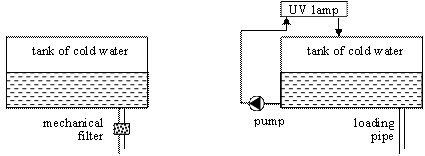
Existing solution imply the installation of
purification devices directly to the vagon before a tank of cold water (fig. 1a)
[4]. Also used a periodic circulation through the UV sterilize (fig. 1b) [5].
a b
Fig. 1. Existing concepts of
water-filled system of passenger railway wagon tank: a) – with mechanical filter;
b) – with a circulation of water through the UV sterilize
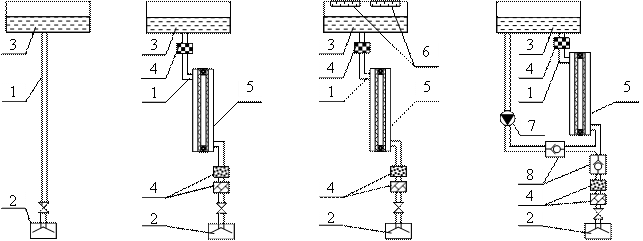
The authors propose another solution. It involves
the installation of a UV sterilizer before tank. Thereby eliminating getting
into the water supply system a bacteria. (fig. 2) [6, 7]. Mechanical filters have no such efficiency without a disinfecting. To eliminate of bacteria reproduction in the tank still got in one can
accommodate extra surface UV irradiators [8]. The circulation of water through
the UV sterilizer in water filled pipe is also possible to achieve a more
efficient disinfecting or unfavorable epidemiological situation. The pump is
used for this purpose. Non-return valves prevent leakage of water [9].
a b c d
Fig. 2. Schematic diagrams of water-filled system of passenger railway wagon:
a) – typical; b) – with UV sterilizer 5;
c) – with UV sterilizer 5 and extra surface UV irradiators 6 under the
tank roof;
d) – with water
circulation through the UV sterilizer 5
(1 – loading
pipe, 2 – filler
pipe, 3 – tank
of cold water, 4 – filters,
7 – circulation pump, 8 – non-return
valves)
Proposed solutions require additional space in the wagon. It is
necessary to install the UV sterilizer, a pump, valves, filters and associated
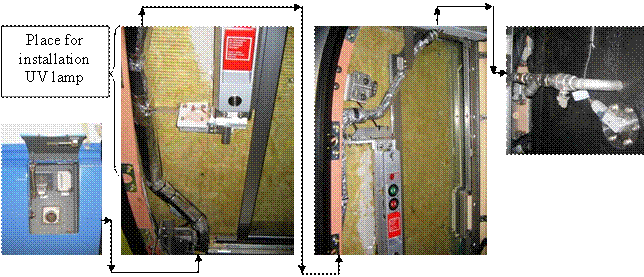
equipment. Potential place of installation is in the filler pipe. For example,
it is shown at fig. 3 for the wagon train Sapsan (VelaroRus) [10]. Easy access
to the system behind removable panels of tambour allows periodic maintenance of
UV sterilizer.
The economic effect of UV sterilizer in water supply system is achieved
by reducing the use of bottled water for drinking. The water from water columns
at the station meets the quality requirements. Existing technology of wagon
water filling is the weak spot. It has an open and non-secure location of hoses
and filler pipes. The use of UV sterilizer is a standard way to bring water
quality up to standards in extended centralized water supply systems. Bottled
water often also passes UV disinfecting process. But it has more expensive transportation.
Applications UV sterilizers in passenger wagons will allow to increase
epidemiological safety of passengers. UV sterilizer will reduce the frequency
of the periodic chlorination of the water supply system. Chlorine solution
requires the spesial preparation and after disinfection it remains in pipes and
tanks.
a b c d
Fig. 3. Elements of water filled system for Sapsan
(VelaroRus) wagon:
a) – filler pipe; b) – the lower part of the loading pipe (view from tambour);
c) – the upper part of the loading pipe; d) – input in the main water tank
1. Tomilova O. S. Efficiency
calculation of the ultra-violet sterilizer of the carriage water supply
modernized system // Izvestia Transsiba / OSTU. Omsk, 2012. № 3 (11). 46 – 54 р.
2. Томилов В. В.
Экспериментальные исследования динамики потоков воды в ультрафиолетовых
стерилизаторах / В. В. Томилов, О. С. Томилова // Materiály XII mezinárodní
vědecko - praktická
konference «Efektivní
nástroje moderních
věd – 2016». Díl
15. Technické vědy.: Praha. Publishing House «Education and
Science». С.
9-10.
3. Томилов В. В. Расчетно-экспериментальный способ
определения дозы ультрафиолетового облучения воды / В. В. Томилов, О. С. Томилова
// Материалы второй всероссийской научно-технической конференции с международным
участием «Приборы и методы измерений, контроля качества и диагностики в
промышленности и на транспорте» / Омский гос. ун-т путей сообщения. Омск, 2016.
С. 97-102.
4. Пат. № 2267422 на
полезную модель (РФ), МПК B61D35/00, B61K11/02. Система заправки водой
пассажирского вагона. / В. В. Кипка
(Россия). – № 2003113379/11; заявл.
06.05.2003; опубл. 27.11.2004 // Открытия.
Изобретения. 2004. № 11.
5. Пат. № 52374 на
полезную модель (РФ), МПК B61D35/00.
Система
холодного водоснабжения пассажирского вагона / Григорьев Э. Н. – № 2005121 392/22; заявл. 07.07.2005; опубл. 27.03.2006 // Открытия. Изобретения. 2006. № 22.
6. Matyash J. I. Arrangement for water disinfection in
carriages for long-distance traffic / J. I. Matyash, O. S Tomilova
// Izvestia Transsiba / OSTU. Omsk, 2010. № 4 (6). 23-27 p.
7. Пат. № 88327 на
полезную модель (РФ), МПК В 61 D 35/00. Водоналивная система пассажирского
вагона / Ю. И. Матяш, О. С. Томилова (Россия). – №
2009127020/22; заявл. 14.07.2009; опубл. 10.11.2009 // Открытия. Изобретения. 2013. № 31.
8. Пат. № 131353 на
полезную модель (РФ), МПК В 61 D 35/00, B 61 K 11/00, E 03 B 7/07. Водоналивная
система пассажирского вагона / Ю. И. Матяш, О. С. Томилова,
В. В. Томилов (Россия). – № 2013109041/11; заявл.
28.02.2012; опубл. 20.08.2013 // Открытия. Изобретения.
2013. № 23.
9. Пат. №
132046 на полезную модель (РФ), МПК В 61 D 49/00, B 61 D 35/00, B 61 K 11/02.
Водоналивная система пассажирского вагона / Ю. И. Матяш,
О. С. Томилова, В. В. Томилов (Россия). – № 2013117428/11;
заявл. 16.04.2013; опубл.
10.09.2013 // Открытия. Изобретения. 2013. № 25.
10. Electro rolling stock operation features in extreme environmental
conditions /
V. Tomilov, E. Likhanova, A. Orlov and other // Achievement of
high school: материали за 9-а меж-дунар. научна практ. конф. / «Бял ГРАД-БГ» ООД Том
45. Технологии. София.
2013. 68 – 73 р.