Pil E.A.
Academic
RANH, dr. sc., professor, Saint-Petersburg
GDP CALCULATION WITH ONE VARIABLE HAVING A NEGATIVE VALUE
This article examines an issue of calculation of the gross domestic
product under influence of four variables, one of which has a negative value.
The calculations served as a basis for plotting 2D and 3D graphs.
The article below shows how the negative values of one parameter out of
four influence the GDP, while other parameters have positive values, grow or diminish by a factor of 10 times. In our
calculations, the variable X4 has negative values. Thus, at issue is the GDP
change Vsu (GDP) = f (Х1, Х2, Х3, Х4). Here
GDP is understood as the volume of the economic shell Vsu. In
this case, the values of the variable X4 may be viewed as a key rate or
taxes, because their values may not equal 1. In our example, let's assume
hypothetically that the variable X4 is a key rate. The State may theoretically
adopt negative taxes, though there was no such precedent in practice.
Recently, articles on negative interest rates have
appeared online, where such rates are referred to as the 'key rate' [1, 2, 3, 4]. This article treats
calculations related to the theory of economic crises.
Figure 1 shows a 2D graph which was plotted with the following
values of variables: Х1 = Х2 = Х3 = 1, Х4 = 0.99…–0.99, i.e. the value of the variable Х4 was
accepted from +0.99 to –0.99. In order to adopt a negative key rate, the State
must, in parallel with the Central bank and commercial banks and large-scale
businesses, represented by the oligarchs in the first place, share some of its
wealth accumulated in a way not always consistent with law, with small and
medium businesses, as well as with the people [5, 6]. This also correlates to
the closure of all offshore zones in the world. This question was raised after
the onset of the world crisis in 2008. As such, the Russian companies and
oligarchs, according to some sources, hoard from 45% to 75%
nation's GDPs offshore [7, 8, 9, 10]. This can mitigate the degree of discontentment
with a big gap between the rich and the poor and raise the wealth of the
latter, help incentivize the market to buy goods and services and hence change
the vector of the GDP trend.
|
Fig. 1. Vsu (GDP) = f(Х1, Х2, Х3, Х4) Х1 = Х2 = Х3 = 1, Х4 = 0.99…–0.99 |
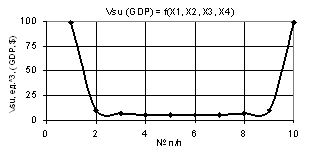
As the symmetrical Fig. 1 shows, the Vsu (GDP) curve goes down at first to its minimum value Vsu (GDP) = 5.25 units3
in the point 5 while the values of variable Х4 diminish, and further, with increase in negative
values of X4, the plotted part of the Vsu (GDP) curve mirrors the part of
the curve with positive values of X4. This figure interprets the situation in a
country in an economic crisis, when banks begin to lower key rates in an
attempt to invigorate the economic situation. The calculations showed
that the theoretical value of the Vsu (GDP) under influence of external pressure, for example
with Х4 = –0.99
equals Vsut (GDP) = 98.12. The
volume of a spherical economic shell is calculated by using a formula Vsu = 4pRsu3/3 = 4.19Rsu3, units3.
Thus, if the radius of a spherical economic shell Rsu equals '1' (Rsu = 1), we shall get Vsu = 4.19 units3 calculating its volume Vsu, i.e.
less than the value of Vsut. Therefore, here we can introduce the notion
of a singular volume of the spherical economic shell Vsusv,
i.e. when the value of Vsusv
= 1 units3. This is the starting value for every country's economy.
In terms of our example, the theoretical value Vsut = 98.12 units3 with Х4 = 0.99, and Vsut = 5.23 units3 with X4 = 0.09, i.e. it
decreased by a factor of 18,76 times,
while the value of variable X4 is decreased by a factor of 11 times. Figure 1
leads to a conclusion that when a negative key rate is used, the Vsu (GDP) of a country begins to grow.
Now we
must mention that the calculated values of the amount of the Vsu (GDP) depend on the accuracy we apply in calculating them. The value of the
variable X4 greatly affects accuracy of the calculation, as shown in Table 1.
This Table shows that along with increase in values of X4 from –0.9 to –0.999999, i.e. by a factor of 1.11111
times, the
values of the GDP increase from 18.07 to 97756.52, i.e. by a factor of 5409.88
times.
|
Table 1. The combined
table of values of X4 and of the Vsu (GDP) with
values of X4 increasing |
||||||
|
№ |
1.
|
2.
|
3.
|
4.
|
5.
|
6.
|
|
Value of X4 |
-0.9 |
-0.99 |
-0.999 |
-0.9999 |
-0.99999 |
-0.999999 |
|
Value of Vsu (GDP), units3 |
18.07 |
98.12 |
549.93 |
3091.45 |
17383.90 |
97756.52 |
The
similar Table 2 may be obtained when the values of the variable X4 decrease
from –0.9 to –0.000009, i.e. by a factor of 100000 times, and the values of the Vsu (GDP) decrease only by a factor of 3.48 times. In other words, it is safe
to draw a conclusion here that if the values of the variable X4 decrease, the
lower limit of the volume of economic shell of the Vsu (GDP) may be assumed as 5.199.
|
Table 2. The combined
table of values of X4 and of the Vsu (GDP) with
values of X4 decreasing |
||||||
|
№ |
1.
|
2.
|
3.
|
4.
|
5.
|
6.
|
|
Value of X4 |
-0.9 |
-0.09 |
-0.009 |
-0.0009 |
-0.00009 |
-0.000009 |
|
Value of Vsu (GDP), units3 |
18.07 |
5.23 |
5.199 |
5.198982 |
5.1989792 |
5.1989791 |
On the basis of calculations presented in Tables 1 and 2 two curves have
been plotted, shown on Fig. 2 and 3 respectively.
|
Fig. 2. Vsu (GDP) = f(Х1, Х2,
Х3, Х4) Х1 = Х2 = Х3 = 1, Х4 = –0.9…–0.999999 |
Fig. 3. Vsu (GDP) = f(Х1, Х2,
Х3, Х4) Х1 = Х2 = Х3 = 1, Х4 = –0.9…–0.000009 |

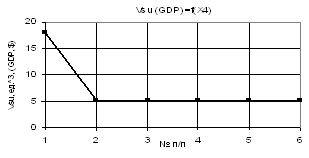
Additionally, the values of the Vsu (GDP) for the curve plotted in Figure 2 may be calculated
using a simpler formula by means of employing the following exponential
equation of the Vsu (GDP) = 3,178e1,7211Х4, as the correlation coefficient R2 in this case equals 1 (R2
= 1).
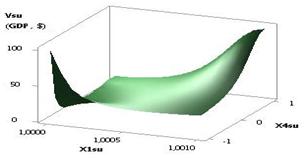
The following Figure 4 depicts a 3D graph for a
2D curve on Figure 1, which gives a more illustrative presentation of how a
calculated parameter of the Vsu (GDP)
changes.
|
Fig. 4. Vsu (GDP) = f(Х1, Х2,
Х3, Х4) Х1 = 1, Х2 = Х3 = 1, Х4 = 0.99…–0.99 |
In view of the fact
that theoretical values Vsutmin > 0 and obviously diverge from practical values which can equal zero (Vsupmin
= 0), a diminution coefficient for Ksumin = 8.06E–11 can be introduced here.
This coefficient helps render minimum theoretical values of Vsutmin into minimum practical Vsupmin according to the formula Vsutmin = Ksumin Vsupmin. Here we can offer a similar coefficient of
increase for the maximum theoretical value of Ksumax which allows for rendering the maximum theoretical values Vsutmax into the maximum practical Vsupmax according to the following formula Vsutmax = Ksumax Vsupmax.
|
Table 3. The combined
table of values of Х4 and maximum theoretical values of Vsutmax with values of Х4 increasing. |
||||||
|
№ |
1.
|
2.
|
3.
|
4.
|
5.
|
6.
|
|
Value of Х4 |
-0.9 |
-0.99 |
-0.999 |
-0.9999 |
-0.99999 |
-0.999999 |
|
Value of Vsutmax, units3 |
1.241 |
1.241 |
1.241 |
1.241 |
1.241 |
|
In the following two tables 3 and 4 there are the maximum theoretical
values of Vsutmax, while values of the variable X4 increase and
decrease. Table 3 shows that the values of Vsutmax, don't change and have the same amount of Vsutmax, = 1.241.
It can be seen from Table 4 that in the event of decrease in values of
the variable Х4 from –0.9 to –0.000009, i.e. by a factor of 100000 times, the values of Vsutmax, decrease from 4.31 to 1.24080647, i.e. by a factor of 3.47 times.
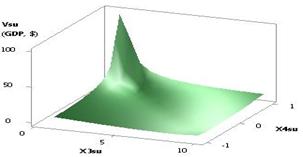
The following Figure 5 presents the Vsu (GDP) curve with the following variables: Х1 = Х2 = 1, Х3 = 1…10, Х4 = 0.99…–0.99. As
seen on the figure, the plotted curve plummets from 98.12 to 3.61
between the points 1 and 2, and continues to decrease to its minimum 0.3 in the
point 8, and then increases to 3.1, i.e. by a factor of 10.31 times. Figure 6
below shows the same curve using 3D graph.
|
Table 4. The
combined table of values of X4 and maximum theoretical values of Vsutmax with values of Х4 decreasing |
||||||
|
№
|
|
|
|
|
|
|
|
Value of Х4 |
-0.9 |
-0.09 |
-0.009 |
-0.0009 |
-0.00009 |
-0.000009 |
|
Value of Vsutmax, units3 |
4.31 |
1.24839 |
1.24088 |
1.240807 |
1.24080648 |
1.24080647 |
|
Fig. 5. Vsu (GDP) = f(Х1, Х2, Х3, Х4) Х1 = Х2 = 1,
Х3 = 1…10, Х4 = 0.99…–0.99 |
Fig. 6. Vsu (GDP) = f(Х1, Х2,
Х3, Х4) Х1 = Х2 = 1, Х3
= 1…10, Х4 = 0.99…–0.99 |

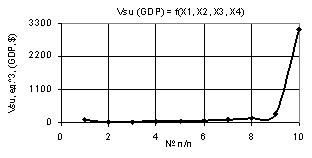
Further, in Figure 7 the Vsu (GDP)
dependency is illustrated with the variables Х1 = 1, Х2 = Х3 = 1…10, Х4 = 0.99…–0.99. It's noteworthy that the
plotted curve has its minimum 28.85 in the point 2, and then the values of the Vsu (GDP) grow to 3102.97, i.e. by a factor of 105.55. Now, if we compared the
calculated values of the Vsu (GDP), we would come up with the
following values: with Х4
= 0.11 the
values of the Vsu (GDP) = 58.66, and with Х4 = –0.11 they jump to Vsu (GDP) = 77.11. Thus, this option is acceptable in terms of economy's recovery from
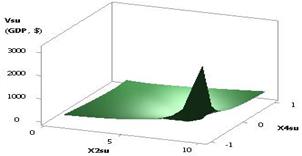
the crisis with the key rate having negative value. Figure 8 shows a
three-dimensional picture of this curve.
|
Fig. 7. Vsu (GDP) = f(Х1, Х2,
Х3, Х4) Х1 = 1, Х2 =
Х3 = 1…10, Х4 = 0.99…–0.99 |
Fig. 8. Vsu (GDP) = f(Х1, Х2,
Х3, Х4) Х1 = 1, Х2 =
Х3 = 1…10, Х4 = 0.99…–0.99 |
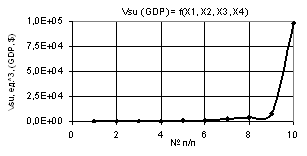
If all three first variables are increased by a
factor of 10, Х1 = Х2 = Х3 = 1…10 with Х4 = 0.99…–0.99, then the values of the Vsu (GDP) will be increased from 98.12 to a larger amount of the Vsu (GDP) = 98124.68, i.e.
by a factor of 1202.39, as
shown in Figure 9. This option should be employed during a country's recovery
from the economic crisis, as under any negative values of the variable Х4 the
amount of the Vsu (GDP) only grows.
Here, the plotted curve has its minimum 81.62 in the point 2 and therefore the values of the
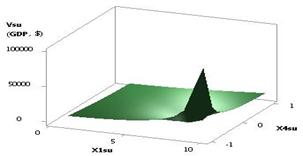
variable Х1 = Х2 = Х3 = 2, Х4 = 0.77 shouldn't be applied. Figure 10 shows a
three-dimensional picture of this dependency which in no way differs in appearance
from the previous one in Figure 8.
|
Fig. 9. Vsu (GDP) = f(Х1, Х2,
Х3, Х4) Х1 = Х2 = Х3 = 1…10, Х4 = 0.99…–0.99 |
Fig.10. Vsu (GDP) = f(Х1, Х2,
Х3, Х4) Х1 = Х2 = Х3 = 1…10, Х4 = 0.99…–0.99 |
|
Fig. 11. Vsu (GDP) = f(Х1, Х2,
Х3, Х4) Х1 = Х2 = 1…10, Х3 = 1, Х4 = 0.99…–0.99 |
Fig. 12. Vsu (GDP) = f(Х1, Х2,
Х3, Х4) Х1 = Х2 = 1…10, Х3 = 1, Х4 = 0.99…–0.99 |
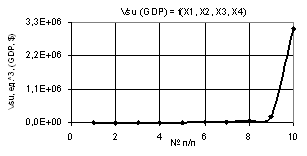
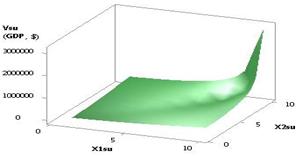
If we apply the following values of the variables Х1 = Х2 = 1…10, Х3 = 1, Х4 = 0.99…–0.99, the parameter Vsu (GDP) will then be big too, increasing from 98.12 to 3.10E+06, i.e.
by a factor of 31622.38 times, as
shown in Figure 11. Therefore, this option is also recommended for use in
selection of a way for a country's recovery from the crisis. Here, for example
with Х4 = 0.11 the value Vsu (GDP) = 7332.44, and with Х4 = -0.11, the Vsu (GDP) will equal 16655.74, i.e. 2.3 times.
Calculations served as a basis for a 3D graph, presented in Figure 12.
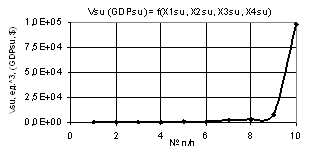
The following Figure 13 was plotted with Х1 = Х3 = 1, Х2 = 1…10, Х4 = 0.99…–0.99 and
is analogous to Fig.9. As we can see here, the values of the Vsu (GDP) do also reach a significant amount, from 98.12 they grow to 98124.68, i.e.
by a factor of 1202.39 times.
Here, the plotted curve has its minimum 81.62 in the point 2. Thus, the values of the variables
where the Vsu (GDP) = 81.62 shouldn't be selected during a country's
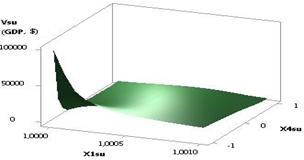
recovery from the economic crisis. Figure 14 shows the influence two variables
exert over the calculated amount of the Vsu (GDP).
|
Fig. 13. Vsu (GDP) = f(Х1, Х2,
Х3, Х4) Х1 = Х3 = 1,
Х2 = 1…10, Х4 = 0.99…–0.99 |
Fig. 14. Vsu (GDP) = f(Х1, Х2, Х3, Х4) Х1 = Х3 = 1,
Х2 = 1…10, Х4 = 0.99…–0.99 |
If we use the following values of the variables Х1 = Х3 = 1…10, Х2 = 1, Х4 = 0.99…–0.99 when
we plot a curve of the Vsu (GDP), we
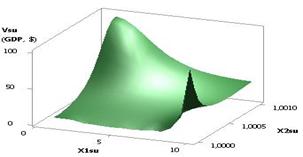
will get a curve presented in Fig.15, which is absolutely analogous to the
curve in Fig.1. Therefore, here we can make the same conclusion. In
Fig.16 below we see a three-dimensional interpretation of a two-dimensional
graph in Fig.15.
|
Fig. 15. Vsu (GDP) = f(Х1, Х2,
Х3, Х4) Х1 = Х3 =
1…10, Х2 = 1, Х4 = 0.99…–0.99 |
Fig. 16. Vsu (GDP) = f(Х1, Х2,
Х3, Х4) Х1 = Х3 =
1…10, Х2 = 1, Х4 = 0.99…–0.99 |

Earlier, we had figures where the values of
the variables Х1,
Х2,
Х3 grew by a factor of 10 times. Now we are going to
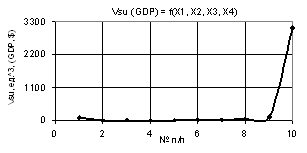
look at the options where the variables Х1, Х2, Х3 will decrease, as
illustrated in Fig.17 with Х1 = Х2 = 1, Х2 = 1…0.1. As the figure demonstrates, with the variable X3 decreasing by a
factor of 10 times, the calculated values of the Vsu
(GDP) grow to the maximum value 3102.97, and the plotted curve has its minimum 9.52 in the point 3. Thus, this option is also suitable
for a country's recovery from the economic crisis, excluding only the
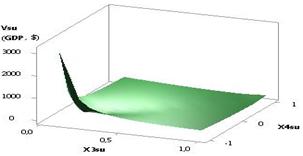
variables' values where the Vsu (GDP) = 9.52. Figure 18
shows the 3D graph of the Vsu
(GDP).
|
Fig. 17. Vsu (GDP)= f(Х1, Х2,
Х3, Х4) Х1 = Х2 = 1,
Х2 = 1…0,1, Х4 = 0.99…–0.99 |
Fig. 18. Vsu (GDP) = f(Х1, Х2,
Х3, Х4) Х1 = Х2 = 1,
Х2 = 1…0,1, Х4 = 0.99…–0.99 |
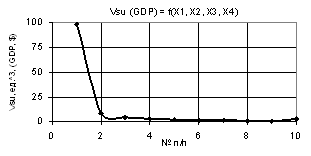
If we calculate the parameter of the Vsu (GDP) with the following values of the variables Х1 = 1, Х2 = Х2 = 1…0.1, Х4 = 0.99…–0.99, we will get a
diminishing curve which has its minimum 0.91 in the point 9, and then grows to
3.1 in the point 10 (Fig.19). The obtained calculations served as a basis for a
3D graph, presented in Figure 20.
|
Fig. 19. Vsu (GDP) = f(Х1, Х2,
Х3, Х4) Х1 = 1, Х2 =Х2
= 1…0,1, Х4 = 0.99…–0.99 |
Fig. 20. Vsu (GDP) = f(Х1, Х2,
Х3, Х4) Х1 = 1, Х2 =Х2
= 1…0,1, Х4 = 0.99…–0.99 |
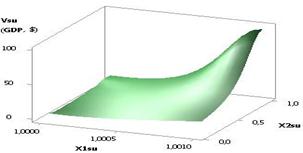
|
Fig. 21. Vsu (GDP) = f(Х1, Х2, Х3, Х4) Х1 = 1…10,Х2 =
Х2 = 1…0,1, Х4 =0.99…–0.99 |
Fig. 22. Vsu (GDP)= f(Х1, Х2,
Х3, Х4) Х1 = 1…10,Х2 =
Х2 = 1…0,1, Х4 =0.99…–0.99 |

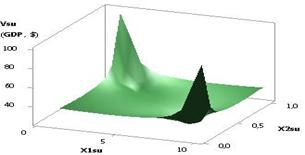
Figure 21 demonstrates that the plotted curve of the Vsu (GDP) with Х1 = 1…10, Х2 = Х2 = 1…0.1, Х4 = 0.99…–0.99 imitates
Fig. 1 and 15 by form and, naturally, the same conclusions also apply to it. It
is noteworthy here that with these variables the minimum value of the Vsu (GDP) equals 27.26. Figure 22 clearly demonstrates
the look of this curve when its three-dimensional picture is used.
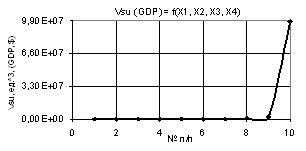
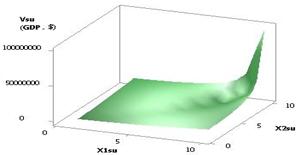
The last Figures 23 and 24 show 2D and 3D dependencies of the Vsu (GDP) when the variables were the following: Х1 = Х2 = 1…10, Х2 = 1…0.1, Х4 = 0.99…–0.99. The
calculations data show that with these variables the values of the Vsu (GDP) were the biggest, increasing from 98.12 to 9.81E+07, i.e. grew by
a factor of 1000000. This option is, thus, the
most favourable for use in terms of recovery of a country's economy from the
crisis.
|
Fig. 23. Vsu (GDP) = f(Х1, Х2,
Х3, Х4) Х1 = Х2 =
1…10, Х2 = 1…0,1, Х4 = 0.99…–0.99 |
Fig. 24. Vsu (GDP) = f(Х1, Х2,
Х3, Х4) Х1 = Х2 =
1…10, Х2 = 1…0,1, Х4 = 0.99…–0.99 |
We have the combined Table 5 below containing all
the calculations referred to above. Their number is somewhat bigger as some
parameters of the Vsu (GDP) had both minimum and
maximum values during calculations. Besides, all values of the Vsu (GDP) parameters were sorted by a degree of diminution. Here, the values of Vsub and Vsuf denote starting and ending values of the Vsu (GDP) parameter, obtained by
calculation. The ratio Vsuf / Vsub characterises the extent of increase (decrease) of the last value of the
parameter Vsuf in relation to the starting Vsub. This
enables us to single out such values of the variables Х1, Х2, Х3, Х4, where the Vsu (GDP) grows even in the times of
the economic crisis.
|
Table 5. Options of
changing values of the variables X1 X2, X3 и X4, as well as
calculated data Vsub and Vsuf and
their ratio Vsuf / Vsub |
||||||
|
№ |
Х1 |
Х2 |
Х3 |
Х4 |
Vsub…Vsuf (GDPsub… GDPsuf, $) |
Vsuf / Vsub (GDPsuf / GDPsub) |
|
1.
|
1…10 |
1…10 |
1…0.1 |
0.99…–0.99 |
98.12…9.81E+07 |
1.00E+06 |
|
2.
|
1…10 |
1…10 |
1 |
0.99…–0.99 |
98.12…3.10E+06 |
31622.78 |
|
3.
|
1…10 |
1…10 |
1…10 |
0.99…–0.99 |
81.61…98124.68 |
1202.39 |
|
4.
|
1 |
1…10 |
1 |
0.99…–0.99 |
81.61…98124.68 |
1202.39 |
|
5.
|
1 |
1 |
1…0.1 |
0.99…–0.99 |
9.52…3102.97 |
325.95 |
|
6.
|
1 |
1…10 |
1…10 |
0.99…–0.99 |
28.85…3102.97 |
107.55 |
|
7.
|
1 |
1 |
1 |
0.99…–0.99 |
5.24…98.12 |
18.70 |
|
8.
|
1…10 |
1 |
1…10 |
0.99…–0.99 |
5.25…98.12 |
18.70 |
|
9.
|
1 |
1 |
1…10 |
0.99…–0.99 |
0.30…3.10 |
10.31 |
|
10. |
1…10 |
1…0.1 |
1…0.1 |
0.99…–0.99 |
24.63…98.12 |
3.98 |
|
11. |
1 |
1…0.1 |
1…0.1 |
0.99…–0.99 |
0.91…3.10 |
3.40 |
|
12. |
1…10 |
1…0.1 |
1…0.1 |
0.99…–0.99 |
24.63…27.26 |
1.11 |
|
13. |
1…10 |
1…0.1 |
1…0.1 |
0.99…–0.99 |
27.26…24.63 |
0.90 |
|
14. |
1…10 |
1…10 |
1…10 |
0.99…–0.99 |
98.12…81.61 |
0.83 |
|
15. |
1 |
1…10 |
1 |
0.99…–0.99 |
98.12…81.61 |
0.83 |
|
16. |
1 |
1…10 |
1…10 |
0.99…–0.99 |
98.12…28.85 |
0.29 |
|
17. |
1…10 |
1…0.1 |
1…0.1 |
0.99…–0.99 |
98.12…24.63 |
0.25 |
|
18. |
1 |
1 |
1…0.1 |
0.99…–0.99 |
98.12…9.52 |
0.097 |
|
19. |
1 |
1 |
1 |
0.99…–0.99 |
98.12…5.24 |
0.05 |
|
20. |
1…10 |
1 |
1…10 |
0.99…–0.99 |
98.12…5.25 |
0.05 |
|
21. |
1 |
1…0.1 |
1…0.1 |
0.99…–0.99 |
98.12…0.91 |
0.009 |
|
22. |
1 |
1 |
1…10 |
0.99…–0.99 |
98.12…0.30 |
0.003 |
The last table 6 is in fact a modified table 5, where only ratios Vsuf / Vsub ≥
1 are left. By doing so, we got the final Table 6 which combines all the values
of the variables Х1, Х2, Х3, Х4, which can help us to drive the country out
of the economic crisis. It's important to note here that an emphasis must be
made during the selection of variables from Table 6 on those rows which have
the maximum quantity of ones. In our example this happens with two values of
the variables, highlighted in bold. In such case, only two variables should be
changed, which is certainly easier than three or four.
|
Table 6. Options of changing values of the variables X1 X2, X3, X4, as
well as calculated data Vsub and Vsuf
and their ratio Vsuf / Vsub
with Vsuf / Vsub
≥ 1 |
||||||
|
№ |
Х1 |
Х2 |
Х3 |
Х4 |
Vsub…Vsuf (GDPsub… GDPsuf, $) |
Vsuf / Vsub (GDPsuf / GDPsub) |
|
1.
|
1…10 |
1…10 |
1…0.1 |
0.99…–0.99 |
98.12…9.81E+07 |
1.00E+06 |
|
2.
|
1…10 |
1…10 |
1 |
0.99…–0.99 |
98.12…3.10E+06 |
31622.78 |
|
3.
|
1…10 |
1…10 |
1…10 |
0.99…–0.99 |
81.61…98124.68 |
1202.39 |
|
4.
|
1 |
1…10 |
1 |
0.99…–0.99 |
81.61…98124.68 |
1202.39 |
|
5.
|
1 |
1 |
1…0.1 |
0.99…–0.99 |
9.52…3102.97 |
325.95 |
|
6.
|
1 |
1…10 |
1…10 |
0.99…–0.99 |
28.85…3102.97 |
107.55 |
|
7.
|
1 |
1 |
1 |
0.99…–0.99 |
5.24…98.12 |
18.70 |
|
8.
|
1…10 |
1 |
1…10 |
0.99…–0.99 |
5.25…98.12 |
18.70 |
|
9.
|
1 |
1 |
1…10 |
0.99…–0.99 |
0.30…3.10 |
10.31 |
|
10.
|
1…10 |
1…0.1 |
1…0.1 |
0.99…–0.99 |
24.63…98.12 |
3.98 |
|
11.
|
1 |
1…0.1 |
1…0.1 |
0.99…–0.99 |
0.91…3.10 |
3.40 |
|
12.
|
1…10 |
1…0.1 |
1…0.1 |
0.99…–0.99 |
24.63…27.26 |
1.11 |
List of references:
1. Negative rates in mortgage. Now it's doable (in
Russian).// http://www. vestifinance.
ru/articles/52690
2. The Central Bank of
3. Negative interest rate (in Russian)//
http://sverigesradio.se/sida/artikel.aspx? programid
=2103&artikel=6091650
4. Negative interest rates (in Russian).//
http://consulting-finance.com/stati/ otricatelnye-procentnye-stavki.html
5. Billions for charity: in
6. The moneybags are asked to cede half of their wealth (in Russian). //
http://www.mixnews.lv/ru/world
/news/43138_boga4ej-prosyat-otdat-polovinu-nazhitogo/
7. Laura Keffer. Throughout 15 years in
8. Offshores in five graphs: trillions hidden
from eyes of the beholder. // https://news.mail.ru/society/31625187/
9. The Russians hold 62 trillion roubles or 75% of the national income
in offshores (in Russian). // https://newdaynews.ru/finance/612444.html
10. Olga Sorokina. Return to the
motherland: how