Mathematics/2.
Prospects of information systems
Pashkova
E.E.
Stary Oskol technological institute n.a. A.A.
Ugarov (branch) National University of Science and Technology
"MISiS", Russia, Stary Oskol
Profile of integrated management of the international
conflicts on the basis of multiagentny approach
The
complex principle of the organization of management of the international
conflicts (further – MK) assumes distribution of the mechanism of realization
of functions of management and regulation of MK. Thus, the time
period of achievement of a strategic objective is reduced. All actions of
system break into separate works, and realization of all scale of works leads
to achievement of the established purpose. The required resources are distributed between the
number of separate works and management of MK passes to other object – a set of
works and actions [1]. Combination of multiagentny approach and the complex
principle of the organization of management in MK gives an opportunity of
creation of the effective mechanism of operational management [2; 3]. In
the figure 1 we will present a combination of multiagentny approach and the complex
principle of the organization of management to MK in the form of a profile of
ternary counts where each count is a basic part of all mechanism. The profile of ternary counts includes the following
basic elements: And – set is more whole on management and regulation of MK; Х – number of works on management and regulation of MK;
With – functions of agents; E – agentny orgstructure (interaction of agents); D
– agents liquidators of MK (analysts, experts, etc.); J – resources necessary
for regulation of MK; F – technologies of performance of work for regulation of
MK. We will present a profile of integrated management and regulation of MK in
the form of the following model which of set of elements it is possible to make
thirty five subsystems excellent from each other: R_mk = { A, X,C,D,E,F,J }.
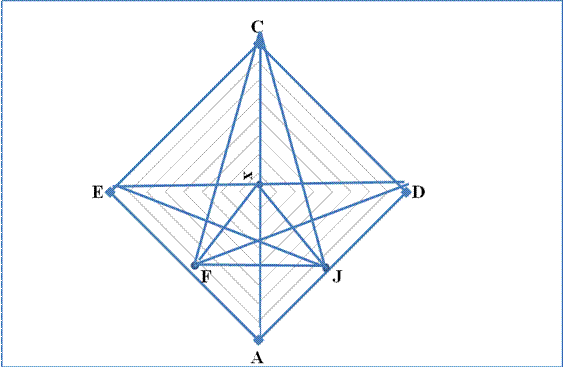
Fig. 1 – Profile of
integrated management and regulation of MK
We will group the allocated
subsystems in some properties and we will mark out five categories. The first
category of subsystems defines influence of agents on properties of a profile.
The subsystem of DJA displays interrelations of the purposes on management with
the resources necessary for regulation of MK and agents liquidators of MK. DJX
points in a profile determine the professional level of agents liquidators of
MK necessary resources and the number of works on management and regulation of
MK. The subsystem of DJC defines interaction of agents liquidators of MK,
resources and a set of the functions which are carried out by them. The
subsystem of DJF demands knowledge from agents of technologies of performance
of work on regulation of MK. Points
of DJE assume coordination of a great number of agents liquidators of
organizational structures, formed or by means of the located resources. Subsystems
of DCA, DCX, DCF assume comparison of knowledge and functions of agents to a
set of the purposes, the number of works and technologies of performance of
work for regulation of MK. Points
of DCE display interrelations the organizational structures and the functions
realized by them.
Subsystems
of DEA, DEX, DEF define interrelation the organizational structures, a set of
the purposes and technologies of performance of work. Points of DXA, DXF, DFA
assume coordination of knowledge of agents with the performed works applied by
technologies and goals.
The
second category of subsystems defines a role of the located resources at
establishment of properties of a profile. Points of this subsystem assume
resource comparison of set of the purposes, the number of works, the applied
technologies and the agentny of organizational structures. The third category
of subsystems of a profile establishes interrelation of the realized functions,
the number of works and the applied technologies. The fourth category of
subsystems of a profile assumes comparison of the applied technologies and a
set of the purposes to the realized works. Points of AEX focus on coordination
of set of the purposes and the number of the performed works and also the
agentny of organizational structures.
Having
described a profile of integrated management and regulation of MK, it is
possible to draw a conclusion that it represents system model with a set of the
organizational elements connected with regulation of MK. Thus, the
organizational and functional structure of system of operational management in
the conditions of MK presented in the form of the profile consisting of five
categories each of which is defined describes a certain group and interrelation
of elements of a profile.
Literature
1. Saati T.L.,
Kearns K.K. Analytical planning: organization of systems. Moscow, Radio and
communication, 1991; Saati T.L. Decision-making: method of the analysis
of hierarchies.
Moscow, Radio and communication, 1993
2. Minayev V. A.
It is information – the analytical systems of safety: problems and
decisions.//Security systems of communication and telecommunications. 2001, No.
42(6), page 20
3. Lincoln P.
Bloomfield and Allen Moulton Managing International Conflict: From Theory to
Policy. - New York: St. Martin's Press, 1997.