Sarsembayeva
A.T.,1 Sarsembay A.T.2
1Satbayev University,
Almaty, Kazakhstan
2School-Lyceum №250 named after T.Komekbayev, Karmakchi
area, Kyzylorda region, Kazakhstan
Analysis
of a solar flare on 2017 April 2
Monitoring of solar flares in real time
is performed by the Geostationary Operational Environmental Satellite (GOES). An
eruptive solar flare was just observed from active region 12644 positioned to
the northwest quadrant or near the western limb of the solar corona. The sun
emitted three mid-level solar flares on Apr. 2, 2017. The first peaked at 12:52
UT. The second, larger flare, peaked at 07:50 UT. The third flare, peaked at
21:35 UT. The classification of flares is carried out by measuring the flow of
solar X-rays in wavelengths ranging from 1 to 8 angstrom. All solar flares are
divided into 5 classes according to these measurements depending on the maximum
power of radiation emitted. These classes are denoted by letters of the Roman
alphabet: A, B, C, M and X.
The first flare is classified as an M2.3
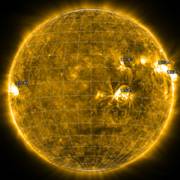
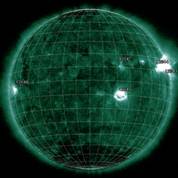
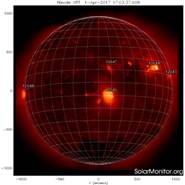
flare. The second as M5.4. The third flare classified as M4.4. The figure 1
shows the images obtained using instruments onboard STEREO, SOHO and Hinode.
|
|
|
|
|
Figure 1: Active area 12644 in the
ranges, AIA171 Å, AIA94 Å and XRT [1] |
||
References:
1.
https://solarmonitor.org/