Ekologia
CARCINOGENIC RISK OF ZIRCONIUM INDUSTRY OF UKRAINE
Doctor Levenets V.V., doctor Neklyudov I.M., Rolik I.L.
National
Science Center “Kharkov Institute of Physics and Technology”
61108,
Kharkov, Ukraine, 1, Academicheskaya Str.
levenets@kipt.kharkov.ua; rolik@kipt.kharkov.ua
Abstract. Article is dedicated to
scientific problem which is assessing the impact of zirconium production
companies of the nuclear power industry of Ukraine on ecological safety and
humans using principles of ecological
risk assessment methodology for humans.
Under influence of State Scientific and Production
Enterprise “Zirconium” outliers the evaluation
of carcinogenic risk for health of Dneprodzerzhinsk city population has been carried out. A map-scheme
of the spatial distribution levels of carcinogenic
risks at the location of enterprise was developed. It was found that the determining factor for an unacceptable
level of environmental risk in Dneprodzerzhinsk is a background pollution. The determining
factor for an unacceptable risk level on the territory of industrious site SSPE “Zirconium” is joint effect of background pollution and
emissions of the enterprise.
Key words: zirconium
production, nuclear fuel, ecological
safety, carcinogenic risk assessment, air pollution.
I.
Introduction
State Scientific and
Production Enterprise “Zirconium” (SSPE “Zirconium”) is one of the main parts
of the nuclear-pure zirconium alloy production in Ukraine. The enterprise is
located in Dneprodzerzhinsk, Dnepropetrovsk region, which is one of the main
centers of ferrous metallurgy, chemical and chemical-recovery
industry of Ukraine. With population of 276 thousand people 1.75% of the
country’s products are produced here, i.e. the load three times higher the
average. As a consequence, the peculiarity of the city is high urbanization and
unfavorable ecological situation which reflects directly on the health status
of the city. The acute cancer problem: sickness rate is 37.27 per 10 thousand
of population average during the years 2002-2006, death-rate from malignant
tumors is 25.44.
The objective of this work is
to study the impact of atmospheric emissions from SSPE “Zirconium” on the level
of cancer rates of Dneprodzerzhinsk population.
Relevance of these studies is
determined by the prospects of increasing the capacities of zirconium
production according to the Energy Strategy of Ukraine till 2010 [1] as well as
lack of information on potential contribution of SSPE “Zirconium” in the
formation of general background cancer rates in the city.
II.
Methods of
research
To
achieve this objective we used
the principles of methodology for
assessing the carcinogenic risk
[2, 3] carried out in four stages:
1.
Risk identification.
2.
Impact assessment.
3.
Assessment of
dose-response relationship.
4.
Risk characteristics.
Risk
identification is carried out based on ecological characteristics of the
studied production and territory of its impact [4]. As a result, atmospheric
emissions were selected as the main negative factor of SSPE
“Zirconium” that has a direct impact on human health. Population that lives in
the area of the enterprise influence and workers of the industrial area of SSPE
“Zirconium” are the potentially exposed groups. Chrome and carbon were selected
as priority pollutants as among the substances present in plant emissions only they
possess carcinogenic effect [5].
Selection of
preliminary scenario and route of chemicals exposure (table 1) was done based
on the obtained information.
Table 1.
Exposure scenario
|
Source of pollutants |
Atmospheric emissions of enterprise from stationary
organized sources |
|||||
|
Inflow route |
Inhalation |
|||||
|
Impact scenario |
Residential area |
Industrious area |
||||
|
Type of impact on the time of contact |
Acute |
Lifetime (70 years) |
Acute |
Chronic (30 years) |
||
|
Age of the exposed group |
Average person |
≤ 6 |
6-18 |
18≥ |
18≥ |
18≥ |
Impact assessment
was to calculate
specific doses of receipt of pollutants in the human body [2,3]:
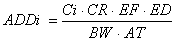 , (1)
, (1)
Where ADDi –
average daily rate of i-substance and mg/kg of body weight per day;
Ci – average
annual concentration in receptor point of i-substance, mg/m3;
CR – respiration
rate, m3/hour;
EF – effect
frequency, number of days/year;
ED – effect
duration, number of years;
BW – body weight:
average body weight during exposition, kg;
AT – exposure
averaging period, number of days.
Lifetime daily
dose considering age periods (LADD) was calculated as average dose for three
life periods using the following formula [2]:
 , (2)
, (2)
Where LADD – lifetime average daily
dose, mg/kg of body weight per day;
EDb – duration of exposure for younger
children (< 6 years);
EDc – duration of exposure for older
children (6-18 years);
EDa – duration of exposure for
adults (> 18 years);
ADDchb – chronic average daily dose
for younger children, mg/(kg-day);
ADDchc – chronic average daily dose
for older children, mg/(kg-day);
ADDcha – chronic average daily dose
for adults, mg/(kg-day);
AT – averaging time, number of years
(70).
Three types of variables were used
to calculate the intake:
1) Describing the exposing population
– value of the contact, frequency and duration of effect, body weight (table
2);
2) Determined by researcher – time
of exposure averaging, depends on type of assessed toxic effects (table 2);
3) Related to chemical substance – concentration
influence.
Table 2.
Characteristics of exposure
|
Parameter |
Characteristics |
Standard value |
|
CR |
Respiration rate, m3/hour |
children under 6 years – 4; children from 6 to 18 лет – 20; adults from 18 лет – 22; average person - 20 |
|
EF |
Effect frequency, days/year |
сценарий селитебный – 350; сценарий промышленный - 83 |
|
EDi |
Effect duration, years |
Lifetime: - children
under 6 years - 6; - children
from 6 to 18 years -12; - adults from
18 years - 52; Chronic
– 30; Acute - (EF
× ED =1) |
|
BW |
Body weight, kg |
children under 6 years - 15 children from 6 to 18 years -
42 adults from 18 years - 70 average person - 60 |
|
AT |
Period of exposure averaging, days |
carcinogens
-
365×70; |
Affecting concentrations were evaluated on the basis
of dispersion simulation of pollutants from stationary sources of pollution of
SSPE “Zirconium” which was carried out using computer program Eol-Plus 5.23.
This approach allowed to determine the affecting concentrations with and
without consideration of background of contaminants in the affected area.
As the simulation results provide maximum annual
concentrations of pollutants, to obtain average annual data we used information
that, as a rule, maximum one-time, average daily, monthly and annual average
concentrations are correlated as 10 : 4 : 1,5 : 1, i.e., average annual
concentration is usually one order less than maximum [6]. Maximum annual
concentrations were used in calculations the risks of acute effects, average
annual-chronic.
In assessment of dose-response relationship the so-called
linear threshold model of carcinogenesis was used according to which the
exposure even of a small quantity of substance in theory gives a finite
increase of cancer risk. This model was implemented using the so-called factors
of carcinogenic potential and as a result was brought to obtaining the value of
lifetime risk.
Carcinogenic
potential factor (CPS) or “slope factor” (SF) (mg/kg-day)-1 is a
risk per unit dose of this substance. It is determined by splitting the risk at
the highest level on the dose [2].
The
risk of an individual over
a lifetime or the lifetime risk
(Rind) – is excess (increase) of probability that during the lifetime there
will be some disturbances as a result of influence on the agent’s risk. It is
determined as an extra in comparison with the background risk for individual to
have cancer in the lifetime when exposed to specific substances in certain
concentration or dose:
Rind
= ADDi · CPS, (3)
Where Rind is the
risk of an individual during the lifetime;
ADDi –
average daily dose of i-substance intake, mg/kg of body weight per day;
CPS – is a factor
of carcinogenic potential (mg/kg-day)-1. Acceptability of the
obtained values was given in accordance with the generally accepted criteria
system recommended by WHO [2].
Calculation of
carcinogenic risks according the above described methodology was done in
computer program EcoAir [7]. Spatial data analysis and mapping of risk level
distribution was done in GIS ArcView 3.2a.
Use of
carcinogenic risk assessment method allows to calculate risk on the highest
(95%) confidential limit of risk assessment under assumption of certain
reassessment of risk. The value of this risk should not be used to conduct
direct similarities between the levels of actual cancer rates or death-rates,
and values of these risks. Mainly, they reflect a long-term tendency to change
the cancer background which is formed under the influence of risk factors.
III. Results
of research
III.I. Characteristics of influence area
SSPE “Zirconium” implements and
hydro metallurgical concentrate to produce zirconium
ingots of CTC alloy. The enterprise is
located on the right bank of the Dnieper river in the industrious North-Eastern
part of Dneprodzerzhinsk city, Dnepropetrovsk region,
its sites are near and mixed with workshops of other more powerful
metallurgical and chemical productions (Closed joint-stock company “DZMU”, SE
“PGMZ”, “DneprAzot Ltd.” etc) (fig. 1).
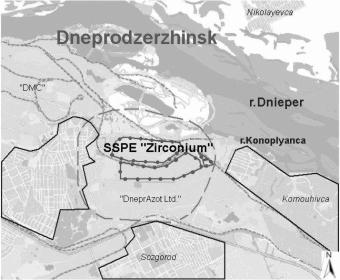
Note: hereinafter:
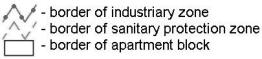
Fig. 1. Schematic map of SSPE
“Zirconium” location
General status of
biosphere elements in the studied region is characterized in table 3.
General
technological scheme for production of ingots from zirconium alloys is
represented by following stages [10]:
·
Sintering of zirconium concentrate
with technical sodium hydroxide (granular);
·
Cake washing from excess alkali
alkali silicon;
·
Desiliconization of alkaline
solutions;
·
Nitrate leaching of
hydrated zirconium cake;
·
Extraction
separation of zirconium and hafnium;
·
Hafnium hydroxide obtaining by
ammonia precipitation with its further transfer to pilot production;
·
Evaporation of zirconium re-extract;
·
Precipitation of zirconium tetrafluoride monohydrate
(ZTM)∙40% by hydrofluoric acid;
·
Drying, dehydration of ZTM monohydrate
and desorption of fluoride hydrogen;
·
Sublimation purification of ZTM from
impurities;
·
Calcium and thermal reduction of ZTM
to produce bullion ingot of zirconium;
·
Refining re-melting of bullion ingot
to obtain KTC-110 ingot;
·
Mechanical processing of ingot.
Table
3.
Indices
of biosphere elements pollution in Dneprodzerzhinsk city [8, 9]
|
The environment object |
Pollution indices |
Pollution category |
Indices and properties
according to which the calculation was done |
|
Atmospheric air |
250-365 |
extremely high |
main and specific
pollutants |
|
Surface water |
5-12 |
moderate |
organoleptic, toxicological properties and
health regime |
|
Soil |
3-4 |
increased |
average doses in the
state for all pesticides considering their disintoxication |
III.II. Risk characteristics
III.II.I. Scenario of
residential area.
Calculation
results of carcinogenic risks indicate that risk values are at minimum
acceptable level (with and without background contamination) (see table 4)
under acute exposure of chromium and soot on population.
Table 4
Carcinogenic risk for
population
|
Substances |
Background |
Without background |
With background |
||||||
|
On all studied area |
On all studied area |
||||||||
|
min |
max |
mean |
σ |
min |
max |
mean |
σ |
||
|
Rind ac |
|||||||||
|
Chromium |
3E-07 |
0 |
3E-07 |
4E-08 |
9E-08 |
0 |
4E-07 |
4.3E-07 |
6E-08 |
|
Soot |
0 |
0 |
0 |
0 |
0 |
0 |
0 |
0 |
0 |
|
∑ |
3E-07 |
0 |
3E-07 |
4E-08 |
9E-08 |
0 |
4E-07 |
4.3E-07 |
6E-08 |
|
Rind ch |
|||||||||
|
Chromium |
8E-04 |
5.5E-05 |
8E-04 |
7E-05 |
6E-05 |
8E-04 |
0.002 |
9E-04 |
6E-05 |
|
Soot |
3E-05 |
8E-08 |
1E-07 |
1E-07 |
4E-08 |
3E-05 |
3E-05 |
3E-05 |
0 |
|
∑ |
8E-04 |
5.5E-05 |
8E-04 |
7E-05 |
6E-05 |
9E-04 |
0.002 |
9E-04 |
6E-05 |
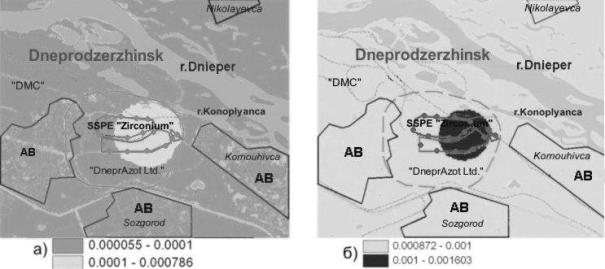
Values of carcinogenic
risks in the residential area in lifelong impact of emissions directly from
SSPE “Zirconium” (without background) are at low and
minimum risk level for chromium and soot, respectively. Registration of
background results in increase of individual risk values to medium
(unacceptable) level for chromium and low level for soot (see table 4, fig. 2, 3).
Herewith, risks at chromium background concentration are unacceptable, and risk
values for soot are determined completely by background contamination.
Note: hereinafter:
Fig.
2. Spatial distribution of carcinogenic risk values for population health at
lifelong chromium impact: a). without background; b). with background.
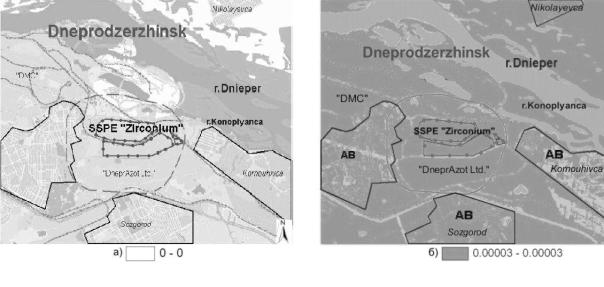
Fig.
3. Space distribution of carcinogenic risk values for population health at lifelong
soot impact: a). without background; b). with background.
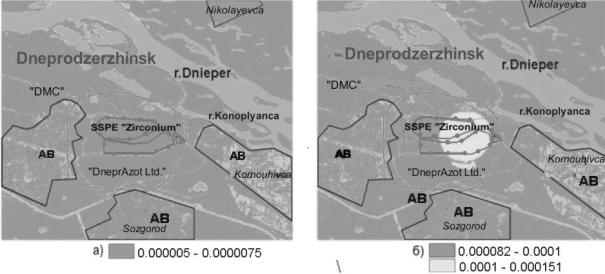
Values of total
carcinogenic risk indicate that maximum number of people for which
emissions SSPE “Zirconium” contribute to
the formation of malignant tumors of <1 in 10 thousand, and for background
noise, this value ≈ 8 to 10 thousand (see
table 4, fig. 4). Difference in absolute risk values between chromium and soot leads to the
fact that the overall risk of 97% determined by the influence of chromium.
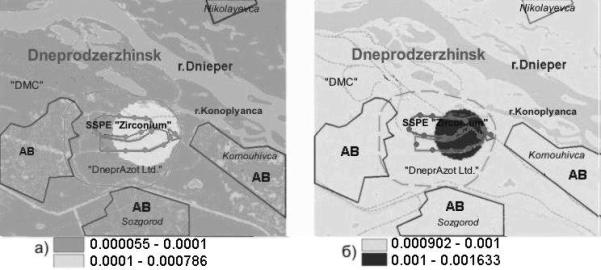
Fig. 4. Spatial distribution of total
values for carcinogenic risks for population health at lifelong impact: a). without background; b). with background.
III.II.II. Scenario of
working area.
Carcinogenic
risks observed at acute exposure of chromium and soot on population are one
order or more lower than acceptable ones (table 5).
Table
5.
Carcinogenic risk for workers
|
Substances |
Back-ground |
Without
background |
With background |
||||||
|
On all studied
area |
On all studied
area |
||||||||
|
min |
max |
mean |
σ |
min |
max |
mean |
σ |
||
|
Rind acw |
|||||||||
|
Chromium |
3E-07 |
0 |
0 |
0 |
0 |
3E-07 |
6E-07 |
3.4E-07 |
9E-08 |
|
Soot |
0 |
0 |
0 |
0 |
0 |
0 |
0 |
0 |
0 |
|
∑ |
3E-07 |
0 |
0 |
0 |
0 |
3E-07 |
6E-07 |
3.4E-07 |
9E-08 |
|
Rind chw |
|||||||||
|
Chromium |
8E-05 |
5E-06 |
7E-05 |
7E-06 |
6E-06 |
8.2E-05 |
1.5E-04 |
8E-05 |
6E-06 |
|
Soot |
3E-06 |
0 |
0 |
0 |
0 |
2.9E-06 |
3E-06 |
3E-06 |
0 |
|
∑ |
8E-05 |
5E-06 |
7E-05 |
7E-06 |
6E-06 |
9.1E-05 |
1.6E-04 |
9.2E-05 |
6E-06 |
Level
of carcinogenic risk at acute exposure on workers is at minimum level for soot,
with and without background contamination (table 5). All studied area with
chromium exposure (with and without background) is characterized by low risk
level, and only background registration results in average (acceptable for
workers) risk level on Eastern part of industrial site (fig. 5). Herewith,
background risks in themselves are higher than maximum risks caused by
emissions impact, though they are on a low level.
Note: hereinafter:
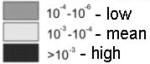
Fig.
5. Spatial distribution of carcinogenic risk values for health of workers
at chronic exposure of chromium: a). with background; b). without background.
Values of total carcinogenic risk indicate that
maximum number of workers for whom emissions from SSPE “Zirconium” contribute to the formation of
malignant tumors makes ≈ 0.7∙ per
10 thousand, herewith, for background contamination this value makes ≈
0.8 per 10 thousand (table 5, fig. 6). Total carcinogenic risk is almost (98%)
determined by chromium exposure as well as in scenario for residential area.
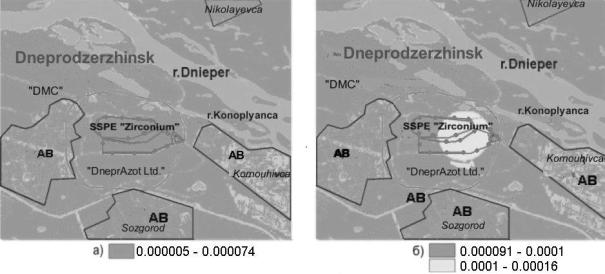
Fig. 6. Spatial distribution of total
carcinogenic risk values for health of workers at chronic exposure: a). without
background; b). with background.
IV. Conclusions
Assessment of
emissions impact from SSPE “Zirconium” has been
carried out into formation of cancer rates for population of Dneprodzerzhinsk.
Calculations of carcinogenic risks for the health of population that lives in
the area of enterprise impact and people that work in the industrial area of
this enterprise with acute and chronic effect.
It is determined that level of
cancer risk with direct impact from SSPE “Zirconium” emissions is at acceptable
level for population as well as for workers and makes <1 and 0.7 per 10
thousand, respectively. Registration of background results in increase of data
indices up to 10 and 106 per 10 thousand whish is unacceptable for population
and acceptable for conditions of the working area. Due to background
contamination, the level of cancer rate, herewith, for population is formed on
85% and for workers on 55%. The obtained values of carcinogenic risks are
determined by effect from chromium and soot with the share of chromium equal to
≈ 97% of contribution.
Therefore, SSPE
“Zirconium” contribution into formation of cancer rate level for population and
workers is acceptable and is at essentially lower level than contribution of
background contamination of atmosphere.
Literature
references
1.
Necklyudov I.M. (2007). Status and
problems of nuclear power engineering in Ukraine. Issues of nuclear power
engineering and technology, 2 (90), 3-9.
2.
Methodical recommendations “Risk
assessment for health of population from contamination of atmospheric air”
(2007). Ministry of Health of Ukraine, Decree No. 184 dated from 13.04.2007.
3.
Bol’shakov A.M., Krut’ko
V.N, Putzylo E.V. (1999). Assessment and risk management of
environmental influences on health. Moscow.
4.
Ahazha V.M., Rolik I.L.,
Kozhevnikova M.F., Levenetz V.V., Shchyr A.A. (2007). Ecological characteristics of zirconium production,
its alloys and rolling for nuclear fuel cycle of Ukraine. Scientific and
production journal “Ecology and inductry”, 4 , 44-50.
5.
Pinigin M.A. (1993). Hygienic basis for evaluating the
level of air pollution. Hygiene and sanitary, 7, 4-8.
6.
Kozhevnikova M.F.,
Levenetz V.V., Rolik I.L. (2009). Program implementation of method of risk
assessment of air pollutions from emissions from chemical production. Bulletin of the National Technical
University “KPI”. Collection of scientific works. Thematic edition “Chemistry,
chemical technology and ecology”, 24, 164-171.
7.
Map. Environmental contamination,
scale: 1:200000. (1996). Chief Directorates of Surveying, cartography and
land-survey in the Cabinet of Ministers of Ukraine, 8.
8.
National Report on
the Environment in
Ukraine in 2008. (2009). Ministry of Environment of Ukraine
and the Council of Productive Forces of Ukraine of NAS of Ukraine, 227.
9.
Azhazha V.M., V’yugov P.N.,
Lavrienko S.D., Lind K.A., Mukhachev A.P., Pilipenko N.N. (1998). Zirconium and
its alloys: production technologies, areas of application. Review. Kharkov: NSC
KIPT.