Экономические науки/10. Экономика предприятия
Assistant. Natalia
V. Krivovyaz.
National Research Tomsk
Polytechnic University, Russia
The
multiple-factor analysis of the criteria influencing size of insurance payments
on the CMTPL on the example of Limited liability company IC «Komestra-Tom»
At calculation of a tariff rate numerous
factors are analyzed. Any sign which
has insignificant impact on risk implementation, can be rejected. Besides, some signs can be formed only in
small groups, for example, the sign "floor" has only two groups.
Considering special complexity of an
assessment of insurance of risks and calculations of insurance tariffs, the
Russian Insurance Supervision recommends to use the techniques of 1 and 2
insurance tariffs developed and approved by it on risk types of insurance. In this research it would be desirable to
pay attention that most often has impact on any economic indicator not one, and
some factors.
For carrying out the analysis data of limited
liability company of Insurance corporation «Komestra-Tom» formed in 1993 were
taken. IC «Komestra-Tom» in the insurance market is about 20 years, dynamically
develops and takes the first places in ratings of insurance companies of the
Siberian region.
Monthly insurance payments on risk types of
insurance make over 3 million rubles. More than 75 thousand contracts of
insurance are annually signed. The most used and simplest of models of multiple
regression – model of multiple linear regression.
In regression models as explaining variables
often it is necessary to use not only quantitative, but also qualitative
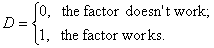
variables. In models influence of a qualitative factor is expressed in the form
of a fictitious (artificial) variable which reflects two opposite conditions of
a qualitative factor. In this case the fictitious variable can be expressed in
a binary form:
Let's carry out the analysis of influence of
factors at a size of insurance payments according to the CMTPL on the basis of
statistical data of IC «Komestra-Tom». To IC «Komestra-Tom» I provided
statistical data on 3517 contracts of insurance by the CMTPL concluded in the
period from 01.01.2009 to 01.01.2011. Data include: sum of insurance payments,
sum of collected awards, driving experience, sex of the driver, year of release
of the car and make of the car.
First of all it is necessary to calculate
under each contract of insurance the sum the earned company of an award. For
this purpose for all contracts, since 02.01.2010, we multiply the sum of a
collected award by the share of the year which has remained till 31.12.2010.
The share of year can be calculated by means of built-in function of an Excel «DOLYAGODA»
package. For the contracts signed till 02.01.2010, the sum of a collected award
is already equal to the sum of the earned award.
Let's consider influence of various factors
which in model will be explaining variables (X1 – the earned awards; X2 – a
driving experience; X3 – a sex of the driver; X4 – year of release of the car;
X5 – make of the car), on an explained variable Y – insurance payments.
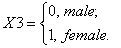
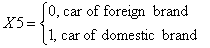
The X3 and X5 variables are qualitative
therefore in model they will be expressed in the form of fictitious variables:
The greatest difficulties in use of the device
of multiple regression arise in the presence of a multicollinearity of factors
when more than two factors are connected among themselves by linear dependence,
that is cumulative influence of factors at each other takes place. The
multicollinearity of factors is stronger, the assessment of distribution of the
sum of the explained variation on separate factors by means of a method of the
smallest squares is less reliable.
Factors included in multiple regression have
to explain a variation of an independent variable. If the model with a set of
factors is under construction, for it the determination indicator which fixes a
share of the explained variation of a productive sign at the expense of factors
considered in regression pays off. If the coefficient of determination doesn't
increase at inclusion in model of the next factor and these indicators
practically don't differ from each other, the factor included in the analysis
doesn't improve model and practically is an excess factor.
The greatest impact on the size of insurance
compensation (Y) is made by a driving experience (X2 factor). As value of
coefficient at X2 factor negative, dependence the return, that is the more a
driving experience, the less sum of payment, and vice versa.
Other factors influence the size of insurance
compensation in much smaller degree. The size of an insurance tariff (X1
factor) has the weakest impact.
Results of the carried-out analysis showed
that the driving experience rather strongly influences the amount of insurance
payments, so, tariff differentiation depending on an experience of driving is a
reasonable measure.
In the Russian union of autoinsurers offers of
Minpromtorg on differentiation of tariffs of the CMTPL depending on age of the
car arrived. However the carried-out analysis revealed rather weak dependence
between year of release of the car and the amount of insurance compensations. So, such measure
isn't reasonable.
Literature:
1 . The Federal law of the Russian Federation of April 25, 2002 N 40-FZ
"About obligatory insurance of a civil liability of owners of
vehicles" (in an edition. Federal laws of 01.07.2011 N 170-FZ (an edition
30.11.2011), of 11.07.2011 N 200-FZ, with the amendments brought by the Federal
law of 24.12.2002 N 176-FZ, the Resolution of Constitutional the Vessels
Russian Federation of 31.05.2005 N 6-P, the Federal law of 16.05.2008 N 73-FZ).
2 . Official site of Insurance company KOMESTRA-TOM//access Mode:
http://www.komestra.tomsk.ru/
3 . Dougerti, Christopher. Introduction in econometrics: the textbook
for higher education institutions: the lane with English / K.Dougerti. — 3rd
prod. — M: Infra-M, 2010. — 465 pages: silt. — University textbook. — ISBN
978-5-16-003640-3.