




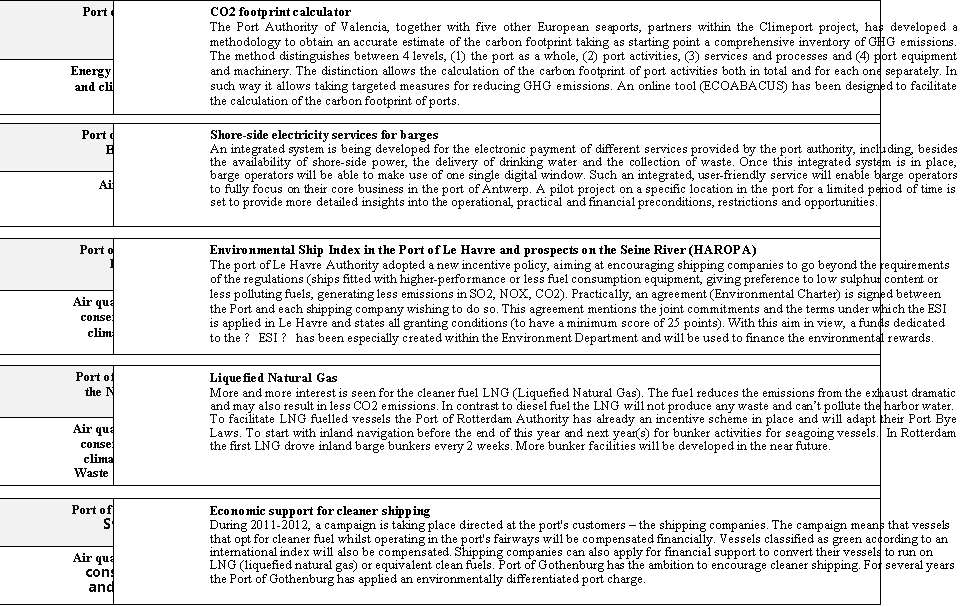
 Table 1: Examples of Green Port projects in European Union
Economic sciences/11. Logistics
PhD student Y. Mamatok
Dalian University of Technology, China
Environmental
challenges of seaports and the concept of a “Green Port”
Transport
policy for the next decade will clearly be influenced by the environment and,
more specifically, climate change agenda. Sustainable transport will therefore
require the reduction of Green House Gas (GHG) emissions from transport. (GHG
emissions can be seen as the product of three components: the amount of the
activity that generates the emissions; the energy intensity of that activity;
and the GHG intensity of the energy that is being used).
Evidently,
transport cannot be seen in isolation from wider economic growth and developments,
along with other sectors and producers of GHGs. The strong increase in global
trade and the deepening integration prevented the decoupling of freight
transport from GDP in the last decade. The growth of freight transport is also
linked to economic practices – concentration of production in fewer sites to
reap economies of scale, delocalization, just-in-time deliveries, wide-spread
recycling of glass, paper, metals – that allowed reduction of costs and,
possibly, of emissions in other sectors at the expense of higher emissions from
transport.
The
path to increased sustainable freight transport rests largely with the ability
of industry to optimize its transport and logistics requirements in line with
the wider supply chain needs. In doing so, legal, technical and operational
barriers need to be removed and incentives for speedier development, investment
and implementation of more sustainable technology and measures may sometimes be
required.
Environmental challenges of seaports
The past
years have seen an increasing attention on the environmental impact of port
operations and development. The focus on environmental issues is especially
felt at the level of vessel and cargo handling operations, industrial
activities in ports, port planning and extension initiatives and hinterland
accessibility. Ports need to comply with ever higher regulatory and societal
requirements in the fields of environmental protection which can have an impact
on the further space/room for the ports to grow, not only in terms of hectares,
but also in terms of the so-called environmental space. This challenges
seaports to minimize emissions of existing and future activities in the port
areas and the wider logistics area. Environmental aspects also play an
increasing role in attracting trading partners and potential investors. A port
with a strong environmental record and a high level of community support is
likely to be favored. As such, port management in light of green port
development is a topical issue which deserves much research work.
Environmental impact of port operations
One of the
major environmental impacts generated by ports is air pollution, particularly
greenhouse gas (GHG) emission which leads to global warming since GHG traps
heat. There are also health effects impacting the residents of the local
community surrounding ports which include asthma, other respiratory diseases,
cardiovascular disease, lung cancer and premature mortality. Ships that call at
ports are a major source of air pollutants such as CO2, SO2, NOx, PM10, PM2.5,
HC, CO and VOC. Land side activities, particularly cargo operations at
terminals, form another source of airborne emission. Emissions of dust from
bulk cargo handling, electricity consumption, and gases from cargo handling
equipment and trucks adversely affect air quality.
The concept of a “Green Port”
European port
authorities encourage best practice amongst its member ports and set
challenging targets. The new Green Guide is part of that process. This action
framework is applied to five selected environmental issues: air quality, energy
conservation and climate change, noise management, waste management and water
management. The Guide introduces a common framework for action under 5 Es:
Exemplify Enable, Encourage, Engage and Enforce:
1. Exemplifying: Setting a good example
towards the wider port community by demonstrating excellence in managing the
environmental performance of their own operations, equipment and assets
2. Enabling: Providing the operational
and infrastructural conditions within the port area that facilitate port users
and enhance improved environmental performance within the port area
3. Encouraging: Providing incentives to
port users that encourage a change of behavior and induce them to continuously
improve their environmental performance
4. Engaging: with port users and/or
competent authorities in sharing knowledge, means and skills towards joint
projects targeting environmental improvement in the port area and the logistic
chain
5. Enforcing: Making use of mechanisms
that enforce good environmental practice by port users where applicable and
ensuring compliance.
The
following Table 1 represents of some Green Port projects in Europe.
Table 1: Examples of Green Port projects in European Union
It should be
noticed that the enforcing element is seen by port authorities as a last resort
instrument in line with their belief that a lot can be achieved through cooperation
and common understanding in line with the principle of self-regulation.
The increasing
focus on the environmental impacts of ports is not only associated with
existing port, ship and hinterland transport operations. From an environmental
perspective, port development and extension should ensure sustainable
development. Hence, environmental sustainability of port projects has become as
important as economic and financial viability. This often demands a more
systematic approach in which the impacts of ports and port projects are placed
within wider coastal management and environmental policies.
Literature:
1.
The future of
transport: from policy to practice – a shippers’ perspective. 30 Nov 2008. http://www.greenport.com/news101/community-beyond-the-gate/the-future-of-transport-from-policy-to-practice-a-shippers-perspective
2.
The
Importance of Green Ports and Green Logistic Chains. 08 Apr 2011. http://www.greenport.com/news101/vessel-build-and-maintenance/assessment-tools/the-importance-of-green-ports-and-green-logistic-chain
3.
ESPO,
June 2012. The “ESPO Green Guide; Towards
excellence in port environmental management and sustainability”.
4.
ESPO,
June 2012. The “ESPO Green Guide; Annex 1 Good
practice examples in line with the 5Es.
5.
Lam,
J.S.L. and Notteboom, T. (2012). “The green port toolbox: A comparison of port
management tools used by leading ports in Asia and Europe”. Paper presented at
International Association of Maritime Economists (IAME) conference, Taipei,
Taiwan, 5-8 September 2012.