Экономические науки/ 12.Экономика сельского хозяйства.
Janna
S. Jirickova, post graduated
student, Russian economy and state academy under President of RF, city Moscow
Safarbi
M. Pshikhachev, PhD, Kabardino-Balkarian
State Agrarian University devoted by V.M. Kokov, city Nalchik
Aslan
H. Toguzloev, PhD,
Kabardino-Balkarian State Agrarian University devoted by V.M. Kokov, city
Nalchik
Sustainable agriculture: global trends and factors
A great
number of economists of the past age urged to substantiate scientifically the
idea of harmony of private property and free enterprise undertakings with more
and more employable people being involved into economical life and assistance
rendered to those citizens of the society who are not able to guarantee their
selves adequate conditions of life. Social contrasts coming along with modern
civilizations for the period of all stages of their progress or existing are
apprehended and interpreted in peculiar way in contemporary history under
conditions when the world community at UNO summits (in Stockholm – 1972, Rio de
Janeiro – 1992, Johannesburg – 2002, Rio de Janeiro – 2012) showed clear-cut
rush for transition towards sustainable development standpoints. Within the
last decade of the 20th century the problem of poverty and gap
between rich and poor as well as disparities in the level of economic
enlargement of the countries belonging to the “Gold Billion” and the countries
of Third World strengthening sharpened brilliantly in conditions of demographic
explosion.
In this
way the tendencies in CIS (Community of Independent States) with many transformational
socio-economic contradictions and conflicts in the period of transition and
demarche aside from sustainable development vector towards the vector of more
characteristic for less developed countries than to the high developed one.
The
tendency of global scale poverty, absolute and relative impoverishment of broad
masses of people with FAO declaration on work against poverty and its radical reduction
in halve by 2015 (Extract of Millennium Development Goals
(MDGs): 1. Eradicate extreme poverty and hunger. Target 1. Halve, between 1990
and 2015, the proportion of people whose income is less than US$ 1 a day. 2.
Halve, between 1990 and 2015, the proportion of people who suffer from hunger), though smoothly drifted on to a new
century all the same. Moreover, nowadays these issues are aggravated by
coincidence and interlace of world finance crisis with the world food crisis
alongside a background of multi-years global energy problems. The analysis of published works of foreign and national
economists on the problem gives the ground to suggest that world crises
(finance, food, energy) have deep-rooted imperative interconnected reasons.
Thus doctor I. Ustiyan concerning food crisis sings out four groups of reasons:
systematic and economic; egocentrism of narrow-minded and technocratic
pragmatists; absolutization of all-powerfulness of techniques and technology;
specific economic, ecological-climatic.
[1]
Systematic and economic reasons. The UN experts and
leading economists of the world are single in their views that uncontrolled
growth of prices on wheat, rice and, as a result of it, food crisis sprang from
one and the same reason: prevailing of a cost neoclassical paradigm of market
economy that means the world market economy is oriented to cost indices without
taking due account of overall nomenclature of produced material goods.
Egocentrism of narrow-minded technocratic
pragmatists and absolutization of power of techniques and technology and as a result of
it making a fetish of marginal ecological imperatives took place.
Concrete
economic reasons of get higher in price for food caused by the sharp increase
of demand for food-stuffs in China, India and other countries of the world; by
the decrease of world supplies of grain to the marginal bottom level for the
last 30 years.
Ecological-climatic reasons. The question is about the
broken ecological equilibrium of our planet as a result anthropogenic and
technogenic activity of mankind especially for the last 50 years. To doctor
Ustiyan’s opinion the present deep food crisis has already inflicted damage to
the world estimated in 300 billion of dollars. The summit of the eight
developed countries held in Japan in 2008 decided to allocate $10 billion for
fighting against hunger and malnutrition of population and private financial
funds – $ 4.5 billion. But it is not enough because only the African countries
to the South of Sahara by the World Bank estimate need the emergency aid of $
30 billion. In the absence of proper aid the losses of crops raised in 2008 in
37 countries of the World most suffered from crisis can grow from 30% to 40%.
It will aggravate the heavy burden of hunger and malnutrition of poor layers of
population.
In that
regard the models of dualistic economy has become particular important. Neoclassical
models of development offered at one time by W.A. Lewis, J. Fei, D. Jorgenson,
G. Ranis and others aimed at creating the conception of modernization as a
counterbalance to neokeyncian systems of economic growth and by that way to
providing elimination of real dualism between poorly developed, traditional and
modern, pre-industrial, natural and market economies, but however it didn’t
find any substantial application in practice, because globalization of economy
with the promises of leveling economy of different types of countries with
their own level of development, established technology, traditions in
management are still carried out exactly but back to front.
For
example, one of the theorists of economic convergence Dutchman Jan Timbered who
together with Norwegian Ragnar Frish became in the first Nobel laureates on
economy for creation and application of dynamic models for the analysis of
economic processes, in the middle of 1970 prepared a report offered by Roman
Club “Revision of International Order” (published in 1976). In his scientific
report the author suggested to shorten a gap in take-home pay between the rich
and the poor from 13:1 to 3:1 (3:1 is maximum possible correlation between rich
and poor regions of European Union or even more practically at least up to 6:1.
[2]
The
strategy of the development suggested by Jin Tinbergen combining education,
eradication of poverty, development on its own basis on a background of scientifically
substantiated ecological policy unfortunately still remained within the
framework of good wishes, as after more than 30 out of brilliantly expected 40
years, we have still more contrast world where disparities in the level of economic
development have considerably grown up and show a stronger rising unhelpful
tendency.
A
search of a new paradigm for development in transitional conditions that we are
having in the CIS countries must be realized to our mind on the ways of making
innovative type of development providing socially oriented, ecologically
substantiated market management efficiency. In this regard it is appropriate to
remind the words of academician A.A. Nikonov: “Neither western, neither eastern
nor Israel models will not grow up on Russian ground as a national product by
end use”. In order to construct its own model it is necessary to come out first
of all from modern realities of a country, its historical past with all its
heavy burden, as well as from world accumulated experience. One can always find
a lot of useful time tested things in world practice and science to assemble on
its own framework. It should not be ignored. [3]
It is important from this standpoint to
define acceptability of one or another standard of foreign experience for
agriculture in the transitional terms of the CIS countries estimating the role
of innovative component here.
It is
also important to define to what extent a model of agriculture is receptive to
innovations, imperative and one or another innovation is realized in proper
time; how well in innovative type of economy became materialized in business
and how far this economic system is viable in fact. As a methodological premise
it should be mentioned that though the concept “innovation” was first introduced
by Y. Schumpeter at the end of 1920th who characterized it as
“changes” and during the 20th century innovations in economy were
analyzed from the point of typical changes in market conditions: introduction
of new up-to-date machinery and technology;
food product with new properties; application of new raw materials; management
of production and resource providing; creation of new sales markets;
improvement of population’s standard of living and quality of life. However,
the agrarian practice shows that the efficiency of innovative measures appears
much more below required results without taking into account
ecologic-economical constituents.
In this
regard a topical question becomes urgent weather innovation responds to settle
up imperative guidelines as early as the end of 18th century our
compatriot A.T. Bolotov did really an innovative breakthrough concerning
development and realization in his estate ecologically sound model of
agriculture supposing optimum combination of the systems of agriculture and
stock raising. It should be noted that after more than two ages these
researches remain actual so long as the question is about imperatively vital
irremovable phenomena. In this case the peculiar barrier raised on the way of
imperative development was a mobilization type of economy, permanently
prevailing in Russia those centuries as antipode to the innovative type which
mainly realized in the USA and in a number of the developed countries.
Various
approaches have been developed in the past couple decades to collaborate ecologically
sound models of agriculture. The developed countries demonstrate the advantage
of new and innovative ideas directed on introduction of finished up scientific
researches in agrarian sphere that makes it possible to gain competitive advantages.
Shortly describing from these positions the current world agriculture it should
be noted that the last two or three decades there happened the situation where
all pores were so impregnated with technocratic factors that the industrial
technology was christened “conventional agriculture”, side by side alternative
technology being cultivated as “organic farming” in the context of more capacious
ecological-economically balanced sustainable development as well as rural
development. The conventional agriculture stresses increased production and intensification
through progressively specialized activity. By contrast, the approaches concerning
alternative agriculture seek to meet the dual goals of increased productivity
and reduced environmental impact. They have to do this through solving
imperative tasks on the ways of diversification and selection of inputs and
management practices that foster positive ecological relationships and
biological processes within the entire agro-ecosystem.
Undoubtly,
the innovative factors has become a core of these transformations, when, on one
hand, the organic agriculture has already emerged on a qualitatively new basis
and began to win the niches, and, on the other hand, there appeared the intensive
high technology connected with the cultivation of genetically modified organism
(GMO) and genetically modified products (GMP). At all diversity of GMO and GMP
estimations, the warning of many scientists about the giving segment being
fraught with serious consequences represents the first line of innovative
activity.
It
should be noticed that biofarms appeared in Western Europe in 1920th
and on the other side of the ocean in the middle of the century but their share
is still rather short now that tells about difficulties in mastering
ecologically non-polluting technologies. On the contrary, a new branch in technology
focused on GMO and GMP going applied on the fields only in 1990th is forwarded as almost a doubled green
revolution. It has become to grow in multiple for an extremely short period of
time, especially in Northern America and Asia; moreover, the party concerned
directly declares that is a ring-buoy to settle up the problem of starvation
and under-nourishment in the world, and also ecological problems connected with
economy of chemical means. The argument, in my opinion, doesn’t hold water.
Speaking
about search of a paradigm for the development and concrete models of agriculture
in the context of structural shifts and displacement of accents among the factors
of agrarian production, it should be recollected the methodological approach of
Hayami J. and Rutton W. who classified, in the early seventies (1970), when the
sharpness of environmental problems in agro sector was less obvious than now –
agrarian technologies (land-saving techniques and labour-saving techniques). [4]
The
classical example of labour-saving techniques is the countries of immigrants:
the USA, Canada, Australia, where rise and development of industrial systems of
agriculture came along with the replacement of living labour against a
background of multiple growth of labour productivity and technogenich loadings
on land resources. Japan, India and China belong to the countries with
land-saving techniques. They applied different scenarios of development of farming
systems with overall agrarian overpopulation in the countryside and
insufficiency of land resources. Both models in historical aspect adapted
various alternative proportions in correlation of factors of agrarian
production as land resources labour forces.
At the
current stage under conditions of system ecological crisis such division can be
accepted only with some reservations as in the same countries, where the labour-saving
technologies were cultivated, simultaneously against the background of
favourable functioning of innovative system in economy, the measures for
working out and developing ecological programs on restoration of soil fertility
and also sustainable development of agriculture are carried out. For example,
the experts from the USA Department of agriculture underline, not without
pleasure, that annually at the expense
of conservation measures more than billion tons of the fertile soil is
saved that is equal to a train of soil loading trucks through all America from
New York to Los Angeles.
According
to Hayami and Rutton models of agriculture with inherent land-saving technologies
the changes have been made in the classification for the period of the last
three decades. The technocratic speed up by the western standard creates a lot
of deadlock situations with the view of ecological consequences of economic
advance in agriculture. It goes without saying that in the presence of
objectivity ineradicable geographic and demographic aspects, the agrarian
economy can’t just ignore, Japan, by the contrast with India and China should
be singled out among the countries with land-saving technologies since the
Japanese have reached such results that gross national product (GNP) per head
make up $39184 and GNP in agriculture per head in the countryside area -
$16714; here they displayed a great inventive activity in the point of product
line diversification and ensuring more zealous use of ground resources (an
arable land – 4.5 million, pastures – 0.4 million hectares).
Chinese
and Indian models may be classified as land-saving ones only by stretching a
point since there are ecological problems connected just with land permanent
status: the expansion of erosion of the fertile land possibility, an unfavorable
balance between the expenditure of fertile soil and its restoration, deficiency
of fresh water and pumping out of underground water used for irrigation;
excessive application of mineral fertilizers and pesticides; overgrazing of
available pastures and their degradation. For instance, India has got a total
number of cattle – 283.2 million (it is 26.2 million head of cattle more than
available in China, the USA and Australia taken together), sheep and goats –
182.5 million head, natural pastures only 11 million hectares; as compared with
the U.S.A. where 95 million head of cattle, 8.6 million of sheep, pastures –
234 million hectares; there are 27.5 million, 104.4 million and pasture land –
404.9 million hectares correspondingly.
According
to the researches of Sju Disin only across China the area of land exposed to erosion
has expanded from 1.15 million in the mid-eighties. He points out that annual
wash-out of soil at the rate of 5 billion tons including 50 million tons of
rich upper layer-humus, there for reservoirs are intensively covered with silt
and level of river waters comes up. For example, Huanhe river level rises as
high as 10 centimeters. [5] In the
beginning of XXI century we can observe only the growth of these ecologically
unfavourable phenomena so far as the flywheel of economic advance is still untwisted.
It is remarkable to notice that the rate of growth in farm products in
developing countries twice as high as developed countries in accord with
results of the past century. Thus, the amount of world agrarian production (in
comparable prices by 2000) had been increased from $415.0 billion in 1900 to
2475.0 billion in 2000.
The six
fold growth for a century shows diversity of many – coloured pictures in
different countries, but, as a hole, the amount of output in developed countries
makes $140.0 and $605.0 billion respectively, or increase by 4.3 times; in developing
countries accordingly $202.0 and $1690.0 billion or growth by 8.4 times. [6]
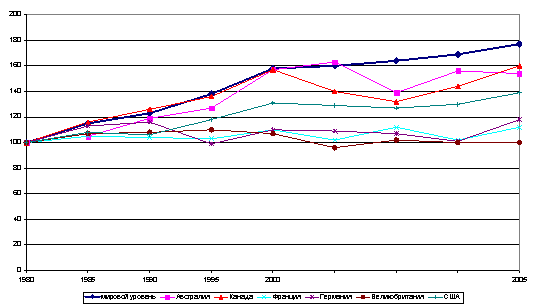
Dynamics
of agrarian production being illustrated in diagrams clearly shows the
influence of developed and developing countries upon the world-wide level of agriculture
for a last quarter of the century.
Diagram 1
Index of agrarian production
in some developed countries.
World Australia Canada France Germany GB the U.S.A.
The
economic growth path of the developed countries has appeared much more low the
average world value level as it is commonly well-known that the reached high
level of agrarian production is the result of the advanced agricultural
practices, high intensity of production and in these conditions it’s much more
difficult to keep further build-up the rate of production output. Besides, the
dynamics is effective by the policy of government regulation of agrarian
sector, the situation of world market as well as removal, due to
agro-ecological programs, of erodible farming areas under crops out of
circulation.
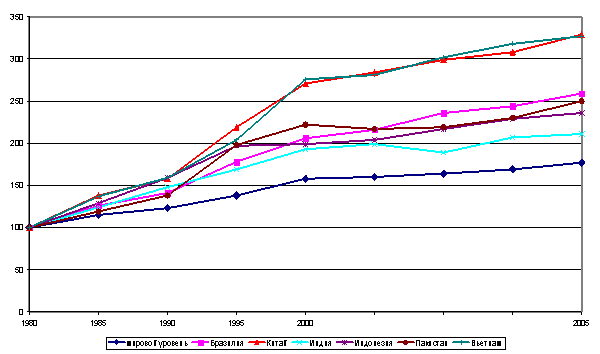
A profound impact on the world amount of
output of agrarian products was exerted by the countries shown in diagram 2.
This peculiar feature of a last quarter of the past century gives an obvious
picture of sharpen increase of agrarian production first of all in China and
Vietnam, a little bit lower a path of the curve for such countries as India,
Brazil, Indonesia, Pakistan but, as a hole, they show an essential growth as
compared with the average world value and also the level of other developing
countries anyhow involved in the process, and marked in due time by “green
revolution” with the effect of “overtake and surpass” development being
inherent.
Diagram 2.
Index of agrarian production output in some developing
countries
World Brazil China India Indonesia
Pakistan Vietnam
At such
a sharp upgrade and upraise of agricultural production in some large countries
of the Third World against the fact of moderate growth in the developed
countries it was possible to hope for some leveling or smoothing of real dualism in agrarian sphere on global scale but
it doesn’t occur. On the contrary, here and below there is a statistical
sampling from official statistics of the International organization of the
United Nations on Food and Agriculture – FAO [7] gives reason to suppose that polarization between developed and
developing countries is permanently increasing that means an obvious drifting
from a sustainable development vector at mega-level.
Here
are some data. Gross national product output per capita in a country and gross
farm product per capita for a rural inhabitant according to FAO data: (in
American dollars for 2004) the USA – 36352; 27651 respectively; Canada – 24835;
24428 respectively; Australia – 22303; 20826 respectively; Great Britain –
26399 and 17567 respectively; France – 22987 and 20334 respectively; Germany –
23238 and 12236 respectively. There exists such a high level of life support in
these countries, with undernourishment rate in all six countries less than
2.5%.
Striking
contrasts can be observed in the countries of the Third World: Democratic
Republic of Congo, population 54.4 million, 72% suffer from continual undernourishment,
GNP per capita $90 and $81 per capita for rural dwellers; Ethiopia, population
72.4 million, 46% undernourished, GNP per capita $109 and $56 a year for rural
dwellers; Bangladesh, 149.7 million of population, 30% undernourished, GNP per
capita $371 and $164 per capita for rural dwellers.
Economic
growth in China allowed to reach GNP which amounted to $1441 per capita for rural
dwellers; moreover according to FAO data out of 1 billion 320.9 million people
the share of the undernourished makes 12%. But it should be noticed that the
report on world-wide development for 2008. Agriculture on service to development
informs that the rapid development of farming over the last years in China due
to introducing the system of responsibility of households as well as liberalization
of markets and fast technological transformation was a principle cause of
decrease in poverty in rural areas from 53% in 1981 to 8% in 2001. [8] The acceleration of economic growth
came after the upraise in agriculture that greatly reminds the fact how a
revolution in agriculture brought about industrial revolutions spread about the
countries of a moderate climate belt from England in the middle of XVIIIth
century up to Japan of the end of XIXth century.
The
data of World Bank and the UN FAO for China varied a little, but nevertheless
an unprecedented economic growth in agriculture is quite obvious. It made it
possible in a most multi-populated country to remove the tension of food
problem with many other social and ecological problems available in the
country. In other words, for China the urgency quest for a new modern
ecological-economically comprehensive model of agricultural development is not
less topical than in other countries where it is still necessary to provide
appropriate acceleration of agrarian economy.
By data
of above mentioned FAO year-book indicators for India – creation of GNP per capita
and GNP in farming per capita for rural dwellers $538 and $242 respectively,
out of population - 1billion 081 million people 20% undernourished; Pakistan
- $547 and $242 respectively,
population 157 millions, 23% undernourished. In other words, only these three
countries have got a problem of chronically undernourishment of more than 410
million people.
We have
to point out that such problem remains at essential increment of produced foodstuffs.
The agrarian sector of these three countries for the last quarter of the
century had essential growth at the expense of strengthening of intensive factors:
use of irrigation systems, substantial increment of mineral fertilizers. So,
the manufacture of mineral fertilizers in these countries in these countries
totally makes 48.7 million tons or 10 million tons more.
Along
with this there centralized the overwhelming majority of irrigated lands: India
– 50.1 million in hectares or 29% of areas under crops; China – 49.8 million in
hectare or 52% of areas under crops;
Pakistan occupies the fourth place in the world (after the USA – 21 million in
hectare or 11% of areas under crops) with irrigated lands of 17.2 million in
hectare or 80% of areas under crops. [9]
India and China are
leaders not only through plenty of irrigated lands available but also deficiency
of fresh water: India – 104 billion of cubic meters, China – 30 billion of
cubic meters. [9] Besides, if take
into account a substantial share of these countries out of 47.7 million hectares of irrigated lands
being already salted all over the world, one can imagine the scale of
technocratic excesses that makes classification of land-saving technology
formalistic.
Undoubtedly,
the high level of labour productivity is the result of permanent unchecked advance
of industrial technologies along with replacement of direct labour by
materialized one. But the point of the problem lies in the fact that the technocratic
variant of development of agriculture today has already produced a menacing ecological
situation of natural resources in many regions of the world. If the Third World
countries will henceforward build up the rate of production in accord with the
Western Technologies variant, the overcoming of real dualism in the world
agrarian economy and large-scaled transition to ecological-economic balanced
sustainable development, that is the call of the present-day time, can become
unrealizable.
Summarizing
the problems of overcoming a real dualism of the world agrarian economy and
social contrasts on the global level, it is necessary to say about a qualitatively
new paradigm offered by Vajtzekker and Lovins. How to reconcile a high quality
of life and solicitous attitude to natural resources? The answer to this
question can be found in the new paradigm (“The Factor of Four”[10]), which offers a new approach to
progress, making the increase in efficiency of resources as corner-stone of any
progress. By their statement, we can live twice better, consuming at the same
time twice less natural resources, and that is necessary for a mankind
sustainable development in the future. The decision consists in using the electric
power, water, fuel, materials, the fertile lands and other resources more
effectively and often without additional expenses and even to benefit.
The
search for a new paradigm of
development and overcoming of the real dualism in agrarian economy should be
carried out on the ways of more perfect use of objective requirements of
multi-purpose and diversified agriculture. Much of the additional production
must originate in ways that follows working out the concrete research, which
have to be increasingly oriented in the namely directions that it must:
-
improve the capacity of world agriculture to underpin further
considerable development in production and also get better dietary attributes
of the produce;
-
move up the efficiency of the underprivileged in the agro-ecological and
social-economic aspects where they practice organic agriculture and earn to
living;
-
bring back and maintain the creative capability of natural resources
while minimizing unpleasant effects on the wider environment.
These
considerations suggest a growing role for rise and development of the
innovative system in agrarian sphere. The basic condition while building up the
innovative system on intra-national scale is the formation of innovative
partnership of government structures, managing subjects, representatives of
business, financial and non-government organizations, scientific and
educational institutions.
The
modernization of agro-industrial production oriented to the adjustment with
resource-saving technologies presuppose, as it is stressed in the scientific report
to the Roman Club, a power-saving type of reproduction, development of essentially
new technologies for generation, transmission and consumption of electric-power
capacities and, as a result – to increase in multiple productivity of the
resources. The priority development of such type of reproduction, undoubtedly,
can bring about the greatest economic, social and ecological effects, and
became a basis of a new paradigm of ecological-economically balanced
sustainable agriculture.
References
1. I. USTIJAN. The
Global Food Crisis: a wake up call for the beginning of XXI century, Economist,
№ 10, 2008, pp. 63-79.
2. M. SAZHINA. An
Economic Olympus: Sketches about Nobel Laureates on Economy. M.: Publishing
House “Business Literature”, 2007, p. 36.
3. A. NIKONOV. The
Spiral of a Centuries – Long Drama: Agrarian Science and Politics in Russia
from the 18th through the 20th Centuries. – Moscow: The
Encyclopedia of Russian villages Publishing House, 1995, p. 437.
4.
Y. HAYAMI and V. RUTTON. Agricultural Development: an International
Perspective. L. The John Hopkins Press,
1971, p. 44.
5. SJIJ DISIN.
Environment Problems of China. Translation from Chinese. – M.: Progress, 1989,
p. 167.
6. World-Wide
Economies. Global Tendencies for 100 years. – M.: Economist, 2003, pp. 590 –
592.
7. FAO Statistical
Yearbook. Country Profiles, 2005 – 2006, vol. 2.
8. The Report on World
Development 2008. Agriculture at service to sustainable development,
Washington, The World Bank, 2007, p. 9.
9. SANDRA POSTEL.
Pillar of Sand. Can the Irrigation Miracle Last? – New York, London,
WWNorton&Company, 1999, pp. 41 – 42.
10. E. VAITZEKKER, E.
LOVINS, L. LOVINS. The Factor of the
Four. A Half of Expenses, Two-fold Return. A New Report to the Roman Club. M.: Academia, 2000.