Экономические
науки/15.Государственное регулирование экономики
Doctor of science Yusupov K.N., post-graduate student Toktamysheva YU.S.
Bashkir State University, Russia
Macroeconomic targets in the management of economic
development.
This paper presents the results of the analysis
undertaken for a number of factors which exert significant influence on
macroeconomic targets. This study has estimated and evaluated macroeconomic
indicators which reflect objectives of the Russian Federation economy in 2000-2011.
The research has been conducted on the basis of the graphic instrument, known
as «golden quadrangle» which has been modified and updated by such essential
parameters as investments and innovations.
The analysis of the economic situation and its dynamics has been
implemented by the method of constructing the«golden quadrangle». It comprises
the dynamics of GDP growth, unemployment rate, the inflation rate and the share
of net exports in GDP. It allows visualizing and exploring the interrelationship
of these parameters along side with subsequent evaluation [1]. However, the
development of the country depends on a number of others equally important
factors. Scientific progress in the mid XX century is becoming increasingly
intensive. It is well known that many developed and developing countries, such
as the U.S.A, China, Japan and others have high level of development largely
due to innovation and investment. Many economists (Robert Solow, Charles Cobb,
Paul Douglas and others) argued that such proxies of the economic policy and by
government –funded priorities contribute to the economic growth. They form the foundation
of intensive growth.
Investments are closely linked with innovations. Innovations are impossible
without investment and effective use of innovations, in its turn, attract more new
investments. Costs and the use of these elements push up demand, product
quality, sales and production efficiency while reducing costs. This leads to
lower unemployment, and thus increases revenues and the economic growth in
general. In modern economies, characterized by globalization, investment and
innovations are also related to net exports. When a country sells a product or
service to another country, it pays for the purchase with part of its assets,
the value of which being equal to the value of the goods or services.
Therefore, there is a relationship not only between investment and
innovation. Both of these factors can change the value of GDP, unemployment rate,
inflation rate and exports. In our view, at present stage it is timely and essential
to create a graphic instrument comprising
not only the four indicators – GDP growth, unemployment, inflation and share of
net exports to GDP. We propose a modified model of the «golden quadrangle», including:
the increase of investment in fixed assets and the share of organizations
engaged in innovative activities in the total number of organizations.
According to the indicators (Table 1) the "hexagon of the economic
condition" (Fig. 1) has been built.
Table 1 - Dynamics of components of the "hexagon of the economic
condition" of the Russian Federation for 2007-2011.
|
Years |
GDP growth,% |
Share of net exports in GDP,% |
Unemp-loyment rate,% |
Inflation rate,% |
Share of organizations with innovative activity, % |
Growth of investment in fixed capital, % |
|
2007 |
8,5 |
8,6 |
6,1 |
11,9 |
10 |
22,7 |
|
2008 |
5,2 |
9,2 |
6,3 |
13,3 |
9,4 |
9,9 |
|
2009 |
-7,8 |
7,4 |
8,4 |
8,8 |
9,3 |
-15,7 |
|
2010 |
4,2 |
8,2 |
7,5 |
8,8 |
9,5 |
6 |
|
2011 |
4,3 |
8,7 |
6,6 |
6,1 |
10,4 |
8,3 |
Source: Calculated by the
authors: www.gks.ru (Rosstat)
In the year 2009 the economy was characterized by the worst ever values of
macroeconomic indicators as a result of the global financial crisis. Economic
growth and investment growth were negative, which made it impossible to build a
hexagon. In the year 2007 the economy showed the best condition. Figures of
investment growth, GDP growth and the share of
organizations with innovative activity were the highest for the whole period
while the unemployment rate was the lowest.
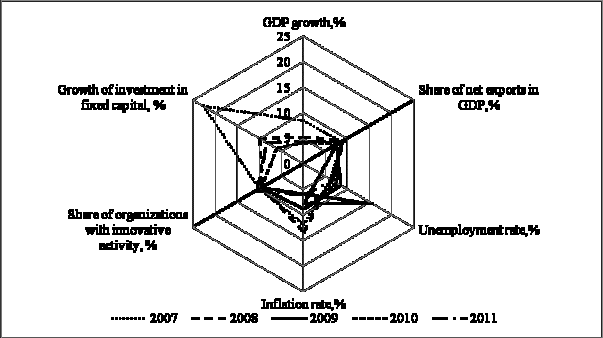
Figure 1 - The dynamics of the
elements in the "hexagon of the economic condition".
We placed indicators on the axes using the following system approach: the
elements that have to be the largest in the economy are placed above the
dividing line of the figures (bold line) – these are the investment growth in fixed capital and GDP growth;
indicators which should be reduced are respectively placed at the bottom –
these are inflation rate and unemployment rate. In this case the effective
framework for the economic development is to be displayed by the share of innovative
organizations and the share of net exports to GDP growth which are located along
the sideline.
To sum up, the proposed parameters could serve as targets for the
strategic development of the Russian economy in the medium and long term period,
and also form the basis for well-balanced economic policies of the Government
of the Russian Federation.
References:
1. National Economy / K.N. Yusupov, A. V. Yangirov, A. R. Taymasov; ed.
K. N. Yusupov. - M.: KNORUS, 2012
2. The official website of the Federal State Statistics Service
(Rosstat). - [Electronic resource], URL: http://www.gks.ru