DIM YUMAGULOV
Ufa State Aviation Technical University
FUNCTIONAL
MOMENTUM STRATEGIES OF PORTFOLIO MANAGEMENT
Stock
exchange is one of the most popular and profitable instruments of money
investment. Investors very often try to associate their financial state with
not one, but several companies and thus they can diversify their security
portfolio. This gives an opportunity to investors to reduce the risk from one
company regress and to get a complex profit from the set of securities.
Moreover, stock exchange gives wide opportunities for investors to apply
different strategies for efficient portfolios obtaining.
The new
type of strategies for the securities portfolio management has been proposed –
functional momentum strategies. Following these strategies, portfolio reforms
by the formal rules at regular time intervals. An empirical research of
such strategies has been conducted, which demonstrated their high efficiency
for an appropriate choice of parameters.
Functional
momentum strategies is based on next parameters.
Reformation
period T. We adopted T equal to a week, a month, a quarter, a
half-year, a year.
Momentum
function f(x). Proportion of shares
of a particular type is defined in accordance with the value of momentum
function of share yield for the previous period. In the course of this research
we considered functions f = ; f =
; f = ; f =
; f = ; f =
; f = ; f =
; f = ; f =1.
Number
of shares k. In each time interval
portfolio consists of k shares, which
values of momentum function became the largest for the previous period. Value
of k varied from 1 to n – common number of shares being
considered.
Costs
for portfolio reformation were considered in this research. It is known that it
is necessary to pay a part of share for buy-sell operation. This part is equal to r < 1.
The
point of proposed functional momentum strategies of portfolio management is as
follows. At the reformation moment t an
investor has a shares portfolio. The market value of this portfolio at the
moment is  , where mi – number
of shares of i-type in the portfolio,
Ci,t
– share cost at the moment t.
, where mi – number
of shares of i-type in the portfolio,
Ci,t
– share cost at the moment t.
Further, the
portfolio will be reformated through the time T by the following algorithm. Let us consider the segment of the market,
which consists of the stocks of n
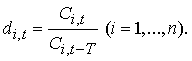
issuers. We must calculate the yield through the time T for each type of stocks:
Next,
we must calculate value of function  for each type of selected
stocks:
for each type of selected
stocks:

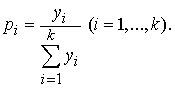
The part of capital
allocated for the purchase of stocks of i-type
will be equal
Let A be portfolio value before the
reformation. Then, balance equation is:
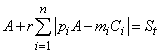
Let pi equal to 0 for the shares,
which will not be included in a new portfolio. Value  is equal to the sum for the
purchase (sale) of i-type stocks.
is equal to the sum for the
purchase (sale) of i-type stocks.
The function
on the left side, as it is easy to verify, looks piece-wise linear and convex.
The equation has the unique solution with respect to A, i.e. the cost of
re-formed portfolio and its structure is uniquely determined.
Experimental
verification of functional momentum strategies efficiency with the modern
computer systems applied let make the next conclusions:
1) Functional momentum strategies are an effective instrument
of portfolio management.
1) Investment at term of
5 years most profitable segments of the market are small (2-3 shares) and
medium (8-12). And, more often on these segments more effective are the
momentum function  , small portfolio dimension (3-4 shares) and reformation period of 6
months.
, small portfolio dimension (3-4 shares) and reformation period of 6
months.
2) In most
cases, the next parameters are most profitable: momentum function  , portfolio dimension k = 3
and reformation period T = 6 months.
, portfolio dimension k = 3
and reformation period T = 6 months.
REFERENCES
1.
Sergio Ortobelli, Svetlozar Rachev, Isabella
Huber, Almira Biglova Optimal Portfolio Selection and Risk Management: A
Comparison between the Stable Paretian Approach and the Gaussian One //
Handbook of Numerical Methods in Finance, Birkhäuser Boston, 2004, p. 197-252.
2.
Jegadeesh, N. and Titman, S., 2001,
Profitability of momentum strategies: An evaluation of alternative explanations
// Journal of Finance. Vol. 56, pp. 699-720.
3.
Chordia, T. and L. Shivakumar, 2002, Momentum,
Business Cycles and Time-Varying Expected Returns // Journal of Finance, Vol.
57, pp. 985-1019.
4.
Cooper, M. J., Gutierrez, R. C. Jr., and A.
Hameed, 2004, Market States and Momentum // Journal of Finance, Vol. 59, 3, pp.
1345-1365.
5.
Griffin, J.N, Ji, X. and J.S. Martin., 2003,
Momentum investing and business cycle risk: Evidence from pole to pole //
Journal of Finance, Vol. 58, pp. 2515-2547.