Vlad Lewandowski
Prediction
of financial condition of company by means of information tool
Postgraduate, teacher, programmer, Comrat State
University
Depechevl80@mail.ru Moldova, Comrat st. Lenin and the 204/4, tel.
298-2-22-02
Summary
The thesis deals
with a new algorithm for information predictive tool with functions of
forecasting the financial condition of the company and the early recognition of
the developing crisis in the enterprise. The principle of an information tool
based on a comparison of a set of financial figures for the previous reporting
period.
In today's
challenging economic environment, many companies are forced to use in their
work different science-based methods of crisis prevention.
One of those ways is to predict financial performance.
The aim is to obtain
the model information tool that has the ability to predict the financial
situation and provide the user with the necessary information for the analysis
of previous management decisions.
Beaver (1966),
Altman (1968), Deakin (1972), Ohlson (1980), and Sayfulin Kadykov (1996-1997)
used previously by forecasting the financial condition of the values
of financial indicators. However, this problem can not be
considered completely solved.
The above methods
were developed at a time when information technology not widespread and the
main instrument of accounting has been
calculator. Is why these techniques are focused on the use of minimal
processing mechanism. It is obvious that such a restriction couldn't not have a negative impact on the quality of
forecasts.
Widely spread
personal computer allows us to develop methods for financial forecasting to a
new level. Thus, the computer can easily monitor the behavior of entire sets of
financial performance over time.
This raises the
need to construct a new model of forecasting the financial condition of the
company.
The basic algorithm of the forecast
The first step
is to obtain the original data. Based on the accounting records and
transactions which has been entered to
the database, the system generates reports, namely the balance of Form 1 and
the profit / loss statement form 2.
The second step
is the calculation of financial ratios, by which will be carried out the
analysis and forecast of the financial situation.
The third step
involves a calculation error that is necessary to allow at the comparison of
indicators, because it would be impossible to find the values of
the indicators are quite similar. Value of the error is 16% of the range of variation
values of the index.
For calculating
the error of 16%, calculated the difference between the maximum and minimum
value of the index for the period of activity of the enterprise. This difference is taken as 100%, of which 16% is
then calculated.
The fourth step
is to look in the archive database of indicators, such accounting period, which
would be at 75% would be similar to the actual reporting period, that is, of
the eleven indicators at least eight should be similar. Implementation of
searching of the similar periods, is performed by the following. Each indicator
of the actual reporting period compares to the same indicator of the reporting
period from the archive database. If the difference between the indicators
would be lower than 16% of the range of variation’s indicator, the system
marks these indicators as similar. If eight or more indicators (75%) from the
eleven will be similar, then the system marks the compared periods as similar.
The fifth step
includes calculation of the dynamics of indicators. Performing comparison of
the dynamics of the reporting period compared to the previous reporting period.
For convenience of the saving results of calculations the system uses the
following coded message. If there is a fall in value of the indicator, then the
result is coded 0, at no change - the number 1, the growth coded by
the numeral 2.
The sixth step
is to comparison of the dynamics of found similar periods. If the dynamics are
also similar, then system reads from
the archive database the values of
financial indicators for the period, following after found similar. These data
and will represent a prognostic values.
The investigations
with the financial statements of three companies will confirm the assumption,
that the current financial condition of the company is in large part the result
of his previous work. For each crisis
situation corresponds to definite pre-crisis conditions, which can be
characterized by definition of a set values of
financial indicators. This assumption also holds true not only for crisis
situations.
The paper
analyzed data from three companies: 1) joint Moldovan-Belgian textile company
"Getateks", 2) an enterprise of production and trade in building
materials "Arsenal» Co.Ltd 3) Printing-office "Safin-group» Co.Ltd
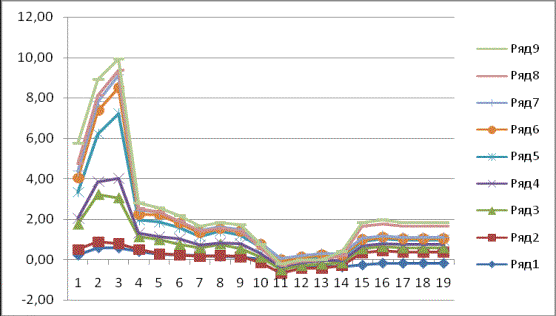
Fig. 1 Dynamics of 9-indicators investigated
enterprise.
The best accuracy
of forecasts has been fixed according to the company "Getateks."
As can be seen from Fig. 1 in the study period (5 years), the company has
experienced different phases of the financial condition, that is, there was an
increase, a fall and was also a steady period. Two indicators were not included
in the chart because their thresholds were not commensurate with the scale
shown in the chart indicators.
Table 1 shows
that over the 5 years was found 11 (line 3 + line 7) reporting periods that
were similar in terms of the dynamics and factors. Of these, only one case (line
7) was not confirmed the prognosis. Thus, the prediction accuracy is about 90%.
Table 1. Results of research on the enterprise
"Gekateks "
|
№ |
Event Name |
Number of
observations |
Note |
|
1 |
All similar periods (All Y) |
51 |
100 % |
|
2 |
Unfulfilled predictions (FY) |
48 |
94,12 % |
|
3 |
Similar indicators, dynamics and forecast (YYY) |
10 |
|
|
4 |
Similar sets of indicators, similar dynamics 7 indicators (YNY7) |
8 |
|
|
5 |
Similar sets of indicators, similar dynamics 6 indicators (YNY6) |
13 |
|
|
6 |
Similar indicators and forecast , but not similar dynamics or similar of
dynamics fewer then 5 indicators
(YNY) 17 |
17 |
|
|
7 |
Similar indicators and similar dynamics but forecast not justified
(YYN) |
1 |
|
|
8 |
Similar indicators are not similar dynamics and forecast (YNN) 2 |
2 |
|
In 8 cases, a
similarity metrics and dynamics only 7-factors (line 4). In 13 cases (line 5) observed
similarity indices at simultaneous of similarity dynamics only of 6 indicators
(6 indicators is more than half of the number of investigated factors). Thus,
of the 48-accurate forecasts (sum of lines 3,4,5,6), in 31 cases (sum of lines
3,4,5) there was similarity indices over 73%, and the dynamics of more than 55%
of the coefficients. It Means, the forecast accuracy when matching indicators and dynamics of
indicators is about 65%. In the remaining 17 cases (line 6) of 48, the forecast was justified only if
observed the similarity of financial performance.
Of the 51
observations (sum of lines 3,4,5,6,7,8)
at similarity, forecasts are not
met in three cases (sum of lines 7, 8).
Conclusions
Research results
suggest that this method of prediction based on the study of sets of values of
financial indicators for reporting periods, shows a high accuracy of the
forecasts. On average, according to the financial statements of three
companies, prediction accuracy was approximately 88%.
Also, it can be
concluded that the prediction accuracy increases when in predicting is comparing not only the data of
financial ratios but data on changes of the dynamics of indicators.
This affords an
opportunity to carry out the
forecast of financial condition
of the company for the next reporting period. Forecast data allow to foresee
the development of the crisis at the plant and in advance to take a number of
anti-crisis measures, in order to avoid the development of a crisis or reduce
the loss of company at the exit from the current situation.
Bibliography
·
Dranko O. I. Forecasting financial condition of
the company on the basis of the financial statements. In the journal «Управленческий
учет». Moscow: Publishing group «Сервис и дело», № 3, 2010;
·
Brealey R., Myers S., Principles of Corporate
Finance: Translated from English. - Moscow: ZAO «Олимп-Бизнес» 2004;
·
Pchelenok N. V. Petrykina MM, «Модель прогнозирования
финансового состояния предприятий агропромышленного комплекса» Magazine «Управленческий учет» № 6, 2006.