Samoylov A., Semenenko N.
Southern Federal
University, Russia
Application of decision support
system based on indistinct logic for choice mobile phones
The market of mobile
devices is actively developing now. Updated mobile phones are increasingly
available. And also advanced companies realize a sharp increase of mobile
device’s functionality. Thus, phone selection is difficult for the average
user, because the phone must meet the basic requirements of user. There is
great number of proposals in the market of mobile phones. This fact makes complexity
of finding a suitable phone. And sometimes the user can not explore all
proposals physically. Because of this, the user must buy a bad mobile phone,
which may not suit to him personally. The problem of development a specialized
information system for choice a mobile phone that meets the requirements of a
particular user is very important. We offer to use the method for decision this
problem. It is based on the decision support system.
There are three
classes of decision support systems. Kind of class depends on the complexity of
the task and the field of application.
The systems of
the first class have the highest functionality. They are designed for use in
the public administration of the highest level (the presidential
administration, ministries) and control department of large companies (board of
directors of a corporation) in the planning of large complex target programs to
explain decisions of inclusion in the various political, social or economic
activities and the distribution of resources between based on an assessment of
their influence on the achievement of the main objectives of the program.
The decision
support systems of the second class are systems for individual use, their database
is formed directly by the user. They are intended for use by government
officials of medium rank, and managers of small and medium-sized firms for
operational management tasks.
The decision
support systems of the third-class are systems for personal use, which are
adapted to the experience of the user. They are designed to address common
application tasks of systems analysis and management (for example, the choice
of the subject of credit, appointment to a post etc.). These systems provide a
solution to the present problem on the basis of the results of the practical
use of solutions of the same problem, taken in the past. In addition, this
class of systems is intended for use in commercial establishments that sell
expensive durable goods. [1].
Analysis of all
existing classes of the decision support systems has shown that the best way for
choice of mobile phone is using decision support system of the third class. It can
provide the best combination of price and quality of decisions. And it will be
a system for individual using for everybody. The introduction of indistinct
logic in the decision support system allows the use of natural language. Based
on the previous experience of studying decision support systems and software,
which realize the possibility of their using, we concluded that it is
appropriate to use a software tool Conclution, which will create an information
system based on indistinct logic to select the desired mobile phone. Let's look
at the process of creating this system. The first step is to determine the name
of linguistic variables and their number, based on the subject field. For our
case of buying a mobile phone such variables can be: price, company, the
manufacturer and availability Wi-Fi.
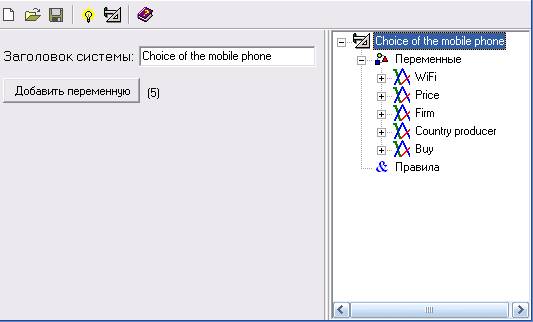
Fig. 1. The introduction
of linguistic variables
Next, you must determine
the terms for every given linguistic variable. It should be noted that the
meanings of
the variables is words of natural language and called terms in the indistinct logic.
Therefore, we can choose the terms for each linguistic variable. There are «low»,
«medium» and «high» in a variable «Price». There are «Nokia», «Samsung» and
«HTC» in the variable «Firm». There are
«Finland», «South Korea», and «Taiwan» in the manufacturer. There are «yes» and
«no» in the availability Wi-Fi. The exact meanings of the input variables
are converted to the meanings of linguistic variables through the application
of certain provisions of the theory of indistinct sets, namely with certain
membership functions. Next, we find the numerical meaning or range of meanings for each term of linguistic
variable. Now it is necessary to consider the indistinct rules that can
describe the control strategy for choice of a mobile phone.
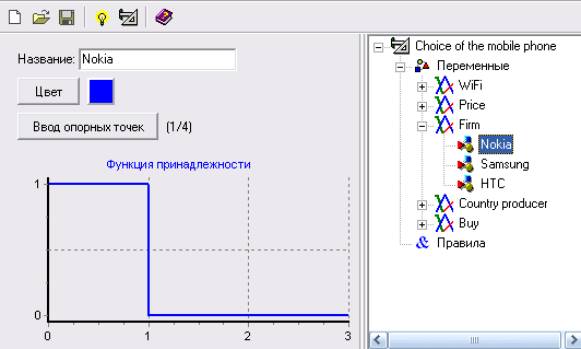
Fig.
2. The construction of the membership function
We need to
determine the grade of belonging of an antecedent of rule in the logical inference.
There are MIN (…) and MAX (…) in the indistinct
logic. The MIN (...) calculates the minimum meaning of
the degree of belonging. And the MAX (…) calculates the maximum meaning of the
degree of belonging. The application of the particular operator depends how the
parcels in the rule are connected. We have to apply the operator MIN (...), if we
use "AND". We have to apply
the operator MAX (...), if we use "OR".
Work out the above procedure for
each rule from the base of indistinct rules:
Пk,r = MIN ЛПi (ЛПi is considered in the rule and ЛПi is Тi,l, where l is 1..mi),
Пk,r is the rule,
k = 1..p, p is number of rules, r is number of solutions, that corresponds to
this rule;
ЛПi is the linguistic
variable, i = 1..n, n is number of the
linguistic variables.
Тi,j – j- term of i - the linguistic variable, j = 1..mi,
mi – number of i - the
linguistic variable.
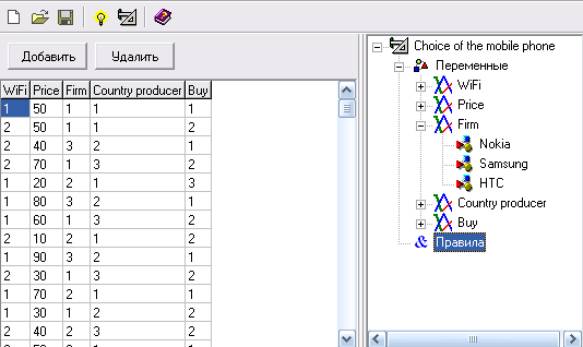
Fig. 3. Creating a
database of indistinct rules
Let’s write the
results in a software environment Conclusion. Thus, we have developed a system
by which the user can enter the data and functionality of the phone. The system
prompts to client to buy the best option.
We tested the
system during the month. We concluded that the system copes with the task of
selecting a mobile phone perfectly thanks to the knowledge of the functional
characteristics of the phone. However, resources are needed for the entry of
all linguistic variables related to mobile phones, their terms and creating a
database of the indistinct rules for decision. Therefore, we decided to upgrade
the system, we used the web – Technology. It will allow users to work with the
Internet. Every internet users will be able to visit the web - site and add the
linguistic variables, their terms and create an indistinct rule specifically
for themselves. It will extend the system and increase the quality of decision.
References:
1. Totsenko B. Decision support systems - your
tool for the right choice - the magazine "Computerra" № 34 dated
September 1, 1998
2. Grinyaev S. Indistinct logic in control
systems - the magazine "Computerra" № 38 dated October 8, 2001
3. Gajzler M., K. Zienkiewicz The use of
indistinct logic to decide in expert systems - Publishing of Poznan University
of Technology: Poznan 2004,
ISSN 1642-9303 No5-2004